
Cassava Flour Particle Size Distribution and Mesh Specification: How Granulometry Affects Your Production Line Performance
For industrial food manufacturers and process engineers, raw material consistency dictates factory floor efficiency. When transitioning to clean-label, gluten-free formulations, R&D and QA teams frequently overlook one of the most critical physical attributes of bulk ingredients: granulometry. Cassava flour particle size distribution standardized through strict mesh specifications—governs everything from pneumatic conveying flowability to dough rheology and finished product mouthfeel. Milled from the whole cassava root (Manihot esculenta), the granulometry of the flour directly impacts how rapidly it absorbs water and how uniformly it disperses within a dry mix. Selecting the correct particle size profile prevents costly production bottlenecks, ensures textural perfection, and secures batch-to-batch repeatability on automated lines.
Direct Answer: Cassava flour particle size distribution, measured via mesh specification, directly controls hydration rates, dough rheology, and dry-blending uniformity. Industrial food manufacturers mandate fine granulometry (typically 99% passing a 100-mesh sieve) to prevent gritty textures, ensure rapid water absorption, and prevent clogging in automated pneumatic conveying systems.
The Physics of Granulometry: Why Mesh Size Matters
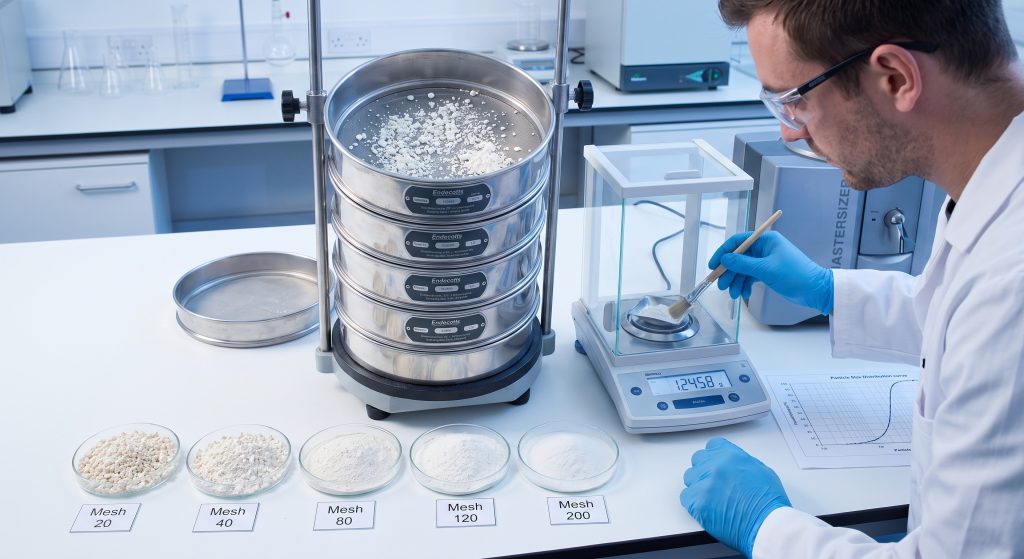
In bulk solids engineering, granulometry refers to the measurement and analysis of particle sizes within a powder. In industrial milling, this is typically quantified using the US Standard Mesh scale, which dictates how many microscopic openings exist per linear inch of a sieve.
Defining Mesh and Micron Equivalents
The higher the mesh number, the finer the particle. For commercial cassava flour, a standard specification is 100-mesh(which equates to particles smaller than 149 microns). If a supplier provides a coarser flour such as a 60-mesh (250 microns) or 80-mesh (177 microns) the physical behavior of the flour changes drastically.
Hydration Kinetics and Dough Formation
Particle size fundamentally alters the available surface area of the flour. Finer particles possess an exponentially larger total surface area per kilogram. When mixed with water in an industrial dough kneader, an ultra-fine 100-mesh cassava flour hydrates almost instantaneously.
If the granulometry is too coarse, the larger particles hydrate slowly and unevenly. The outside of the particle gelatinizes while the inside remains dry, resulting in a gritty mouthfeel and weak structural networks. This uniform, rapid hydration is the exact rheological mechanism required to prevent tearing in high-speed automated sheeting, a principle detailed heavily in our formulation guide for cassava flour in gluten-free tortilla and flatbread manufacturing.
Impact on Automated Production Lines and Dry Blending
Before the flour ever reaches a mixing vat, its physical dimensions dictate how well it moves through your factory. Poorly specified particle size distribution is a leading cause of mechanical downtime in dry processing environments.
Preventing Silo Bridging and Pneumatic Clogging
Cohesive powders with irregular granulometry are prone to “bridging” or “rat-holing” inside bulk storage silos. If a batch contains too many ultra-fine particles (dust) mixed with larger, coarse granules, the flour compacts under its own weight, blocking the discharge hopper.
Conversely, tightly controlled, uniform granulometry ensures a smooth, predictable flow rate through pneumatic conveying systems and rotary valves. Controlling the particle density in tandem with strict ambient humidity protocols is essential, as expanded upon in our warehouse manual for cassava flour shelf life, moisture control, and storage protocols.
Homogeneous Dry Blending
In the production of dry mixes (like pancake mixes, gluten-free baking blends, or spice rubs), the particle size of the cassava flour must closely match the particle size of the other ingredients (such as sugar, salt, and leavening agents). If the cassava flour is significantly finer or coarser than the rest of the blend, segregation occurs during transport. Vibrations from shipping will cause the smaller particles to sift to the bottom of the packaging, destroying the homogeneity of the retail product.
Application-Specific Mesh Requirements
Different manufacturing environments require distinct granulometry profiles. Over-specifying a flour (requesting an ultra-fine powder when not needed) increases procurement costs, while under-specifying leads to product failure.
Engineering the Perfect Grade
Commercial Bakery & Confectionery (100-Mesh to 120-Mesh): Requires ultra-fine granulometry. A smooth, imperceptible texture is mandatory for cakes, cookies, and extruded snacks.
Batter and Coating Systems (80-Mesh to 100-Mesh): Requires rapid hydration to form a continuous film during flash-frying, preventing oil penetration.
Industrial Feed and Pelletizing (60-Mesh to 80-Mesh): For livestock and aquatic feeds, a slightly coarser grind is sufficient. It allows for adequate steam penetration during extrusion without generating excessive dust during mill handling. You can review these extrusion mechanics in our cassava flour aquaculture and animal feed formulation guide.
Quality Assurance (QA) and Procurement Benchmarks
Procurement managers must secure raw materials that behave identically lot after lot. Relying on visual inspections is insufficient; QA teams must validate the physical metrics on the supplier’s documentation.
Validating Certificates of Analysis (COA)
A rigorous COA must state the exact percentage of flour passing through a specified sieve. For high-grade commercial applications, the standard benchmark is $\ge 99.0\%$ passing through a 100-mesh sieve.
QA teams should challenge suppliers on their particle size distribution testing methodologies (such as laser diffraction or mechanical sieve shakers) to ensure accuracy. This level of document verification is just as crucial for bulk flours as it is for soluble ingredients, a process we outline thoroughly in our resistant dextrin COA and solubility procurement guide.
Why Process Engineers Trust Amerta Pacific
Scaling industrial food production requires raw materials engineered with uncompromising physical precision. Amerta Pacific utilizes advanced milling and sorting technology to produce cassava flour that meets the exact rheological and mechanical demands of global manufacturing facilities.
The Amerta Pacific Milling Advantage
Precision Granulometry: Our advanced milling circuits yield an exceptionally uniform particle size distribution, eliminating both oversized grits and excessive airborne dust.
High-Speed Hydration: Engineered to disperse rapidly in both dry and wet blending systems, preventing fisheyes and optimizing dough development times.
Batch-to-Batch Consistency: Every metric ton is verified through strict laboratory sieve analysis, ensuring your factory’s flow rates and hydration settings remain locked in without the need for constant recalibration.
Frequently Asked Questions (FAQ)
Q: What is the difference between cassava flour and tapioca starch regarding particle size? A: Native tapioca starch is a pure extracted carbohydrate and inherently has an extremely fine, almost microscopic particle size (often under 20 microns). Cassava flour contains the whole root (including fiber) and must be mechanically milled to a specific mesh size, typically 80 to 100 mesh.
Q: How does a finer mesh size affect the water absorption capacity of cassava flour? A: A finer mesh size significantly increases the total surface area of the powder. This leads to faster water absorption (shorter hydration times) and often a slightly higher total water holding capacity compared to a coarser grind of the same flour.
Q: Will a 100-mesh cassava flour cause dusting issues in my factory? A: While 100-mesh is fine, it is not considered ultra-fine dust (like powder below 400-mesh). However, standard dust-collection protocols and enclosed pneumatic conveying systems should always be utilized to maintain a clean and safe operating environment.
Q: Can I request a custom mesh size for my specific extrusion application? A: Yes. Advanced B2B suppliers like Amerta Pacific can adjust milling parameters to produce specific granulometry profiles tailored to the precise shear and moisture tolerances of your extrusion equipment.
Optimize Your Production Line with Amerta Pacific
Do not let inconsistent particle sizes disrupt your automated lines or compromise your product’s texture. Amerta Pacificdelivers the precision-milled, high-purity cassava flour you need to ensure flawless manufacturing and premium consumer experiences.
Ready to evaluate our granulometry specifications for your factory? Contact the Amerta Pacific Engineering and Sales Team today to request a comprehensive Technical Data Sheet (TDS), review sieve analysis reports, or secure pilot-scale samples for your production trials.