
Cassava Flour Shelf Life, Moisture Control, and Storage Protocol: A Warehouse Guide for Importers and Distributors
For bulk importers, ingredient distributors, and warehouse managers handling high volumes of clean-label ingredients, preserving raw material quality between port discharge and final delivery is critical to protecting operational margins. Cassava flour is a highly versatile, clean-label staple in gluten-free food manufacturing. However, because it is a natural, unrefined agricultural product, its long-term stability depends heavily on environmental conditions during transit and storage. Implementing rigorous moisture management and storage protocols is essential to prevent caking, clumping, enzymatic degradation, and mold growth, ensuring every bag delivered to your industrial clients meets factory-grade standards.
Direct Answer: Under optimal warehouse conditions—relative humidity below 65% and ambient temperatures between 15°C and 25°C—premium cassava flour maintains a stable shelf life of 24 months. Maintaining raw moisture levels at or below 12.0% and enforcing strict pallet elevation protocols are critical to preventing moisture absorption and microbial growth.
The Science of Moisture: Equilibrium Moisture Content (EMC) in Starch
Cassava flour is naturally hygroscopic, meaning its porous starch granules actively absorb and release atmospheric moisture to reach Equilibrium Moisture Content (EMC) with the surrounding air. When warehouse humidity spikes, the flour absorbs water vapor, triggering quality issues long before physical spoilage appears.
       [High Ambient Humidity (>70% RH)]
                      │
                      ▼
       [Flour Absorbs Atmospheric Water]
                      │
                      ▼
     [Free Water Level (Aw) Increases > 0.65]
                      │
       ┌──────────────┴──────────────┐
       ▼                             ▼
[Microbial Activity]        [Starch Agglomeration]
(Mold / Yeast Growth)         (Caking & Clumping)
Humidity Thresholds and Physical Degradation
Aw Threshold (Water Activity): To prevent mold and bacterial growth, the internal water activity ($A_w$) of cassava flour must remain below 0.60 to 0.65.
Moisture Migration: Temperature fluctuations inside a warehouse cause moisture to evaporate from warmer bags and condense on cooler ones, creating localized “hot spots” where mold spores can germinate.
Caking & Flowability: As flour moisture rises above 13.5%, starch granules expand and bind together, causing bridging in industrial discharge hoppers and clogging automated dosing lines.
Maintaining strict quality specifications at the sourcing stage is your first line of defense. Learn more about setting these baseline parameters in our cassava flour supplier B2B sourcing guide.
Industrial Storage Protocols: Best Practices for B2B Warehouses
To preserve the functionality of bulk cassava flour across its 24-month shelf life, importers and warehouse operators must adhere to strict environmental and structural storage guidelines.
Standard Operating Procedure (SOP) Checklist
| Control Parameter | Target Standard | Operational Action |
| Ambient Temperature | 15°C – 25°C (59°F – 77°F) | Avoid uninsulated metal warehouses exposed to direct sunlight. |
| Relative Humidity (RH) | ≤ 60% – 65% | Install industrial dehumidifiers and automated RH dataloggers. |
| Pallet Clearance | Min. 10 cm off floor / 50 cm off walls | Never stack directly on concrete floors; use clean plastic or heat-treated wooden pallets. |
| Inventory Rotation | First In, First Out (FIFO) | Tag incoming container lots with clear lot numbers and expiration dates. |
| Stacking Height | Max. 2 pallets high (or 10–12 bags) | Over-stacking causes compaction at the base, leading to dense, hardened blocks. |
Packaging Solutions: Multi-Wall Kraft vs. FIBC Super Sacks
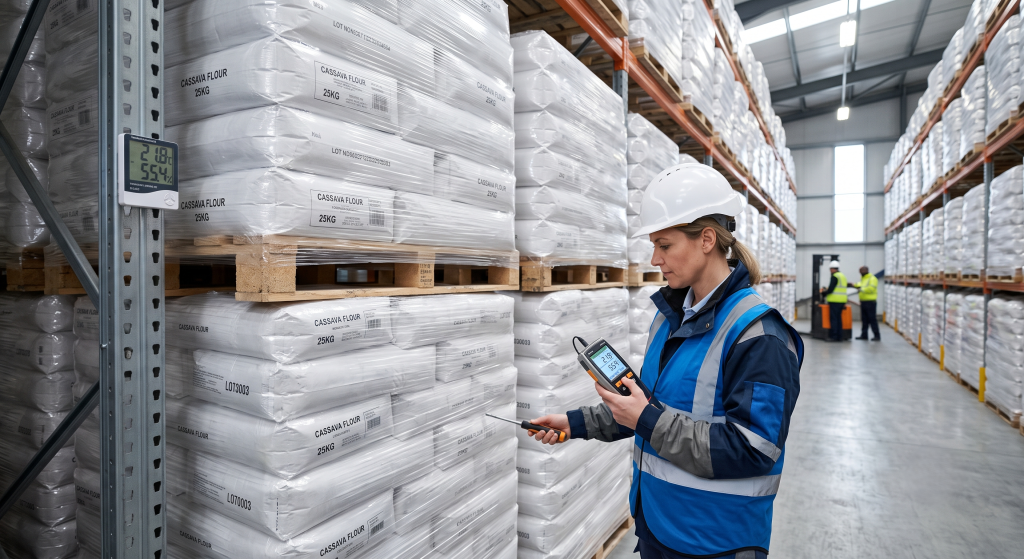
The choice of packaging plays a direct role in how well cassava flour withstands ocean freight and extended storage.
Evaluating Packaging Formats
25 kg Multi-Wall Kraft Paper Bags: Feature a micro-perforated High-Density Polyethylene (HDPE) inner liner. The liner blocks liquid water and humidity while allowing internal gases to escape without bursting the bag during palletization.
1 Metric Ton FIBC Super Sacks: Ideal for high-volume commercial bakeries. Super sacks must include a heavy-duty food-grade polyethylene liner sealed at both the top spout and bottom discharge to prevent ambient air intrusion during long-term storage.
Selecting the right packaging preserves functional traits like particle size and gelatinization temperature, which are critical for bakery performance as detailed in our premium cassava flour B2B functional guide. Furthermore, sustainable, durable packaging reduces material loss, reinforcing the broader cassava ESG and sustainability advantage.
Why Importers and Distributors Trust Amerta Pacific
Protecting ingredient quality requires more than proper warehousing—it starts with strict moisture control during processing and export loading. Amerta Pacific implements rigorous post-harvest drying and moisture testing protocols to ensure every shipment arrives at destination ports in prime condition.
The Amerta Pacific Quality Advantage
Guaranteed Export Moisture: We dry our premium cassava flour down to ≤ 12.0% moisture, providing an extra safety margin against humidity spikes during sea transit.
Desiccant Protection: All export containers are equipped with high-capacity container desiccants and moisture barrier linings to prevent container rain during transoceanic voyages.
Full Batch Traceability: Every pallet is tagged with a Certificate of Analysis (COA) verifying moisture content, mesh size, microbiological purity, and processing dates.
Frequently Asked Questions (FAQ)
Q: What is the official shelf life of cassava flour under standard storage conditions? A: When stored in unopened, lined packaging at temperatures between 15°C–25°C and relative humidity below 65%, premium cassava flour retains its full functional performance for up to 24 months from the date of manufacture.
Q: Can cassava flour be stored in cold storage or freezer facilities? A: Yes, cold storage extends shelf life by suppressing microbial growth. However, when moving bags from cold storage back to ambient warehouse temperatures, allow them to acclimate gradually in a low-humidity zone to prevent surface condensation on the flour.
Q: How can warehouse operators identify moisture damage before opening the bags? A: Inspect pallets for sagging packaging, hardened or compacted bags at the base, or damp paper outer layers. Utilizing infrared moisture meters allows quality control teams to test flour moisture through bag walls without breaking seals.
Q: What should I do if a shipment arrives with elevated moisture levels (above 13%)? A: Isolate the affected lot immediately in a climate-controlled zone with active dehumidification. Prioritize these bags for immediate distribution to high-turnover accounts to prevent long-term storage degradation or mold development.
Secure Your Cassava Flour Supply Chain with Amerta Pacific
Protect your ingredient inventory, prevent warehouse losses, and deliver consistent quality to your commercial clients. Amerta Pacific supplies high-purity cassava flour packaged and engineered to withstand the rigors of global transit and long-term storage.
Ready to secure high-grade cassava flour for your distribution network? Contact the Amerta Pacific Logistics & Supply Team today to request a Technical Data Sheet (TDS), review container loading options, or request sample shipments.