
Tropical Roots: The ESG Advantage of Sourcing Cassava from Indonesia
The Quick Answer: In 2026, a food brand’s value is no longer measured solely by profit, but by its Scope 3 emission reductions. As global grain yields (wheat and corn) become increasingly volatile due to climate-induced water scarcity, Cassava has emerged as the ultimate climate-resilient crop. Sourcing Cassava from Indonesia provides a dual ESG advantage: it offers a significantly lower carbon and water footprint compared to traditional grains, while supporting smallholder farmer ecosystems. For global procurement teams, transitioning to cassava-based ingredients is a high-impact strategy to future-proof supply chains and meet 2030 Net-Zero targets.
The Climate Resilience of the "Rambo" Crop
Agricultural experts often refer to cassava as the “Rambo” of crops because of its sheer toughness. As global temperatures rise, traditional staples are failing, but cassava thrives.
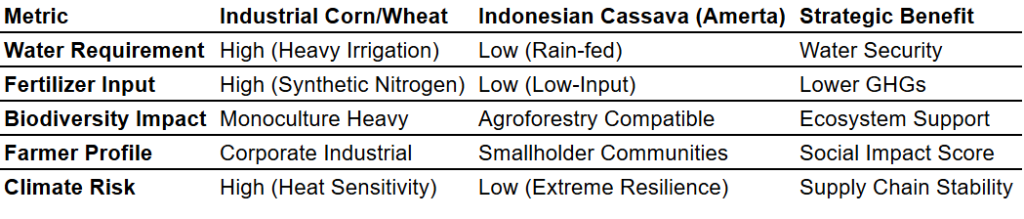
- Drought Tolerance: Cassava can survive months without rain by shedding its leaves to conserve moisture—a trait wheat and corn do not possess.
- Soil Efficiency: It requires significantly fewer nitrogen-based fertilizers than industrial corn, which is a major source of nitrous oxide (a greenhouse gas 300x more potent than CO2).
- Water Footprint: Cassava production utilizes primarily rainwater in Indonesia’s volcanic soil regions, reducing the “blue water” footprint that plagues irrigation-heavy crops in North America and Europe.
Decarbonizing the Supply Chain (Scope 3)
For a global food manufacturer, roughly 70–90% of their total emissions come from their supply chain (Scope 3). Switching to Indonesian cassava ingredients offers an immediate reduction in this category.
The Carbon Math of 2026: Data from Amerta Pacific’s 2026 sustainability audits show that our Premium Cassava Flour produces up to 40% less CO2 equivalent per kilogram than imported wheat flour when considering the full lifecycle. By shortening the supply chain for Asian markets and utilizing solar-mechanical drying processes, we minimize the energy intensity of the final ingredient.
Read also our other article about The Sustainability ROI: Reducing Your Carbon Footprint with Pea Protein
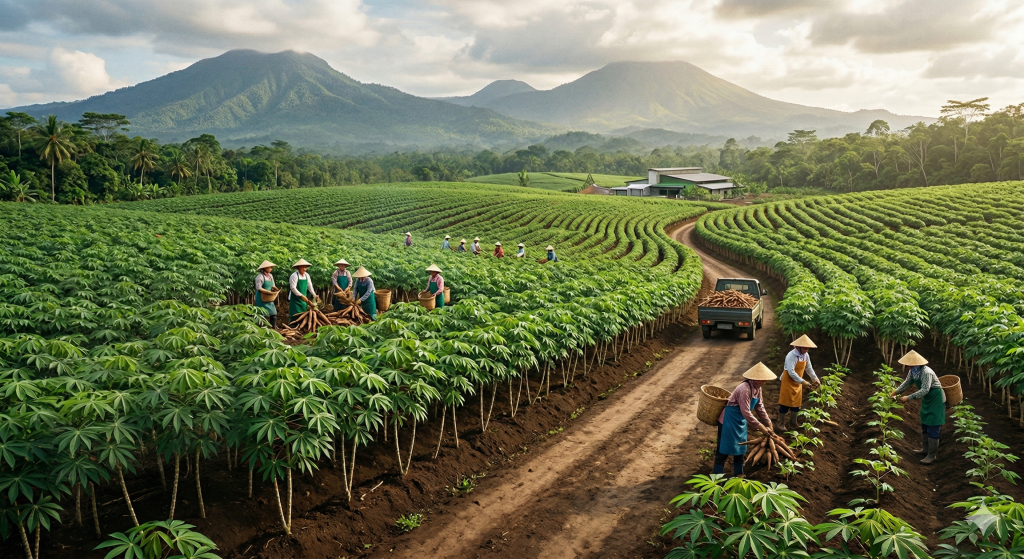
ESG isn’t just “Environmental”; the “Social” pillar is equally critical for 2026 brand reputation.
Unlike industrial grain farming, which is often dominated by massive, faceless corporations, Indonesian cassava is primarily a smallholder crop.
- Economic Empowerment: Sourcing from Amerta Pacific directly supports rural farming communities in Indonesia, providing stable floor prices that protect farmers from global commodity volatility.
- Traceability: In 2026, transparency is non-negotiable. Our “Farm-to-Folder” digital tracking allows B2B partners to trace their ingredients back to specific regional clusters, providing the “Social Impact” data needed for annual sustainability reports.
ESG Performance: Cassava vs. Industrial Grains
Conclusion: Sourcing as a Sustainability Statement
The procurement decisions of 2026 are being made in the boardroom, not just the kitchen. Choosing cassava-based ingredients from Indonesia is a powerful signal that your brand is serious about climate resilience and social equity. At Amerta Pacific, we don’t just provide ingredients; we provide the data and the ethics that power the world’s most sustainable brands.
Is your supply chain climate-ready? [Download our 2026 ESG Impact Report on Indonesian Cassava] and learn how to reduce your carbon footprint today.