
Cassava Flour in Aquaculture and Animal Feed Formulation: Binding Performance and Cost Efficiency for Feed Manufacturers
In commercial aquaculture and livestock feed production, manufacturing high-purity, durable feed pellets that resist breakdown before consumption is a primary operational objective. Feed manufacturers face mounting pressure to balance pellet stability, digestive energy, and raw material costs. When feeds disintegrate prematurely in aquatic environments, nutrient leaching occurs, water quality deteriorates, and Feed Conversion Ratios (FCR) worsen. For procurement managers, feed formulators, and animal nutritionists, cassava flour (Manihot esculenta) provides a high-performance, natural starch binder. Its exceptional gelatinization properties, high carbohydrate energy, and cost advantages over synthetic binders and wheat gluten make it an essential ingredient for modern commercial feed mills.
Direct Answer: Cassava flour serves as a natural hydrocolloid binder and energy source in aquafeed and animal feed manufacturing. Its high amylopectin content and low gelatinization temperature enhance pellet durability (PDI > 95%) and water stability, reducing nutrient leaching and lowering overall feed formulation costs compared to synthetic binding agents.
Processing Mechanics: Gelatinization and Water Stability in Aquafeed
In high-pressure conditioning, extrusion, and pelleting systems, the functional value of cassava flour stems from its rapid starch gelatinization. Unlike cereal grains, cassava starch granules swell and cook at lower thermal thresholds (62°C to 72°C).
During steam conditioning and conditioning extrusion, heat and moisture disrupt the cassava starch granules, causing them to solubilize and form a viscous gel matrix. As the feed mixture is forced through the die plate, this cooked starch acts as a natural glue, encapsulating protein meals and lipid fractions. Upon cooling and drying, the starch retrogrades into a solid, water-resistant network that binds the pellet together.
Key Functional Benefits for Feed Mills
Elevated Pellet Durability Index (PDI): Incorporating cassava flour at inclusion rates of 5% to 15% consistently yields a PDI exceeding 95%, minimizing fines and dust during bulk pneumatic transit and bag handling.
Extended Water Stability: In shrimp and carnivorous fish feeds, cassava-bound pellets resist disintegration for hours under water, ensuring bottom-feeding species digest the complete nutrient profile without nutrient leaching.
Enhanced Digestibility: The fully gelatinized starch provides readily available non-structural carbohydrates, serving as an efficient digestible energy source that spares valuable dietary protein for muscle growth.
This functional gelatinization capability mirrors the structural binding performance observed in human food systems, as outlined in our premium cassava flour B2B functional guide.
Cost Optimization: Replacing Synthetic Binders and Cereal Starches
Rising prices for imported wheat flour and synthetic chemical binders (such as urea-formaldehyde or lignosulfonates) have squeezed feed mill margins worldwide. Cassava flour offers a dual-purpose replacement that functions as both a binder and an energy source.
Comparative Formulation Performance
| Feed Binder Matrix | Binding Mechanism | Pellet Water Stability | Nutritional Energy Value | Relative Formulation Cost |
| Cassava Flour | Natural Starch Gelatinization | High (> 4 hours) | High (~3,400 kcal/kg ME) | Cost-Optimized |
| Wheat Flour (Feed Grade) | Gluten Network + Starch | Moderate (1 – 2 hours) | Moderate to High | High / Volatile Market |
| Lignosulfonates / Gums | Chemical Cross-Linking | Variable | Zero (Non-nutritive filler) | High per active unit |
Replacing non-nutritive synthetic binders with cassava flour allows nutritionists to remove “dead weight” from the feed matrix, allocating full formulation mass toward digestible nutrients.
Quality Benchmarks for Animal Feed Procurement
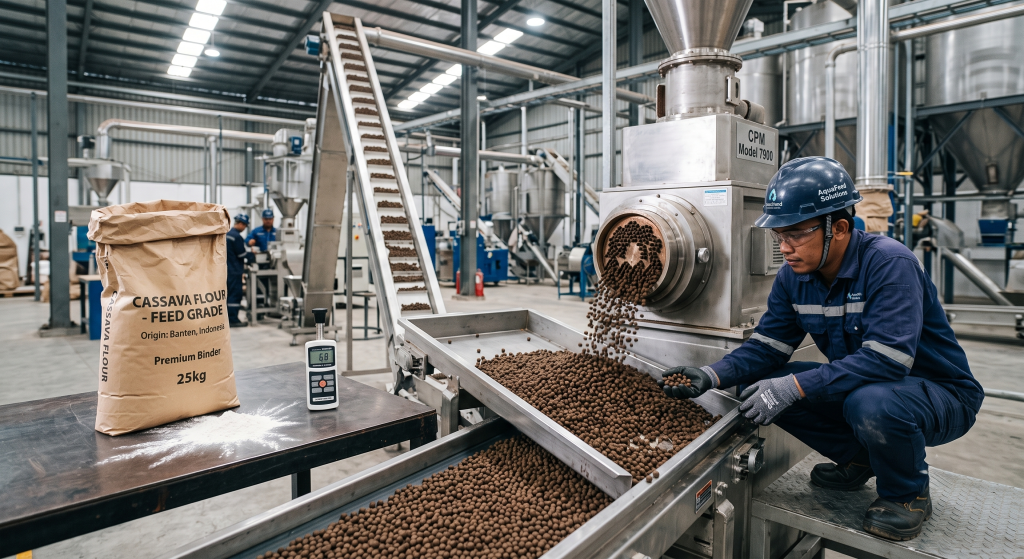
Procurement directors sourcing cassava flour for commercial feed mills must establish precise quality parameters to ensure smooth processing in automated conditioning and extrusion lines.
Essential Quality Control Checklist
Starch Content: ≥ 80.0%. Higher starch content ensures maximum binding capacity per metric ton.
Moisture Content: ≤ 12.0%. Low moisture prevents mold growth (aflatoxin risks) during bulk silo storage.
Sand / Silica Residue: ≤ 1.5%. Minimizing abrasive ash protects high-speed die plates and extruder screws from excessive wear.
Particle Size: 98% passing through a 60 to 80 mesh sieve. Uniform particle size ensures rapid steam penetration during conditioning.
To establish reliable supply channels and evaluate factory-grade specifications, review our comprehensive cassava flour supplier B2B sourcing guide. Sourcing cassava-based ingredients also supports sustainable agricultural practices, reinforcing the broader cassava ESG and sustainability advantage.
Why Global Feed Manufacturers Partner with Amerta Pacific
Securing raw materials for industrial feed mills requires consistent quality, competitive pricing, and multi-container shipping capabilities. Amerta Pacific supplies feed-grade cassava flour processed to meet the demanding requirements of global aquaculture and livestock feed producers.
The Amerta Pacific Supply Advantage
High Gelatinization Yield: Processed from carefully selected cassava roots to maximize starch purity and binding efficiency.
Scalable Bulk Logistics: Available in 25 kg multi-wall bags, 850 kg, and 1,000 kg FIBC super sacks for automated unloading systems.
Batch Traceability: Every shipment is accompanied by a complete Certificate of Analysis (COA) confirming starch purity, moisture, and sand/silica limits.
Frequently Asked Questions (FAQ)
Q: What is the optimal inclusion rate of cassava flour in shrimp feed?
A: Standard inclusion rates for penaeid shrimp feeds range between 8% and 15%, depending on the target water stability duration and die compression ratio of the pellet mill.
Q: Does cassava flour require extra cooking time in steam conditioners?
A: No. Because cassava starch has a lower gelatinization temperature than corn or wheat starches, it cooks rapidly in standard steam conditioners operating at 80°C to 90°C.
Q: Can cassava flour replace synthetic chemical binders entirely?
A: In most sinking aquafeed and livestock pellet formulations, yes. The natural gelatinization of cassava flour provides sufficient binding strength to eliminate synthetic chemical binders completely.
Q: How does cassava flour affect extruder wear compared to native grain meals?
A: Properly processed cassava flour with low sand/silica residue ($\le 1.5\%$) is significantly less abrasive than unrefined grain meals, helping extend the operational lifespan of extruder barrels and die plates.
Upgrade Your Feed Formulations with Amerta Pacific
Improve pellet durability, enhance water stability, and optimize your feed mill’s operational costs. Amerta Pacific delivers high-purity cassava flour engineered to meet the strict production standards of modern aquaculture and animal feed manufacturing.
Ready to enhance your pellet quality and request bulk pricing? Contact the Amerta Pacific Animal Nutrition Team today to request technical data sheets (TDS), analyze cost-saving models, or order samples for pilot mill trials.