
Resistant Dextrin Solubility and Fiber Content: CoA Explained for Procurement Teams
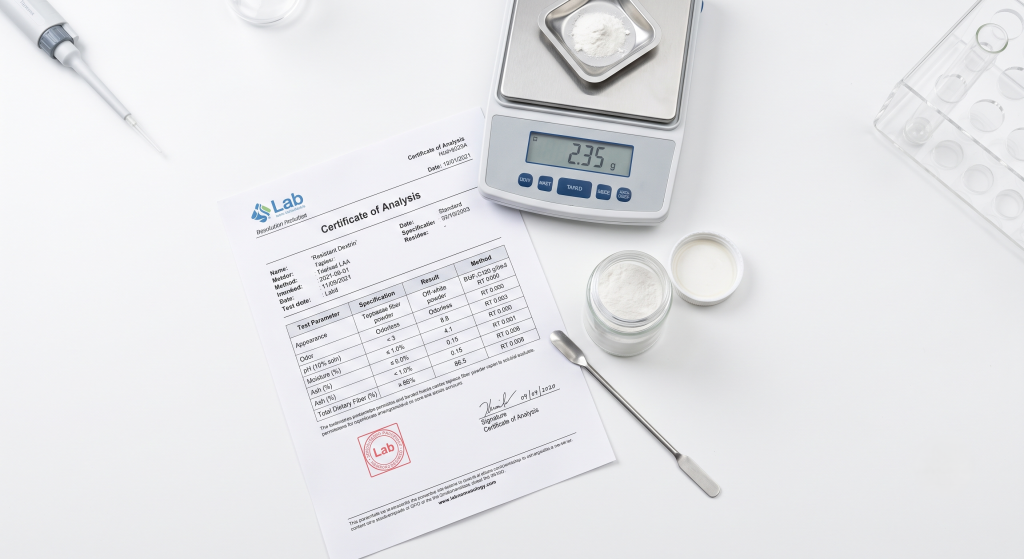
For procurement managers and Quality Assurance (QA) teams in the functional food and beverage sector, the Certificate of Analysis (CoA) is the ultimate line of defense. When sourcing premium soluble tapioca fiber—commercially classified as a digestion-resistant dextrin—accepting a batch based on price alone is a severe operational risk. Substandard batches with fluctuating molecular weights can stall automated production lines, clog liquid injection valves, or fail to meet legal fiber claims on your nutrition panel.
Every international shipment must be validated against precise chemical and physical parameters before it is cleared for warehouse storage. This technical guide breaks down exactly how to audit the resistant dextrin solubility and fiber content sections of an incoming CoA to protect your factory uptime, ensure regulatory compliance, and control formulation costs.
The Direct Answer: The Critical CoA Benchmarks
An authentic, food-grade resistant dextrin CoA for soluble tapioca fiber must verify a dietary fiber content of greater than or equal to 90% on a dry basis when analyzed via the AOAC 2009.01 or 2011.25 testing methods. Additionally, it must guarantee 100% solubility in cold water with a maximum moisture limit of 5% for powders or a dry matter content of 70-75% for syrups.
Section 1: Auditing the Fiber Content Parameter
The most critical figure on your CoA is the total dietary fiber percentage. This metric dictates your front-of-pack labeling legality and prevents expensive regulatory compliance audits.
Dry Basis vs. As-Is Calculations
When reviewing the assay, your QA team must distinguish between “Dry Basis” and “As-Is” fiber content. Suppliers often display the dry basis percentage because it filters out residual moisture, yielding a higher number. However, your formulation team calculates inclusions based on the material’s actual weight. Always ensure the dry basis fiber content meets a minimum threshold of 90%, which typically translates to an as-is fiber content of 85-86% after accounting for natural moisture fractions.
Verifying the Correct AOAC Testing Methods
Standard carbohydrate tests (like the legacy AOAC 985.29) fail to detect resistant dextrins because they measure high-molecular-weight insoluble fibers. To ensure your soluble tapioca fiber is genuinely digestion-resistant, the CoA must explicitly state one of two modern analytical methods:
AOAC 2009.01: The gold standard for measuring total dietary fiber, covering both low and high molecular weight fractions.
AOAC 2011.25: A highly refined multi-enzyme liquid chromatography test that accurately separates and quantifies resistant maltodextrins.
Section 2: Solubility and Rheological Benchmarks
Physical solubility determines how efficiently the raw material behaves inside your automated mixing tanks and blending machinery.
          [Resistant Dextrin Technical Audit Checklist]
                               │
     ┌─────────────────────────┼─────────────────────────┐
     ▼                         ▼                         ▼
[Assay & Purity]        [Physical Properties]     [Contaminant Control]
 ├── AOAC 2009.01 /      ├── 100% Cold Water      ├── Heavy Metals
 │   2011.25 method      │   Solubility           │   (Pb, As < 0.5ppm)
 └── Fiber content       └── Moisture ≤ 5%        └── Microbial Screen
     (≥ 90% Dry Basis)       (Powder Formats)         (Negative E. coli)
Cold Water Dissolution Index
Premium soluble tapioca fiber must exhibit complete solubility in room-temperature water (20-25 celcius), yielding a completely translucent, sediment-free solution. If the CoA indicates any residual opacity or insoluble suspended solids, the material contains unrefined native starches. In liquid RTD beverage lines, unrefined starch fractions will trigger phase separation, sediment drop-out, and shortened product shelf life.
Moisture and Dry Matter Limits
For Fiber Powders: The maximum moisture content must be strictly locked under 5.0%. Excessive moisture causes the hygroscopic powder to cake and clump inside storage silos, creating severe blockages in pneumatic feeding systems.
For Fiber Syrups: The CoA must specify a total Dry Matter (Brix) level of 70% to 75% and a stable viscosity profile. Deviations here will directly alter your dough binding mechanics on high-speed protein bar extrusion lines.
Critical CoA Technical Specification Thresholds
| CoA Parameter | Industrial Target Specification | Approved Testing Method | Direct Manufacturing Impact |
| Dietary Fiber Assay | $\ge$ 90.0% (Dry Basis) | AOAC 2009.01 / 2011.25 | Secures legal “High Fiber” label claims |
| Solubility Index | 100% Completely Soluble | Visual / Gravimetric | Prevents line sedimentation and valve clogging |
| Moisture Content | $\le$ 5.0% (Powders) | Vacuum Oven Drying | Eliminates powder caking in automated silos |
| pH Value (10% Sol.) | 4.0 – 6.0 | Potentiometric | Ensures compatibility with acidic & neutral products |
| Heavy Metals (Pb/As) | $\le$ 0.5 ppm | ICP-MS | Guarantees compliance with strict FDA/EU safety limits |
Section 3: Contaminant and Microbial Verification
Beyond functionality, your QA team must review food safety markers to prevent border rejections or catastrophic product recalls.
Heavy Metal Tracking: The CoA must detail parts-per-million (ppm) levels for lead (Pb), arsenic (As), cadmium (Cd), and mercury (Hg) via Inductively Coupled Plasma Mass Spectrometry (ICP-MS). Premium batches must maintain total heavy metals well under a strict 0.5 ppm threshold.
Microbial Screening: Ensure the batch displays clear negative results for pathogenic organisms, specifically Escherichia coli, Salmonella, and Staphylococcus aureus, alongside a Total Plate Count (TPC) under 1,000 CFU/g.
Secure Uncompromised QA Standards with Amerta Pacific
At Amerta Pacific, we understand that a CoA is not just a piece of paper; it is a legally binding guarantee of your factory’s production safety and yield efficiency. We eliminate sourcing variance by supplying premium, industrial-grade Soluble Tapioca Fiber backed by transparent, ironclad laboratory validation.
Our global wholesale distribution network ensures:
Absolute Batch Integrity: Every container delivery arrives with a lot-specific, fully transparent CoA mapped precisely to verified AOAC testing standards.
Flawless Clean-Label Compliance: Naturally non-GMO, gluten-free, and corn-free, allowing your brand to easily fulfill strict cross-border import regulations.
Direct Technical Alignment: We facilitate direct communication between our manufacturing lab engineers and your internal QA department to guarantee product performance prior to shipping.
Frequently Asked Questions (FAQ)
Q: Why does some soluble tapioca fiber show a higher sugar content on the CoA? A: During the enzymatic hydrolysis process, minor fractions of mono- and disaccharides (glucose and maltose) are naturally generated. Amerta Pacific utilizes advanced chromatographic separation to minimize these free sugars, keeping the carbohydrate profile fully compliant with low-glycemic and keto-friendly formulations.
Q: Can we rely on an annual audit certificate instead of batch-level CoAs? A: Absolutely not. In industrial food manufacturing, every discrete production run or container lot must be accompanied by its own specific CoA. This ensures absolute traceability and protects your plant against batch-to-batch agricultural variations.
Q: What is the standard shelf-life verification required on a fiber CoA? A: A compliant CoA must list both the exact manufacturing date and the expiration date. Stored correctly in its original unopened packaging in a cool, dry warehouse, premium soluble tapioca fiber maintains full physical and chemical stability for up to 24 months.
Protect Your Factory Margins and Product Quality
Do not let sub-standard ingredient documentation expose your production lines to downtime or regulatory failure. Equipping your procurement and QA divisions with a rigorous framework to audit resistant dextrin solubility and fiber content parameters ensures your factory receives highly uniform raw materials that protect both your manufacturing margins and consumer trust.
Ready to upgrade your raw material quality standards? Contact Amerta Pacific today to submit your technical data sheets, request validation samples for immediate laboratory bench-testing, and lock in secure bulk contract rates for the upcoming fiscal quarters.