
Cassava Flour in Gluten-Free Tortilla and Flatbread Manufacturing: Technical Spec and Supplier Guide
In the commercial baking sector, replicating the unique elasticity, flexibility, and tear resistance of standard wheat-based tortillas in a gluten-free format has long been a challenge for product developers. Traditional gluten-free starches often yield flatbreads that are either brittle, dry, or excessively gummy. However, premium cassava flour has fundamentally shifted the formulation landscape. Made from the whole root of the cassava plant (Manihot esculenta), this high-functioning ingredient delivers the exact physical traits required for high-speed automated sheeting and pressing lines, making it an indispensable asset for clean-label bakery brands.
Direct Answer: Premium cassava flour serves as a direct, single-ingredient wheat substitute in gluten-free tortilla and flatbread manufacturing. Its unique amylose-to-amylopectin ratio offers exceptional water-binding capacity, creating a cohesive dough matrix that ensures excellent rollability, flexibility, and resistance to cracking during commercial packaging and shelf life.
The Rheological Advantage of Cassava Flour in Bakery Lines
Unlike isolated starches, premium cassava flour contains the natural fiber and complex carbohydrate structure of the native root. For an R&D team, this complete composition provides unique dough handling characteristics that mimic gluten’s stretchability.
Achieving Rollability and Preventing the “Cracking” Failure
The primary failure point in industrial gluten-free tortilla production is cracking upon folding. Cassava flour addresses this by optimizing water absorption:
High Gelatinization Swelling: Cassava flour absorbs a significant volume of water during mixing, building a hydrated, pliable dough that easily passes through industrial rollers.
Soft Gel Structure: The high amylopectin content yields a flexible, extensible crumb structure that can be rolled, folded, and filled without splitting.
Uniform Sheeting: The physical composition prevents dough stickiness, allowing for clean releases from cutting dies and hot presses on automated baking lines.
To deeply understand how these physical properties interface with broader bakery applications, consult our premium cassava flour B2B functional guide.
Critical Technical Specifications for Commercial Bakery Sourcing
For procurement managers and quality assurance teams, sourcing cassava flour for automated baking lines requires strict technical consistency. Variations in particle size or moisture can easily disrupt automated dosing and hydration settings.
Standard Industrial Specification Blueprint
When evaluating prospective supply channels, your QA laboratory should cross-reference incoming lots against these industrial standards:
| Technical Parameter | Industrial Specification Limit | Manufacturing Significance |
| Moisture Content | ≤ 12.0% | Controls shelf life and prevents microbial clumping in silos. |
| Particle Size (Mesh) | ≥ 99.5% passing 100-mesh | Eliminates grittiness; ensures smooth, flexible sheets. |
| Starch Content | ≥ 80% | Dictates structural binding and viscosity during baking. |
| Crude Fiber | ≤ 2.0% | Balances water absorption without adding dense weight. |
| Total Ash | ≤ 1.5% | Reflects rigorous washing and peel removal processing. |
| SO2 / Sulfites | Free / Non-detectable | Crucial for clean-label, chemical-free positioning. |
Maintaining these strict parameters is essential when replacing chemical modifiers, an approach discussed in our analysis of clean-label thickeners for gluten-free baking.
Managing the Commercial Baking Line: Temperature and Hydration
Integrating cassava flour into a commercial flatbread line requires minor adjustments to traditional wheat processing temperatures.
Processing Parameters for Commercial Production
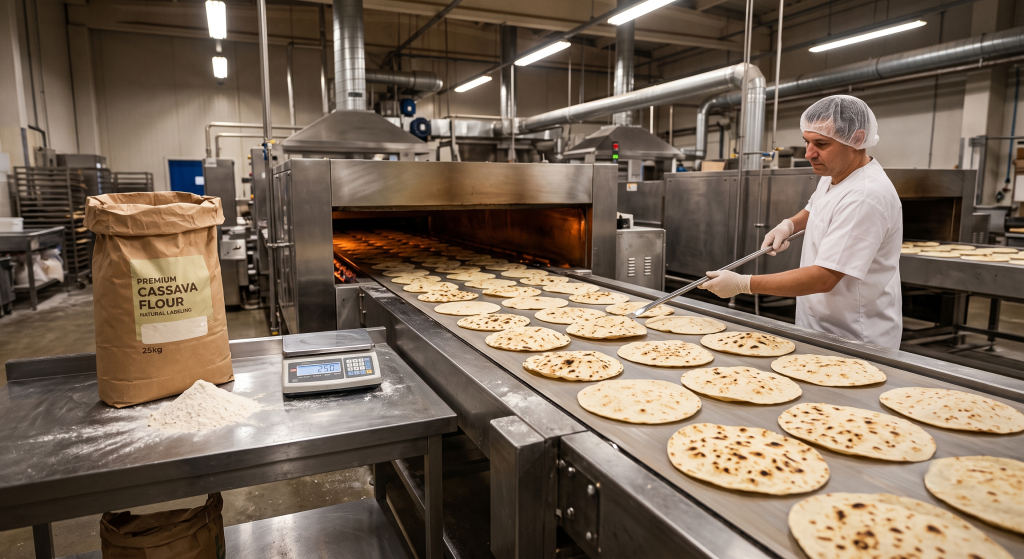
Because cassava flour reaches peak viscosity at a lower temperature than wheat starch, baking lines should be calibrated carefully. Mixing water should be kept at ambient or slightly warm temperatures (30°C–35°C) to fully hydrate the flour particles without triggering premature gelatinization.
During the pressing or sheeting phase, hot-press platens operating between 180°C and 210°C will quickly set the outer starch matrix, sealing in moisture and creating the necessary steam pockets that make the flatbread puff. This rapid gelatinization creates a natural barrier that preserves internal softness, expanding options for the future of clean label cassava as a hero ingredient.
Why Industrial Bakeries Partner with Amerta Pacific
Securing a robust B2B ingredient supply chain requires a partner who can guarantee volume scalability, quality compliance, and reliable logistics. Amerta Pacific supplies high-grade native cassava flour specifically milled for commercial baking.
The Amerta Pacific B2B Edge
Advanced Extra-Fine Milling: Our specialized processing lines produce an ultra-fine mesh flour that hydrates uniformly, preventing processing downtime.
Strict Quality Assurance: Every batch is delivered with a comprehensive Certificate of Analysis (COA) detailing starch yield, viscosity curves, and particle size distribution.
Direct Indonesian Sourcing: We operate sustainable, traceable supply networks directly from primary growing regions, ensuring stable pricing and reliable year-round availability.
For comprehensive procurement guidelines on establishing secure raw material streams, view our cassava flour supplier B2B sourcing guide.
Frequently Asked Questions (FAQ)
Q: Can cassava flour replace wheat flour 1:1 in tortilla recipes? A: In many gluten-free formulations, yes. Because cassava flour mimics the weight, absorption, and texture of wheat flour remarkably well, it can serve as a primary base. However, R&D teams should adjust hydration levels up by 5% to 10% compared to standard wheat recipes.
Q: Does cassava flour require xanthan gum or extra binders to prevent tearing? A: For standard flatbreads and street-taco style tortillas, cassava’s natural starch profile provides sufficient binding power. For large, ultra-thin burrito wraps, a minimal inclusion of a clean-label hydrocolloid can help maximize structural elasticity.
Q: How does the shelf-life stability of cassava tortillas compare to corn tortillas? A: Cassava-based tortillas exhibit superior retrogradation resistance compared to corn. They remain soft and flexible at room temperature for longer periods, reducing the need for chemical anti-staling additives.
Q: Is your cassava flour allergen-free and non-GMO? A: Yes. Amerta Pacific cassava flour is naturally free from gluten, soy, nuts, and grain allergens. It is processed in dedicated facilities to eliminate risk of cross-contamination.
Optimize Your Gluten-Free Production with Amerta Pacific
Don’t let brittle texture or unpredictable raw materials limit your product’s potential in the market. Amerta Pacific delivers high-purity, premium cassava flour engineered specifically to meet the rigorous demands of automated industrial baking.
Ready to enhance rollability and streamline your ingredient sourcing? Contact the Amerta Pacific Commercial Bakery Team today to request a comprehensive Technical Data Sheet (TDS), explore volume contract pricing, or arrange a sample shipment for an upcoming factory line trial.