
Tapioca Starch as a Fat Replacer in Low-Fat Dairy and Spread Products: Formulation Strategy for R&D Teams
As health-conscious consumers demand low-fat and reduced-calorie options, dairy manufacturers face a complex formulation challenge: removing milk fat without destroying the indulgent, creamy texture that defines premium dairy. When butterfat is extracted from yogurts, cream cheese, and table spreads, the resulting matrix is often watery, prone to syneresis (wheying-off), and chalky on the palate. For R&D teams and food formulators, tapioca starch has emerged as a superior carbohydrate-based fat mimetic. Extracted from the cassava root, this highly functional starch replicates the rheological behavior of fat globules, allowing brands to deliver clean-label, low-fat dairy products that retain full-fat sensory appeal.
Direct Answer: Tapioca starch acts as an effective fat replacer in low-fat dairy and spreads by forming a soft, shear-thinning gel that mimics the rheological properties of milk fat. Its high water-binding capacity and neutral flavor restore a rich, creamy mouthfeel without adding excess calories or masking delicate dairy notes.
The Rheology of Fat Replacement: How Tapioca Mimics Dairy Fat
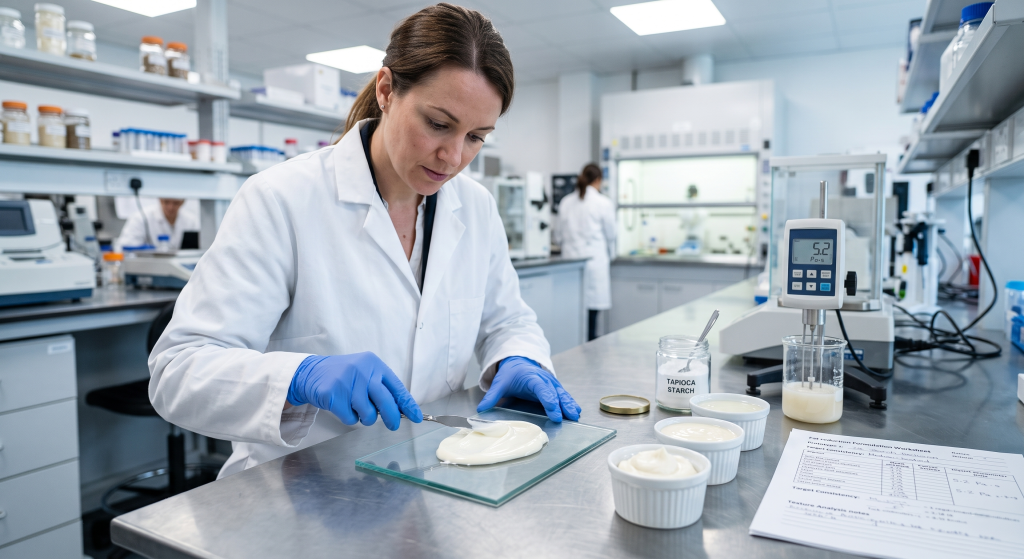
Removing fat from a dairy emulsion destabilizes the entire system. Fat not only provides a rich caloric density but also coats the palate, creating a lubricating effect known as “slip” or “meltaway.” To successfully replace it, a carbohydrate must physically behave like a lipid emulsion in the mouth.
When tapioca starch is introduced into a dairy matrix and undergoes thermal processing (such as pasteurization or UHT treatment), its granules hydrate, swell, and gelatinize. Because tapioca possesses a relatively low amylose content (15%–18%) compared to corn or wheat starches, it does not form a rigid, brittle gel. Instead, the hydrated tapioca starch granules act as microscopic, flexible spheres. When consumed, these swollen granules roll across the tongue seamlessly, perfectly replicating the mechanical “ball-bearing” effect of natural milk fat globules. This physical mimicry tricks the palate into perceiving a high-fat creaminess, even in significantly reduced-fat formulations.
Syneresis Control and Shelf-Life Stability
Beyond mouthfeel, fat plays a structural role in preventing moisture migration. In low-fat yogurts or sour creams, the lack of fat allows the protein network to contract over time, squeezing out water (syneresis). Tapioca starch acts as an exceptional water-binder. It traps free moisture within its gel matrix, stabilizing the casein protein network and ensuring a smooth, uniform surface throughout the product’s shelf life.
Formulation Strategies: Viscosity, Flavor, and Cost Optimization
Integrating tapioca starch into a dairy production line requires precise calibration to ensure the starch is fully hydrated without over-shearing the gel matrix during homogenization.
Balancing the Dairy Matrix
For R&D teams developing reduced-fat cream cheese or vegan butter spreads, replacing 10% to 20% of the lipid phase with an optimized tapioca starch and water slurry can yield identical spreadability to the full-fat control. The key is managing the gelatinization temperature. Because tapioca starch swells at a lower temperature (62°C–72°C), it integrates smoothly during standard dairy vat pasteurization processes.
| Parameter | Full-Fat Dairy Spread (Control) | Low-Fat Spread + Tapioca Starch | R&D Formulation Impact |
| Butterfat Content | 30% – 35% | 10% – 15% | Significant caloric reduction for health-focused branding. |
| Moisture Content | Moderate (~55%) | High (~70%) | Tapioca binds the excess water securely, preventing leakage. |
| Flavor Release | Slow, lingering | Clean, rapid release | Neutral starch profile prevents masking of natural dairy cultures. |
| Spreadability (4°C) | Firm, requires tempering | Soft, immediately spreadable | Tapioca prevents the matrix from becoming overly rigid under refrigeration. |
Financial Impact and Cross-Application Value
Replacing expensive dairy fats with carbohydrate-based thickeners offers a substantial reduction in the Cost of Goods Sold (COGS). This mirrors the high-efficiency cost optimization strategies successfully deployed across other food sectors, as detailed in our guide on cassava starch cost optimization in sauce manufacturing.
Furthermore, the clean-label status of native tapioca allows dairy brands to simplify their ingredient decks, avoiding synthetic hydrocolloids or modified starches. This aligns directly with consumer shifts toward transparent labeling, establishing the future of clean label cassava as a hero ingredient. The binding and texturizing elasticity of tapioca is highly versatile; the same structural benefits that create chew in instant noodle manufacturing and stability in clean-label gluten-free baking translate seamlessly into firming up soft dairy spreads.
Critical Microbiological Standards for Dairy Procurement
Sourcing ingredients for dairy and cultured products requires the highest level of microbiological scrutiny. Introducing a high-bacteria starch into a pasteurized milk base can trigger premature fermentation, off-gassing, and catastrophic spoilage.
When procuring tapioca starch for dairy applications, Purchasing Managers must demand strict Certificates of Analysis (COA) verifying ultra-low bioburden. Key limits must include:
Total Plate Count (TPC): < 10,000 CFU/g (Premium dairy grades often require < 5,000 CFU/g).
Yeast and Mold: <100 CFU/g to prevent surface spoilage in set yogurts and cheeses.
Thermophilic Spores: Strict negative testing, as these spores can survive standard pasteurization and ruin UHT dairy beverages.
Why Leading Dairy Manufacturers Partner with Amerta Pacific
Achieving the perfect low-fat dairy texture requires a starch supplier that understands the strict tolerances of modern dairy processing. Amerta Pacific supplies premium, dairy-grade native tapioca starch engineered for exceptional purity and performance.
The Amerta Pacific Dairy Advantage
Ultra-Clean Microbiological Profile: Our starch is processed under rigorous ISO and HACCP controls, ensuring safe integration into sensitive cultured dairy and UHT lines.
Absolute Flavor Neutrality: Advanced multi-stage washing removes earthy or root-based off-notes, allowing your delicate vanilla, fruit, and lactic flavors to dominate the palate.
Consistent Viscosity Yields: We guarantee tight tolerance bands for peak viscosity, ensuring your yogurts and spreads achieve the exact same thickness batch after batch.
Frequently Asked Questions (FAQ)
Q: Can native tapioca starch replace fat 1:1 in dairy formulations? A: No. Because starch binds water and provides structure differently than lipids, it is typically hydrated into a slurry. R&D teams usually replace the removed fat with a specific ratio of water and tapioca starch (often 1 part starch to 3–4 parts water) to match the original volume and viscosity.
Q: Will tapioca starch mask the flavor of fruit preps in low-fat yogurt? A: Unlike corn starch, which can leave a chalky or cereal-like aftertaste, tapioca starch is exceptionally neutral and has a very clean flavor release. It actually enhances the perception of fruit and sweet notes by clearing the palate quickly.
Q: Is tapioca starch stable under high-shear homogenization? A: Native tapioca starch can be sensitive to extreme shear if fully gelatinized prior to the homogenization valve. Dairy formulators typically optimize the process by adding the starch upstream so it hydrates smoothly during the thermal step, or they utilize a carefully calibrated temperature profile to protect the swollen granules.
Q: Does tapioca starch affect the fermentation time of cultured dairy products? A: Native tapioca starch is generally inert to standard lactic acid bacteria used in yogurt and sour cream. It does not inhibit fermentation, though the added carbohydrates can slightly influence the overall acidification curve, requiring minor timing calibrations by the QA team.
Elevate Your Low-Fat Dairy Formulations with Amerta Pacific
Do not let fat reduction compromise the indulgent texture your consumers expect. Amerta Pacific delivers high-purity, dairy-grade tapioca starch tailored to solve the most complex rheological challenges in modern food formulation.
Ready to perfect your low-fat dairy matrix? Contact the Amerta Pacific R&D Support Team today to request a comprehensive Technical Data Sheet (TDS), review microbiological specifications, or secure premium bench-test samples for your upcoming pilot plant trials.