
Tapioca Starch in Instant Noodle Manufacturing: Texture, Cost, and Quality Control Guide for Procurement Teams
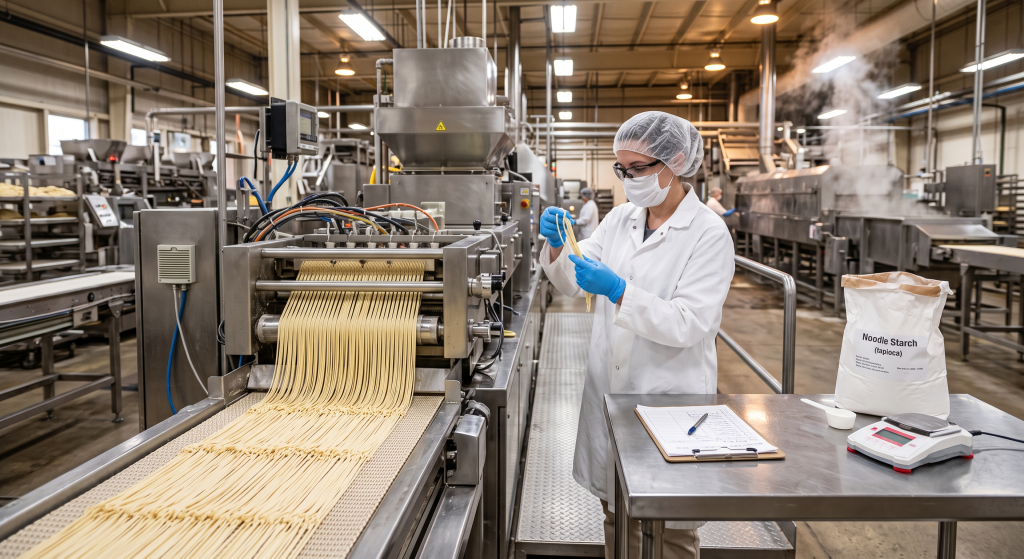
In the ultra-competitive global instant noodle market, maintaining an optimal balance between eating quality, dough behavior, and cost per batch determines market dominance. For procurement managers and food scientists, tapioca starch is no longer just a secondary ingredient—it is a functional game-changer. Integrating premium cassava starch into wheat flour formulations enhances noodle elasticity, reduces rehydration time, and optimizes oil absorption during deep-frying.
Direct Answer: Tapioca starch acts as a functional binder and texturizer in instant noodle manufacturing, lowering gelatinization temperatures to improve dough stretchability, elasticity, and water absorption. It shortens consumer preparation time, delivers a desirable “al dente” bite, and optimizes production costs by partially substituting expensive high-protein wheat flour.
The Functional Role of Tapioca Starch in Instant Noodle Production
When added to noodle dough formulations at replacement rates of 10% to 20%, tapioca starch fundamentally alters the starch-protein matrix. Its lower gelatinization temperature (62°C–72°C compared to wheat starch’s 68°C–80°C) allows starch granules to swell faster during the steaming stage.
Key Textural and Processing Benefits
Enhanced Chewiness and Elasticity: Tapioca’s low amylose content (15%–18%) forms a soft, clear gel with higher peak viscosity, giving cooked noodles a glossy sheen and elastic “spring.”
Accelerated Rehydration Rate: The open porous structure created by tapioca allows hot water to penetrate faster, cutting down preparation time for cup and bowl noodles.
Reduced Fry Oil Absorption: During the flash-frying phase (140°C–160°C), tapioca starch forms a protective surface barrier, reducing oil absorption into the noodle cake and lowering raw material costs.
Balancing Production Cost with Ingredient Performance
Rising prices for high-gluten wheat flour have put pressure on procurement margins worldwide. Food manufacturers looking for raw material efficiency often turn to starch substitution strategies. Similar to strategies used in cassava starch cost optimization for sauce manufacturing, replacing a portion of wheat flour with native or modified tapioca starch yields significant savings without degrading quality.
Cost & Performance Trade-off Benchmark
| Formulation Parameter | 100% Wheat Flour Base | Wheat + 15% Tapioca Starch Blend | Manufacturing Impact |
| Dough Water Absorption | Baseline (32%–34%) | High (35%–38%) | Higher finished yield per kg of dry mix |
| Steaming Gelatinization | Standard | Rapid & Complete | Lower steam energy consumption |
| Cooking Loss (Turbidity) | Standard (5%–7%) | Minimal (< 4%) | Cleaner broth, reduced cooking loss |
| Noodle Surface Sheen | Matte / Pale | Translucent & Glossy | Enhanced visual consumer appeal |
Transitioning to sustainable, plant-based starches also positions your brand ahead of market shifts toward natural texturizers, as highlighted in our look at the future of clean label cassava ingredients.
Quality Control Standards for Procurement Directors
Securing raw ingredients for high-speed automated lines requires strict technical parameters. A minor variation in viscosity or moisture content can lead to dough tearing during sheeting or poor cut definition at the slitter.
Essential COA Parameters for Instant Noodle Grade Tapioca
When evaluating shipments from a B2B supplier, your Purchasing and Quality Assurance teams should mandate the following specifications:
Peak Viscosity (Brabender / RVA): Minimum 700 BU. High viscosity ensures maximum binder strength.
Moisture Content: Max 13.0%. Keeps microbial growth under control during storage and prevents clumping in dry dosing bins.
pH Range (10% Slurry): 5.0 – 7.0. Neutral pH avoids interfering with alkaline salts (Kansui) used in noodle dough.
Whiteness Index: Minimum 92%. Preserves a clear color background for natural or synthetic colorings.
Pulp / Particle Residue: < 0.10 ml/100g (passing 100-mesh sieve). Eliminates black specks and structural weak spots in thin noodle sheets.
For a deeper dive into evaluating prospective suppliers, consult our comprehensive cassava flour B2B sourcing guide.
Why Leading Noodle Manufacturers Partner with Amerta Pacific
Procuring starch for global distribution requires reliable batch-to-batch consistency and secure supply chains. Amerta Pacific supplies industrial-grade, non-GMO native tapioca starch processed under strict ISO and HACCP quality protocols.
The Amerta Pacific Supply Advantage
Rigorous QC Verification: Every lot is backed by a full Certificate of Analysis (COA) matching your exact viscosity and mesh parameters.
Reliable Logistics: We handle export execution, volume security, and door-to-door freight support to prevent costly factory downtime.
Technical Support: Our food science team works alongside your R&D group to refine inclusion rates and test production runs.
Frequently Asked Questions (FAQ)
Q: Why is tapioca starch preferred over corn starch in instant noodles? A: Tapioca starch has a lower gelatinization temperature, higher peak viscosity, and a clearer paste clarity than corn starch. It produces an elastic texture rather than the rigid, firm structure typical of high-amylose corn starch.
Q: What inclusion rate of tapioca starch is recommended for instant fried noodles? A: Standard inclusion rates range between 8% and 15% of the total dry flour weight. Premium bowl noodles or quick-cook varieties may use up to 20% to achieve faster rehydration.
Q: How does tapioca starch affect noodle frying times? A: Because tapioca starches bind water efficiently and gel rapidly, noodles set faster during steaming. This allows for shorter flash-frying durations while keeping oil content lower.
Q: Can native tapioca starch replace modified starch in instant noodles? A: Native tapioca starch works exceptionally well in standard instant fried noodles and clean-label recipes. However, for extreme freeze-thaw or long-shelf-life bowl noodles, a modified tapioca starch may be blended in for extra stability.
Upgrade Your Noodle Line with Amerta Pacific
Optimizing texture and controlling production costs doesn’t have to be a trade-off. Amerta Pacific delivers high-purity tapioca starch formulated to meet the demands of modern automated noodle manufacturing.
Ready to improve your formulation and secure your supply chain? Contact the Amerta Pacific Procurement Team today to request a quote, schedule a factory trial batch, or obtain a full Technical Data Sheet (TDS).