
Tapioca Starch in Adhesive and Biodegradable Packaging Manufacturing: A Procurement Guide for Sustainable Industry Buyers
Industrial manufacturing is undergoing a massive shift towards ecological responsibility. As petrochemical-based glues and single-use plastics face strict regulatory phase-outs across global markets, procurement managers and sustainability directors are under immense pressure to secure high-performance, renewable raw materials. Native tapioca starch, extracted from the cassava root, has emerged as a premier bio-polymer base for industrial adhesives, corrugated board manufacturing, and biodegradable packaging. Offering remarkable binding strength and film-forming capabilities, tapioca starch allows manufacturers to sever their reliance on volatile synthetic polymers while achieving critical compostable certifications.
Direct Answer: Tapioca starch serves as a highly effective, renewable binder in industrial adhesives and a primary polymer in biodegradable packaging. Its naturally high amylopectin content provides superior wet tack, stable viscosity, and strong film-forming capabilities, enabling manufacturers to replace petrochemical polymers while achieving zero-waste and compostable product certifications.
The Role of Tapioca Starch in Industrial Adhesives
For decades, the corrugated cardboard and paper packaging industries have relied on starch-based glues. However, the botanical source of the starch dictates the efficiency of the manufacturing line. In the classic Stein Hall adhesive process used for corrugated boards, native tapioca starch offers distinct rheological advantages over corn or wheat alternatives.
Tack, Viscosity, and Bonding Strength
When formulated into liquid adhesives, tapioca starch delivers an exceptionally high water-binding capacity and an aggressive “wet tack.” This immediate stickiness is crucial for high-speed automated corrugators and paper bag assembly lines, as it holds layers together before the thermal drying phase is complete.
Furthermore, tapioca starch maintains a highly stable viscosity under mechanical shear and temperature fluctuations. Unlike corn starch, which is prone to retrogradation and can gel up or clog applicator nozzles as it cools in holding tanks, tapioca starch remains fluid. This structural resilience and elasticity mirror the same binding principles utilized in the food sector, such as the texturizing mechanics required for tapioca starch in instant noodle manufacturing.
Driving Innovation in Biodegradable Packaging
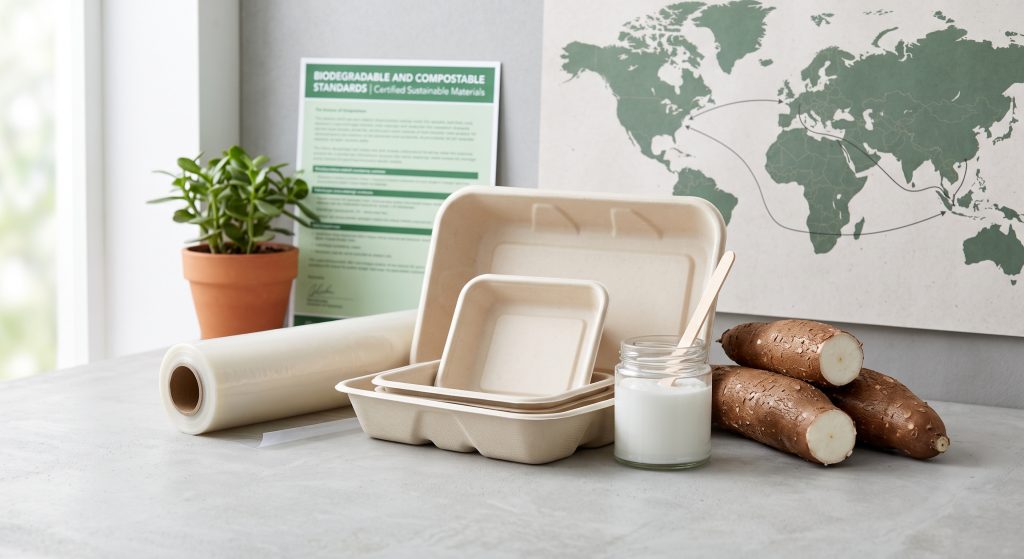
The global push to eliminate single-use plastics has accelerated the development of bioplastics. Tapioca starch is now a foundational ingredient in manufacturing Thermoplastic Starch (TPS), a fully biodegradable polymer resin used to create compostable films, shopping bags, and rigid molded trays.
Bioplastics and Thermoplastic Starch (TPS)
To create TPS, native tapioca starch is subjected to high heat and shear inside an extruder, combined with natural plasticizers like glycerol or sorbitol. This process breaks down the crystalline structure of the starch granules, transforming them into a continuous, flexible plastic melt. This melt can then be blended with other biodegradable polyesters (such as PLA or PBAT) to improve tensile strength and moisture resistance.
The resulting tapioca-based bioplastic can be blown into thin compostable films, injected into rigid clamshell food containers, or expanded into bio-foam shipping peanuts. Because cassava is a highly renewable, fast-growing crop, scaling its use for industrial plastics represents the absolute future of clean label cassava as a hero ingredient, stretching far beyond traditional food applications.
Sustainability and ESG Compliance for Procurement
For Sustainability Directors and industrial buyers, ingredient sourcing is no longer just about the bottom line; it is about meeting rigorous Environmental, Social, and Governance (ESG) targets.
Meeting Corporate Sustainability Goals
Transitioning from synthetic, fossil-fuel-derived adhesives and plastics to bio-based tapioca starch drastically reduces a manufacturing facility’s carbon footprint. Cassava cultivation requires significantly fewer chemical inputs and water resources compared to other starch crops. Sourcing industrial-grade tapioca starch allows large-scale manufacturers to support sustainable agricultural economies while securing a stable, renewable supply chain. This strategic procurement pivot directly aligns with the broader cassava ESG and sustainability advantage.
Technical Specifications for Industrial Procurement
Procuring tapioca starch for adhesives and bioplastics requires a strict evaluation of physical and chemical parameters. While food-grade microbiological standards are less critical, the physical viscosity and purity of the starch must be tightly controlled to prevent machine downtime.
Essential Quality Control Parameters
When evaluating a B2B supplier for industrial applications, procurement teams should mandate the following specifications on their Certificates of Analysis (COA):
| Technical Parameter | Industrial Specification Limit | Manufacturing Significance |
| Starch Purity (Dry Basis) | ≥ 85.0% | Maximizes polymer yield and binding strength per metric ton. |
| Moisture Content | ≤ 13.5% | Prevents caking in silos and ensures accurate dry-weight dosing. |
| Viscosity (Brabender) | 600 – 800 BU | Ensures optimal flow rate through adhesive applicator nozzles. |
| pH Level (10% Slurry) | 5.0 – 7.0 | Prevents unwanted chemical reactions with cross-linking agents. |
| Ash / Mineral Content | ≤ 0.20% | Minimizes abrasive wear on high-speed corrugator rollers and extruder dies. |
Why Industrial Manufacturers Source from Amerta Pacific
Securing thousands of metric tons of highly consistent industrial starch requires an experienced partner capable of navigating complex global supply chains. Amerta Pacific supplies premium industrial-grade tapioca starch engineered specifically to meet the high-shear, high-temperature demands of adhesive and bioplastic manufacturing.
The Amerta Pacific B2B Advantage
Guaranteed Viscosity Stability: Our meticulous processing ensures a standardized amylose-to-amylopectin ratio, delivering predictable tack and flow rates for your automated lines.
High-Volume Scalability: We operate robust, sustainable supply networks capable of fulfilling continuous high-tonnage contracts for global industrial plants.
Flexible Industrial Packaging: Available in standard 25 kg multi-wall bags, as well as 850 kg and 1,000 kg FIBC super sacks designed for seamless integration into bulk pneumatic unloading systems.
Frequently Asked Questions (FAQ)
Q: Can tapioca starch completely replace synthetic resins in corrugated adhesives? A: Yes. In the manufacturing of corrugated cardboard, tapioca starch is frequently used as the primary binder in the Stein Hall process, fully replacing synthetic polyvinyl acetate (PVA) glues while delivering excellent edge crush test (ECT) performance.
Q: Does tapioca-based bioplastic require industrial composting facilities to break down? A: Pure thermoplastic starch (TPS) is highly hydrophilic and will rapidly biodegrade in home compost environments or marine settings. When blended with polymers like PLA to increase moisture resistance, the resulting film typically requires standard industrial composting conditions to break down efficiently.
Q: Is industrial-grade tapioca starch safe for food-contact packaging adhesives? A: Absolutely. Native tapioca starch is non-toxic and inherently food-safe. Adhesives formulated with pure native tapioca starch are ideal for paper straws, food carton sealing, and bottle labeling where indirect food contact is a regulatory concern.
Q: How does the pricing of industrial tapioca starch compare to petrochemical polymers? A: Industrial tapioca starch offers a highly stable and competitive price point. Because it is not tied to the volatile crude oil market like synthetic polymers, it provides procurement teams with predictable long-term cost modeling.
Drive Sustainable Innovation with Amerta Pacific
Transitioning to bio-based adhesives and compostable packaging is a necessary step for the future of industrial manufacturing. Amerta Pacific provides the high-performance, renewable industrial tapioca starch you need to reduce your carbon footprint without sacrificing structural integrity or production speed.
Ready to secure a sustainable supply chain for your manufacturing facility? Contact the Amerta Pacific Industrial Procurement Team today to request a comprehensive Technical Data Sheet (TDS), explore volume pricing structures, or arrange bulk sample shipments for your upcoming pilot trials.