
Pea Protein Isolate Solubility and Dispersibility: Why These Two Properties Determine Your RTD Beverage's Commercial Success
In the competitive Ready-to-Drink (RTD) plant-based beverage market, nutritional claims bring consumers to the shelf, but mouthfeel dictates repeat purchases. When formulating high-protein vegan shakes, milks, or sports recovery drinks, R&D teams frequently encounter a critical barrier: achieving a perfectly smooth liquid suspension. Unlike dairy proteins that naturally dissolve into clear or milky solutions, plant proteins inherently resist hydration. For food manufacturers and process engineers, understanding and optimizing the solubility and dispersibility of pea protein isolate is the absolute baseline for commercial success. Failing to secure raw materials optimized for these two physical properties guarantees gritty textures, severe sedimentation, and unmarketable products.
Direct Answer: Pea protein isolate solubility refers to its ability to dissolve on a molecular level, preventing a chalky mouthfeel, while dispersibility determines how rapidly the powder wets and suspends in liquid without clumping. Together, these properties eliminate sedimentation and ensure a smooth, stable RTD beverage over its entire shelf life.
The Science of Suspension: Differentiating Solubility and Dispersibility
While often used interchangeably by marketing teams, solubility and dispersibility are distinct physical phenomena that must be managed independently during the manufacturing process. A protein powder can be highly soluble once mixed but feature terrible dispersibility, causing it to form impenetrable lumps in the mixing vat.
Defining Nitrogen Solubility Index (NSI)
Solubility is technically measured as the Nitrogen Solubility Index (NSI). It defines the percentage of protein that completely dissolves into the liquid phase at a specific pH level. Native pea proteins are generally insoluble near their isoelectric point (pH 4.5). For neutral RTD beverages (pH 7.0), a high-quality pea protein isolate should exhibit an NSI of 75% to 85%. High solubility is what prevents the consumer from experiencing a dry, “chalky” or “sandy” sensation on the palate.
The Mechanics of Dispersibility
Dispersibility relates to the macroscopic behavior of the powder when it first contacts water. It involves four distinct stages: wettability (how fast the powder absorbs water), sinkability (overcoming surface tension), dispersibility (breaking down into primary particles), and finally, solubility. If a pea protein isolate lacks proper dispersibility, the exterior of the powder clumps hydrates instantly, forming a gel-like barrier that prevents water from reaching the dry protein inside. This leads to massive “fisheyes” or lumps that clog automated processing lines and require excessive shear to break down.
Overcoming Formulator Challenges in RTD Manufacturing
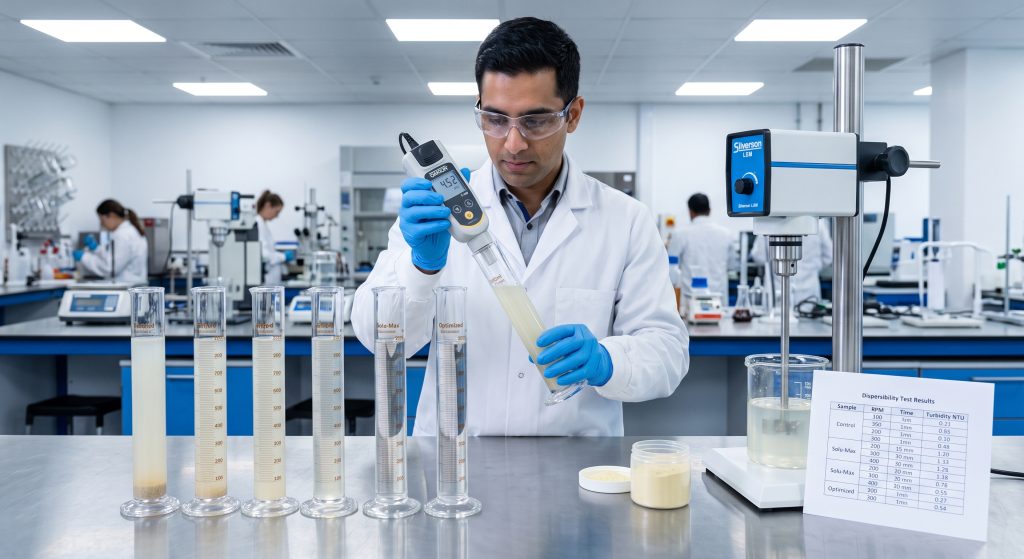
For beverage manufacturers, the transition from lab-scale prototypes to industrial UHT (Ultra-High Temperature) lines amplifies any physical flaws in the protein source.
Defeating Sedimentation and Flocculation
The most common defect in RTD plant-protein drinks is sedimentation—a thick layer of sludge that forms at the bottom of the bottle over its six-to-twelve-month shelf life. This occurs when insoluble protein particles agglomerate and fall out of suspension due to gravity.
To prevent this, R&D teams must utilize pea protein isolates with exceptionally fine particle sizes (typically 100% passing a 100-mesh sieve). Smaller particles remain suspended within the liquid matrix far longer. Additionally, utilizing the inherent emulsifying capabilities of the protein helps stabilize added fats, a strategy thoroughly explored in our guide on utilizing pea protein as a clean-label emulsifier in vegan milk.
Thermal Stability During UHT Processing
RTD beverages must undergo extreme thermal processing to ensure commercial sterility. When subjected to temperatures exceeding 135°C, pea proteins can rapidly denature, unfold, and cross-link, causing the liquid to spike in viscosity or gel entirely in the holding tubes. Managing this requires a high-solubility isolate paired with the correct buffer salts (like dipotassium phosphate) to stabilize the protein structure during heat shock. This same thermal stability is heavily relied upon when developing thicker structured matrices, such as pea protein isolate in functional yogurt and dairy alternatives.
Why Procurement Managers Specify 85% Grade for RTD Lines
Securing the right raw material dictates the operational efficiency of the entire factory. When purchasing directors source pea protein for liquid applications, specifying the highest purity grade is not just a marketing decision; it is an engineering necessity.
The 85% Isolate Advantage in Liquid Systems
In solid foods, lower-grade isolates function perfectly. However, in RTD beverages, standard 80% isolates often contain higher levels of residual starches and fibers that swell unpredictably in water, increasing viscosity and causing sedimentation.
Premium 85% Pea Protein Isolate has undergone advanced filtration to remove these insoluble fractions. The result is a powder with a significantly higher NSI, superior dispersibility, and a cleaner flavor profile that requires fewer masking agents. This makes the 85% grade mandatory for high-performance liquid formulations, including sports nutrition RTD BCAA blends. For procurement teams finalizing their ingredient specifications, reviewing our comprehensive B2B guide to sourcing premium pea protein isolate 85% is an essential step in standardizing your supply chain.
Sourcing High-Performance Ingredients with Amerta Pacific
Achieving a perfectly smooth, shelf-stable RTD beverage requires an ingredient supplier that understands the rigorous demands of industrial liquid processing. Amerta Pacific supplies premium pea protein isolate specifically engineered to solve the most difficult solubility and dispersibility challenges in modern beverage manufacturing.
The Amerta Pacific RTD Advantage
Optimized Particle Size: Our isolates are micronized to ensure rapid wetting and instant dispersion in high-speed commercial blending tanks.
Industry-Leading NSI: Advanced physical extraction processes protect the native protein structure, delivering an exceptionally high Nitrogen Solubility Index to eliminate chalky textures.
UHT Ready: Formulated for maximum thermal stability, ensuring your product flows smoothly through heat exchangers without fouling the line.
Frequently Asked Questions (FAQ)
Q: Do I still need hydrocolloids if I use a highly soluble pea protein isolate? A: Yes. While high solubility prevents chalkiness and minimizes sedimentation, hydrocolloids like gellan gum or carrageenan are still recommended in RTD beverages to create a weak yield stress network that holds the micronized protein particles in suspension over a long shelf life.
Q: How does pH affect the solubility of pea protein in my beverage? A: Pea protein solubility is highly pH-dependent. It is highly soluble at neutral pH (7.0) and alkaline conditions, but its solubility drops to nearly zero around its isoelectric point (pH 4.2 to 4.5). For acidic RTD beverages (like fruit-flavored protein waters), specialized hydrolyzed proteins or encapsulation technologies are required.
Q: Can I improve dispersibility on the factory floor without changing my protein supplier? A: Dispersibility can be improved operationally by using high-shear inline mixers (like triblenders) or by pre-blending the pea protein isolate with dry ingredients like sugar or cocoa powder before introducing it to the liquid phase, which prevents the protein particles from clumping instantly.
Q: Does highly soluble pea protein taste different from standard grades? A: Yes. Because highly soluble isolates undergo more rigorous extraction and washing, they contain fewer residual lipids and volatile compounds, resulting in a significantly cleaner, less “earthy” flavor profile that is easier to flavor in liquid applications.
Secure Your RTD Supply Chain with Amerta Pacific
Do not let poor solubility ruin your product’s mouthfeel or your brand’s reputation. Amerta Pacific delivers the ultra-refined, high-solubility pea protein isolate required to formulate premium, smooth, and shelf-stable RTD beverages.
Ready to perfect your liquid formulation? Contact the Amerta Pacific Ingredient Specialists today to request a Technical Data Sheet (TDS), review NSI specifications, or order bench-test samples to run through your homogenizer.