
Pea Protein Isolate in Functional Yogurt and Dairy Alternatives: Formulation Guide for R&D Teams
As consumer demand for plant-based nutrition shifts from novelty to daily habit, dairy alternative manufacturers face a critical challenge: achieving the signature creamy texture, gel structure, and high-protein profile of traditional dairy yogurt without sacrificing flavor. Pea protein isolate has emerged as the premier ingredient solution for plant-based R&D teams. Derived from non-GMO yellow peas (Pisum sativum), high-purity pea protein isolate offers excellent solubility, allergen-free labeling, and robust gelation properties required for next-generation spoonable and drinkable plant-based yogurts.
Direct Answer: Pea protein isolate acts as a structural texturizer and nutritional fortifier in plant-based yogurt formulations. Containing 80% to 85% protein, it builds gel strength through heat-induced network formation, enhances water-binding capacity to prevent syneresis (wheying-off), and provides a clean, allergen-free base that mimics dairy mouthfeel.
Techno-Functional Advantages of Pea Protein Isolate in Fermented Systems
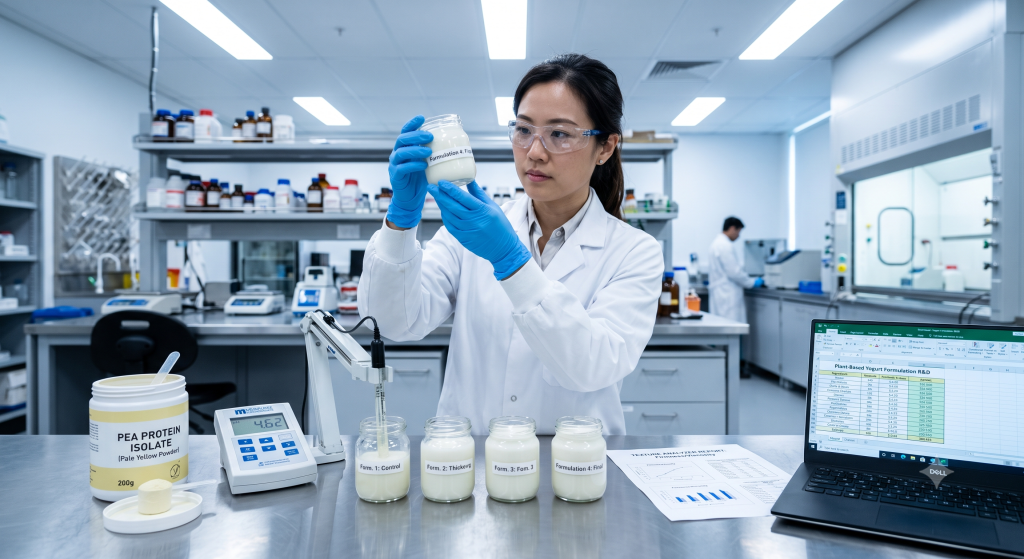
Formulating plant-based yogurt requires an ingredient that can withstand thermal processing, homogenize cleanly, and aggregate into a cohesive curd structure during acidification. Pea protein isolate fulfills these requirements through distinct functional attributes:
Key Functional Attributes for Dairy Alternatives
Gelling and Curd Formation: During thermal treatment (85°C–90°C), pea globulins unfold and cross-link. As the pH drops toward the isoelectric point (~4.5) during fermentation, these proteins form a stable three-dimensional gel matrix.
Syneresis Reduction: Pea protein isolate exhibits exceptional water-holding capacity, absorbing up to 3 to 4 times its weight in water. This prevents liquid separation (wheying-off) over the product’s shelf life.
Emulsification & Fat Retention: High surface activity allows pea protein to stabilize plant fats (such as coconut or sunflower oil), ensuring a smooth, fatty mouthfeel similar to whole-milk dairy yogurt.
Beyond fermented systems, pea protein’s amphiphilic nature allows it to act as an effective stabilizer across various liquid matrices, as detailed in our guide on pea protein as a clean-label emulsifier in vegan milk.
Overcoming R&D Challenges: Texture, pH, and Flavor Optimization
While pea protein isolate offers superior functional characteristics, formulators must navigate specific physical and sensory hurdles during product development.
Managing Texture and Viscosity Controls
The viscosity of pea protein increases rapidly during heat treatment and acidification. Formulators must balance solids content with shear force:
| Formulation Variable | Standard Plant Base | Optimized Pea Isolate Base | Technical Strategy |
| Protein Content | 2.0% – 3.0% | 5.0% – 8.0% | Enables high-protein claims (10g+ per serving) |
| Gelation Point | Weak / Chalky | Firm & Creamy | Thermal step at 88°C for 5 minutes prior to culture dosing |
| Mouthfeel / Grittiness | High sedimentation | Smooth & Gel-like | Micro-fluidization / high-pressure homogenization (200–250 bar) |
| Syneresis Index | Moderate to High | Minimal (< 2%) | Synergistic blend with native tapioca or hydrocolloids |
Achieving structural firmness without chalkiness requires precise raw material selection. Similar structural texturizing strategies are utilized in meat analog texture optimization with pea protein isolate.
Off-Flavor Masking and Fermentation Synergy
Native pea protein can carry earthy or “beany” notes driven by hexanal compounds. To neutralize these notes:
Select Low-Flavor Isolates: Work with suppliers like Amerta Pacific that utilize mild physical extraction rather than harsh chemical processing.
Optimize Culture Selection: Use Lactobacillus bulgaricus and Streptococcus thermophilus strains optimized for plant substrates; bacterial fermentation naturally breaks down volatile hexanals, reducing grassy flavor notes.
Quality Control and Procurement Benchmarks for R&D Managers
When sourcing pea protein isolate for fermented dairy alternative lines, purchasing and R&D teams must specify technical parameters to ensure batch-to-batch consistency.
Critical Specification Checklist
Protein Content (Dry Basis): ≥ 80% – 85% (N x 6.25). Ensures predictable gelling power.
Solubility Index (NSI at pH 7.0): ≥ 75%. High initial solubility is mandatory for uniform hydration before thermal processing.
Particle Size: 100% through 100-mesh sieve (D90 < 50 microns). Prevents a gritty texture on the tongue.
Heavy Metals & Micro Standards: Total Plate Count < 10,000 CFU/g, with zero tolerance for Salmonella or E. coli.
BCAA & Nutritional Density: High levels of Lysine and Branched-Chain Amino Acids, crucial for functional nutrition positioning similar to sports nutrition RTD formulations.
Partnering with Amerta Pacific for Dairy Alternative Innovations
Scaling a high-protein, plant-based yogurt from bench-top to commercial production requires consistent raw material performance. Amerta Pacific provides food-grade Pea Protein Isolate specifically refined for high-solubility and low-flavour applications.
The Amerta Pacific Ingredient Advantage
Clean Neutral Profile: Our proprietary water-extraction process minimizes pea flavor notes, reducing the need for costly masking agents.
Non-GMO & Allergen-Free: Fully compliant with Soy-Free, Dairy-Free, Gluten-Free, and Non-GMO clean label requirements.
Technical Support: Our food application specialists work with your R&D lab to optimize hydration times, shear settings, and inclusion rates.
Frequently Asked Questions (FAQ)
Q: Can pea protein isolate achieve a set-style plant-based yogurt without added gums? A: Yes. At inclusion rates between 5% and 8%, heat-denatured pea protein forms a firm gel matrix upon acidification (pH 4.5–4.6) capable of supporting a set-style spoonable yogurt without starch or hydrocolloids.
Q: How does pea protein isolate compare to soy protein in fermented dairy alternatives? A: Pea protein isolate provides comparable gel strength and viscosity to soy isolate, but holds a distinct market advantage by being allergen-free (Big 9 allergen compliant) and non-GMO.
Q: What is the optimal homogenization pressure for pea protein yogurt bases? A: A two-stage homogenization at 180–200 bar (Stage 1) and 30–50 bar (Stage 2) prior to fermentation yields optimal fat droplet dispersion and prevents protein gritty perception.
Q: Does pea protein interfere with yogurt starter culture activity? A: No. Pea protein isolate provides adequate free amino nitrogen (FAN) and peptides that nourish lactic acid bacteria, often resulting in faster acidification curves than unfortified bases.
Accelerate Your Plant-Based Dairy Formulations with Amerta Pacific
Transform your plant-based dairy alternative pipeline with high-performance ingredients engineered for superior texture and taste. Amerta Pacific delivers premium pea protein isolate tailored to meet the exacting standards of modern food manufacturing.
Ready to elevate your functional yogurt line? Contact the Amerta Pacific R&D Support Team today to request a Technical Data Sheet (TDS), Certificate of Analysis (COA), or order bench-test samples for your laboratory trials.