
Texture Realism:
Optimizing Meat Analogs with Isolate Pea Protein
As of 2026, the “first generation” of plant-based meats often criticized for being overly processed and mushy is being replaced by “Texture-First” analogs. The critical ingredient driving this shift is Isolate Pea Protein. With a protein density of 80-85%, it provides the essential amino acid profile and, more importantly, the thermal cross-linking capabilities required to mimic the fibrous “bite” of animal muscle. For B2B manufacturers, using a high-purity pea isolate is the key to creating clean-label, high-protein beef, pork, and chicken alternatives that satisfy the “flexitarian” consumer.
Beyond Nutrition: The Functional "Bite"
In meat analog formulation, protein isn’t just a nutrient; it’s a structural building block.
The Extrusion Advantage: Most premium plant-based meats are produced via High-Moisture Extrusion Cooking (HMEC).
- Fibrous Alignment: During extrusion, the globular proteins in pea isolate are denatured and “stretched” into long, linear strands.
- Tensile Strength: Amerta’s Pea Protein Isolate has a specific disulfide-bond density that allows these strands to knit together, creating a “whole-muscle” feel that holds up to grilling, frying, and braising without losing its shape.
Overcoming the "Beany" Barrier: Flavor Neutrality
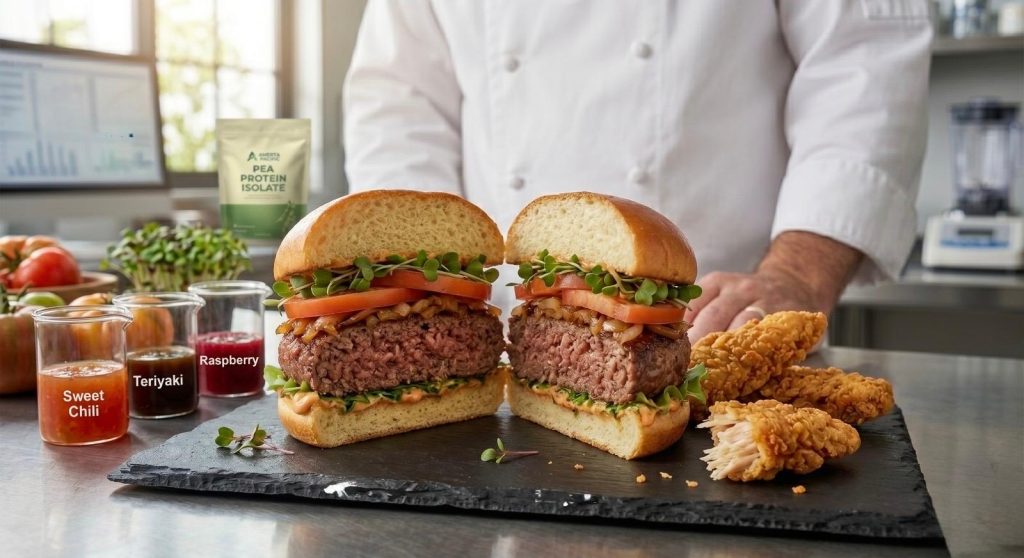
One of the biggest hurdles for pea protein has historically been its “earthy” or “beany” off-notes.
The 2026 Refinement: Amerta Pacific utilizes a proprietary Low-Temperature Aqueous Extraction process. This removes the volatile lipoxygenases responsible for bitter tastes while keeping the functional proteins intact.
Flavor Carrier: Because our isolate is neutral, it acts as a perfect “blank canvas” for your expensive flavor systems (heme, yeast extracts, or wood-smoke aromatics), allowing you to use 15% less flavoring while achieving a more authentic meat taste.
Clean Label Synergy: Eliminating Methylcellulose
Many plant-based meats rely on methylcellulose (a synthetic binder) to provide “hot-set” firmness. In 2026, health-conscious consumers are actively avoiding this “chemical glue.”
The Pea-Starch Synergy: By combining our Pea Protein Isolate with a small fraction of Native Cassava Starch, formulators can create a natural “gel matrix.”
- Cold-Set Binding: The starch provides the “fatty” mouthfeel and cold-set adhesion.
- Hot-Set Firmness: The pea protein provides the structural “spring” when heated.
Result: A 100% plant-derived, clean-label product that looks, cooks, and bites like the real thing.
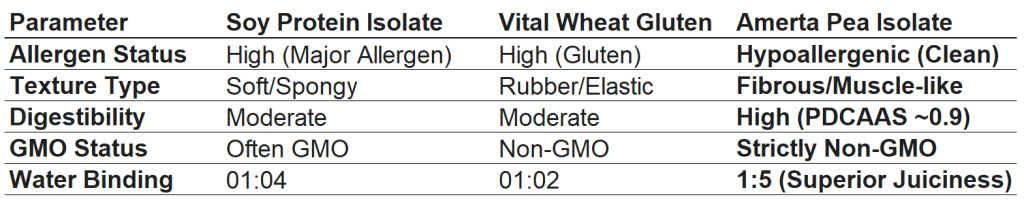
Technical Performance: Pea Isolate vs. Soy & Wheat Gluten
Conclusion: The New Standard for Plant-Based Protein
The manufacturers who win in 2026 will be those who bridge the gap between “plant-based” and “meat-identical.” By leveraging the structural power of Amerta’s Pea Protein Isolate, you are securing an ingredient that solves the two biggest problems in the industry: Allergen concerns and Texture failures.
Ready to upgrade your plant-based “bite”? [Request our Meat Analog Texture Guide] and order a 10kg sample of our High-Fibre Pea Isolate for your next R&D run.