
Pea Protein Isolate in Plant-Based Egg Alternatives: Gelation, Emulsification, and Scramble Texture Formulation Guide
Replicating the functional mechanics of the avian egg is one of the most complex challenges in modern food science. Eggs are culinary multitaskers—they emulsify fats, bind ingredients, leaven baked goods, and coagulate under heat to form unique, delicate curds. When developing liquid plant-based egg alternatives for scrambled eggs, omelets, and baking, R&D teams cannot rely on simple starches or gums alone. Pea protein isolate (Pisum sativum) serves as the critical functional backbone in these advanced formulations. Its unique globulin structures provide the necessary emulsification power to stabilize the raw liquid phase in the bottle and the thermal gelation capacity to coagulate into a fluffy, satisfying scramble in the skillet.
Direct Answer: Pea protein isolate replicates the functional properties of avian eggs in plant-based alternatives by acting as a highly effective emulsifier and thermal gelling agent. Upon heating, its native globulin proteins denature and cross-link, transitioning from a liquid matrix into a cohesive, elastic “scramble” texture while securely trapping moisture and fat.
The Mechanics of Plant-Based Egg Formulation: Emulsification and Gelation
A successful liquid egg alternative must perform perfectly in two completely different states: as a stable, homogeneous liquid during its refrigerated shelf life, and as a solid, cohesive gel after brief exposure to high stovetop heat.
Emulsifying the Liquid Base
Liquid plant-based eggs typically consist of water, a lipid source (such as canola or sunflower oil to mimic egg yolk fat), and protein. Native pea protein isolate contains amphiphilic amino acid sequences that naturally orient at the oil-water interface. By wrapping around the lipid droplets, the protein reduces interfacial tension and prevents the oil from coalescing and floating to the top of the bottle.
This inherent emulsification capacity ensures a smooth, homogeneous liquid pour without the need for heavy doses of synthetic surfactants. Understanding the physics of keeping these micro-particles suspended aligns directly with the stability principles discussed in our guide on pea protein isolate solubility and dispersibility in RTD beverages.
Thermal Gelation and Coagulation
The true test of a plant-based egg is how it behaves in a hot skillet. When the liquid emulsion hits a pan (typically between 75°C and 85°C), the pea globulins (legumin and vicilin) undergo rapid thermal denaturation.
As the protein structures unfold, they expose their hydrophobic core regions and immediately bond with neighboring proteins. This cross-linking forms an irreversible three-dimensional gel network. This matrix captures the surrounding water and fat, transforming the liquid into the fluffy, opaque, and slightly elastic curds that consumers expect from scrambled eggs.
Engineering the Perfect "Scramble" Texture
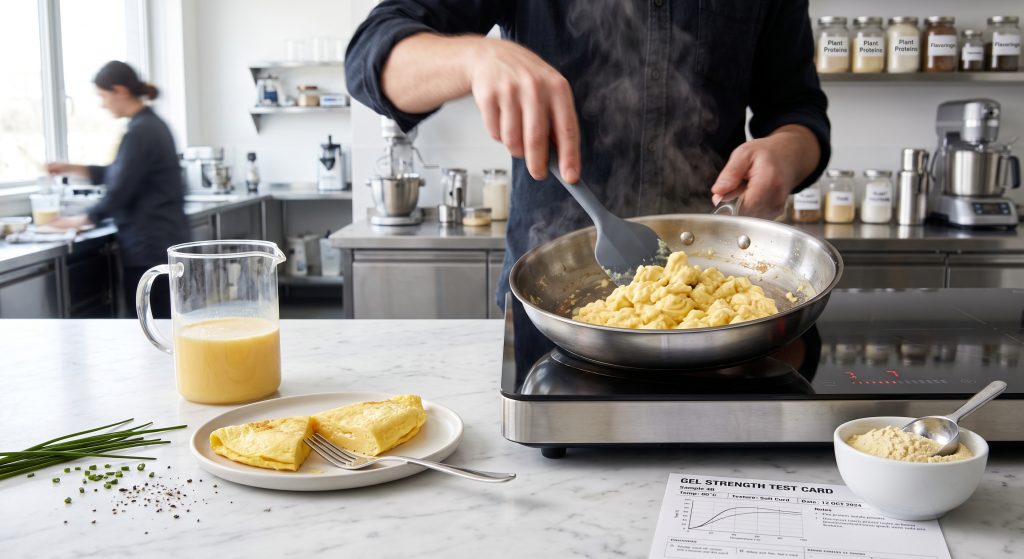
Early generations of vegan eggs often failed because they cooked into a dense, rubbery pancake or degraded into a mushy paste. Optimizing the scramble requires a precise balance of protein concentration, lipid ratios, and ionic strength (salt).
Formulation Parameters for Optimal Curd Formation
R&D teams must carefully calibrate the protein load to achieve the right yield stress and gel strength.
| Formulation Parameter | Optimal Range for Scramble Texture | Rheological Impact in the Skillet |
| Pea Protein Isolate | 10% – 14% | Provides the structural framework for thermal coagulation and curd formation. |
| Lipid Phase (Oil) | 8% – 12% | Lubricates the gel network, preventing a dry, rubbery mouthfeel. |
| pH Level | 6.8 – 7.2 (Neutral) | Neutral pH maximizes protein solubility before cooking and ensures even gelation. |
| Hydrocolloid Support | 0.2% – 0.5% (e.g., Gellan Gum) | Stabilizes the raw liquid in the bottle and provides initial structure before the protein fully coagulates. |
The ability of pea protein to form resilient, cross-linked thermal networks is highly versatile. These exact same structural capabilities are utilized to prevent starch leaching and provide a firm bite in dry-extruded foods, as explored in our formulation breakdown of pea protein isolate in high-protein pasta and rice alternatives.
Color, Flavor, and Quality Control in Egg Analogs
Flavor and visual appeal are just as critical as texture. A traditional egg profile is subtle, savory, and slightly sulfurous (often replicated using black salt, or kala namak). If the base protein carries heavy leguminous, earthy, or bitter off-notes, it will completely overpower these delicate flavor systems.
Achieving a Neutral Base and Egg-Like Appearance
To create a convincing egg analog, formulators typically color the liquid matrix with natural pigments like turmeric, beta-carotene, or annatto. If the pea protein isolate has a dark brownish tint, it muddies these pigments, resulting in a dull, unappetizing scramble.
Utilizing a premium, ultra-refined pea protein isolate guarantees a light cream-colored powder with an exceptionally neutral flavor profile. For technical insights on the physical water-extraction process that yields this necessary purity, R&D teams and QA officers should review our Amerta Pacific Ingredient Analysis.
Why Foodservice and Retail Brands Source from Amerta Pacific
Scaling a liquid plant-based egg product from a benchtop prototype to industrial manufacturing requires raw materials that deliver identical gelation curves lot after lot. Amerta Pacific supplies high-purity pea protein isolate engineered specifically for advanced food matrix applications.
The Amerta Pacific Processing Edge
Standardized Gelling Capacity: We strictly monitor the denaturation profiles of our isolates, ensuring your product coagulates predictably in both consumer skillets and commercial foodservice griddles.
Ultra-Fine Dispersion: Our micro-milled particles hydrate rapidly in cold liquids, preventing gritty textures and ensuring a perfectly smooth pour.
Clean Label and Allergen-Free: 100% free from soy, dairy, and gluten, allowing your brand to confidently market an allergen-friendly egg replacement to health-conscious demographics.
Frequently Asked Questions (FAQ)
Q: Can a pea protein-based liquid egg be used for baking as well as scrambling? A: Yes. The emulsifying properties of pea protein help bind fats and liquids in batters, while its thermal gelation provides structure to cakes and muffins, making it an excellent 1:1 functional replacement for whole liquid eggs in commercial bakery formulations.
Q: Will pea protein isolate cause the liquid egg product to separate in the bottle over time? A: If formulated correctly with a high-solubility pea protein isolate and a supporting hydrocolloid (like gellan gum or xanthan gum) to establish a weak yield stress, the emulsion will remain completely stable throughout its refrigerated shelf life without separating.
Q: Why does my plant-based egg prototype stick severely to the frying pan? A: Plant proteins lack the natural phospholipids found in egg yolks that provide lubrication. Formulators must ensure an adequate lipid content (typically around 10%) within the liquid egg base, and consumers should be instructed to use a non-stick pan or a light coating of cooking oil.
Q: How does the coagulation time of pea protein compare to a real chicken egg? A: Pea protein generally requires a slightly higher temperature and a few more seconds of thermal exposure to fully coagulate compared to avian egg proteins. R&D teams can optimize this cooking time by adjusting the protein concentration and carefully managing the ionic strength of the liquid base.
Perfect Your Plant-Based Egg Formulations with Amerta Pacific
Do not let inconsistent gelation or earthy off-flavors compromise your plant-based egg product. Amerta Pacific delivers the ultra-refined, high-gelling pea protein isolate you need to engineer a flawless, commercially viable egg alternative for retail and foodservice markets.
Ready to optimize your liquid egg emulsion? Contact the Amerta Pacific Food Science Team today to request a comprehensive Technical Data Sheet (TDS), review rheological gelation curves, or secure premium bench-test samples for your R&D test kitchen.