
Defending Your Supply Chain: Heavy Metal Testing and Contaminant Specs for Pea Protein Isolate
The plant-based protein market operates under a paradox: while consumers perceive vegan ingredients as inherently “cleaner,” agricultural realities often dictate otherwise. Yellow peas (Pisum sativum) are highly efficient bioaccumulators. If grown in soil laden with industrial runoff or historic pesticide use, the plant’s root system will actively absorb heavy metals, concentrating them within the harvested pulse. When these peas are processed and concentrated into an 80% or 85% isolate, the heavy metal load concentrates right along with the protein.
Direct Answer: Before approving a pea protein isolate supplier, procurement and QA teams must verify that the manufacturer tests every production lot for Lead (Pb), Arsenic (As), Cadmium (Cd), and Mercury (Hg) using Inductively Coupled Plasma Mass Spectrometry (ICP-MS). Compliance must be measured against the strictest global thresholds, specifically California’s Proposition 65 and EU Regulation 2023/915, to prevent costly product recalls and class-action lawsuits.
The Soil-to-Silo Risk: Why Peas Absorb Heavy Metals
Heavy metal contamination is rarely a result of factory negligence; it is an agricultural inevitability. Elements like lead and cadmium exist naturally in the earth’s crust, but commercial farming practices—specifically the repeated use of phosphate fertilizers—dramatically increase their prevalence in the topsoil.
Because pea plants require significant mineral uptake to develop their high protein content, they act as botanical sponges. If a supplier does not enforce strict geological sourcing protocols and crop rotation mapping, the resulting protein isolate will almost certainly breach regulatory limits. This agricultural traceability is the exact foundation required when formulating sensitive applications, as detailed in our analysis of pea protein isolate for clinical and medical nutrition diets.
Navigating Global Thresholds: Prop 65 vs. EU Regulations
A common procurement mistake is relying solely on federal FDA guidelines, which are often less stringent or lack specific limits for plant proteins compared to international or state-level mandates. QA teams must set their internal specification limits to clear the highest regulatory hurdles.
The B2B Compliance Matrix for Heavy Metals
| Heavy Metal | EU Limit (Reg 2023/915) | California Prop 65 (Safe Harbor MADL) | QA Procurement Action |
| Lead (Pb) | 0.20 ppm (mg/kg) | 0.5 mcg/day | Require COAs showing < 0.10 ppm. (Lead is the #1 trigger for Prop 65 lawsuits in plant proteins). |
| Cadmium (Cd) | 0.20 ppm | 4.1 mcg/day | Cadmium concentrates in the pea hull. De-hulling during wet milling must be flawless. Require < 0.10 ppm. |
| Arsenic (As) | 0.20 ppm (Inorganic) | 10.0 mcg/day | Distinguish between total and inorganic arsenic. Target < 0.10 ppm inorganic. |
| Mercury (Hg) | No specific pulse limit | 0.3 mcg/day | Generally lower risk in pulses than seafood, but still mandate < 0.05 ppm verification. |
Failing to meet these strict thresholds will block your brand from entering lucrative markets like California or the European Union. Securing this level of compliance requires finding a vendor capable of true trace-level documentation, a process outlined in our B2B guide to sourcing certified bulk pea protein isolate 85%.
The Analytical Arsenal: What to Look for on a COA
A Certificate of Analysis (COA) is only as reliable as the testing methodology behind it. QA officers cannot accept generic, outdated testing methods when human health and legal liability are on the line.
Mandating ICP-MS Testing
Many lower-tier suppliers still use Atomic Absorption Spectroscopy (AAS), which lacks the sensitivity to accurately detect trace metals down to the parts-per-billion (ppb) level required by Prop 65.
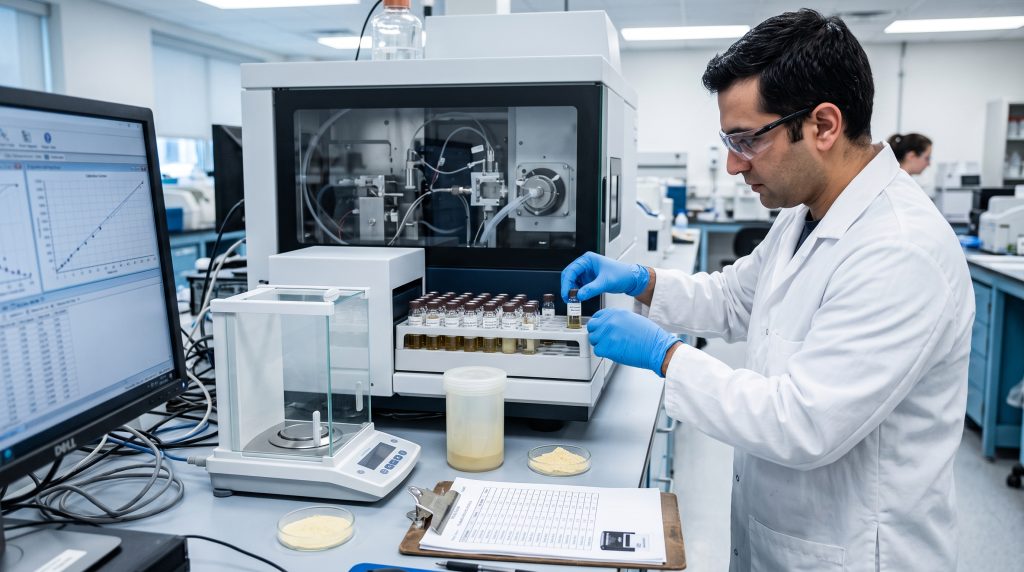
Your vendor approval checklist must mandate Inductively Coupled Plasma Mass Spectrometry (ICP-MS) for all heavy metal testing. ICP-MS can detect multiple elements simultaneously at exceedingly low concentrations. If the supplier’s COA simply states “Heavy Metals: Pass” without listing the specific ppm limits and the ICP-MS methodology, the document should be immediately rejected. This rigorous document validation mirrors the exact processes procurement teams use when auditing carbohydrate purity, as seen in our resistant dextrin COA and solubility procurement guide.
Beyond Metals: Pesticides, Glyphosate, and Mycotoxins
While heavy metals dominate the legal headlines, agricultural chemical residues present an equally severe threat to a clean-label protein brand.
Glyphosate Desiccation: Many farmers spray yellow peas with glyphosate just before harvest to dry the crop evenly. This leaves massive chemical residues on the hull. QA teams must demand third-party testing proving Glyphosate levels are < 0.01 ppm (the limit of quantification).
Mycotoxins (Aflatoxin & Ochratoxin A): If raw peas are stored in humid, poorly ventilated silos prior to milling, mold will rapidly develop and excrete toxic mycotoxins. These toxins survive the heat of pasteurization and milling. COAs must explicitly show Aflatoxin limits below 20 ppb.
Selecting a premium extraction grade is one of the best ways to mitigate these physical contaminants, as the aggressive washing required for higher purities strips away residual hulls and dust. Compare these processing differences in our pea protein isolate 80% vs 85% grade selection guide. Furthermore, ensuring the facility is free from biological cross-contact is just as crucial, requiring a strict allergen management facility audit.
Secure Your Brand with the Amerta Pacific Standard
Do not let unverified agricultural sourcing expose your food or beverage brand to toxicological risk and devastating legal penalties. Amerta Pacific supplies ultra-pure pea protein isolate backed by uncompromising, lot-specific analytical testing.
The Amerta Pacific QA Guarantee
Geographical Sourcing Control: We source our yellow peas exclusively from pristine, low-industrial agricultural zones with documented low soil heavy metal baselines.
Third-Party ICP-MS Verification: Every production lot is tested by accredited independent laboratories using advanced ICP-MS, ensuring you have the exact quantitative data needed to prove Prop 65 and EU compliance.
Zero-Tolerance Chemical Protocols: Our isolates are guaranteed free from glyphosate residues, harmful pesticides, and dangerous mycotoxins.
Ready to upgrade your protein sourcing and protect your supply chain? Contact the Amerta Pacific Quality Assurance Team today to request a comprehensive Supplier Audit Packet, review our latest batch COAs, or order certified trial samples for your own lab verification.
Frequently Asked Questions (FAQ)
Q: Will sourcing “Certified Organic” pea protein guarantee that it is free from heavy metals? A: No. Organic certification governs farming practices (prohibiting synthetic pesticides and fertilizers), but it does not account for the natural geological presence of heavy metals in the soil. An organic pea protein can still easily fail Prop 65 lead limits if grown in metal-rich soil.
Q: Can heavy metals be removed from pea protein during the factory milling process? A: Mostly, no. Heavy metals bind tightly to the protein matrix itself at a cellular level. While aggressive de-hulling removes cadmium that sits on the seed coat, lead and arsenic absorbed through the roots cannot be “washed” out. Procurement must solve this at the agricultural sourcing level.
Q: How does Prop 65 differ from FDA limits for heavy metals? A: The US FDA generally sets limits based on acute toxicity and broad dietary exposure. California’s Proposition 65 sets limits based on Maximum Allowable Dose Levels (MADL) for reproductive toxicity, which are exponentially stricter (often measured in micrograms per day) than federal FDA guidelines.
Q: What does the term “Limit of Quantification” (LOQ) mean on my supplier’s COA? A: The LOQ is the lowest concentration of a heavy metal that the testing equipment (like ICP-MS) can reliably measure. QA teams should require an LOQ of at least 0.01 ppm to confidently clear Prop 65 thresholds.
Partner with Amerta Pacific for Uncompromising QA
Do not let unverified agricultural sourcing expose your food or beverage brand to toxicological risk and devastating legal penalties. Amerta Pacific supplies ultra-pure pea protein isolate backed by uncompromising, lot-specific analytical testing.
The Amerta Pacific QA Guarantee:
Geographical Sourcing Control: We source our yellow peas exclusively from pristine agricultural zones with documented low soil heavy metal baselines.
Third-Party ICP-MS Verification: Every production lot is tested using advanced ICP-MS, ensuring you have the exact quantitative data needed to prove Prop 65 and EU compliance.
Zero-Tolerance Chemical Protocols: Our isolates are guaranteed free from glyphosate residues, harmful pesticides, and dangerous mycotoxins.
Ready to upgrade your protein sourcing and protect your supply chain? Contact the Amerta Pacific Quality Assurance Team today to request a comprehensive Supplier Audit Packet, review our latest batch COAs, or order certified trial samples for your own lab verification.