
Pea Protein Isolate 80% vs 85%: How to Choose the Right Grade for Your Production Budget and Application
In the fast-scaling plant-based nutrition sector, procurement managers and R&D teams constantly balance raw material costs with strict functional performance standards. When sourcing yellow pea protein isolate (Pisum sativum), the choice often narrows down to two industry benchmarks: 80% protein isolate and 85% protein isolate (measured on a dry basis). While a 5% difference in protein concentration might seem small on paper, it introduces distinct trade-offs in yield, solubility, organoleptic profile, and cost per batch. Understanding these differences allows food manufacturers to optimize their formulations without overspending on unnecessary specifications.
Direct Answer: Choosing between 80% and 85% pea protein isolate depends on your application’s sensitivity to viscosity, flavor, and target protein claims. The 80% grade offers a cost-effective solution for solid matrixes like bakery and meat analogs, while the 85% grade provides the high solubility, neutral taste, and low ash content needed for clear RTD beverages and premium supplements.
Technical Comparison: What Does the 5% Difference Represent?
The distinction between 80% and 85% pea protein isolate stems from the depth of the extraction and purification process. Achieving an 85% concentration requires additional washing and separation phases to remove native lipids, carbohydrates, ash, and anti-nutritional factors.
Analytical Specification Matrix
Below is a standard specification benchmark comparing both grades:
| Technical Parameter | Pea Protein Isolate 80% | Pea Protein Isolate 85% | Production Impact |
| Protein Content (Dry Basis) | ≥ 80.0% | ≥ 85.0% | 85% grade requires lower inclusion weight to hit label protein targets. |
| Nitrogen Solubility Index (NSI) | 60% – 70% | 75% – 85% | 85% grade disperses much faster in liquid matrices. |
| Ash / Mineral Content | ≤ 6.0% | ≤ 4.5% | Lower ash in 85% grade reduces salty or metallic off-notes. |
| Fat Content | ≤ 8.0% | ≤ 3.0% | Lower fat in 85% grade improves shelf-life stability and flavor clarity. |
| Price Point / Metric Ton | Baseline (Cost-Optimized) | Premium (+10% to +18%) | Direct impact on overall cost of goods sold (COGS). |
Application Matching: Selecting the Grade for Your Product Line
Over-specifying your raw materials can erode profit margins, while under-specifying can lead to processing failures and consumer complaints. Matching the ingredient grade to the end product’s physical structure is critical for operational efficiency.
When to Use Pea Protein Isolate 80% (Cost-Optimized Applications)
The 80% grade is the workhorse of the plant-based ingredient world. It shines in solid and semi-solid food systems where high solubility is not mandatory, and where slightly higher natural fat content enhances mouthfeel:
Meat Analogs & Extruded Formulations: The higher lipid and carbohydrate matrix helps bind water and fat during high-moisture extrusion (HMEC), as detailed in our guide on pea protein isolate meat analog texture optimization.
Industrial Bakery & Snacks: Ideal for fortifying cookies, crackers, and high-protein breads where thermal baking naturally masks subtle earthy flavor notes.
Powdered Meal Replacements: Works well in complex blended powders that use strong cocoa, peanut, or vanilla flavor systems to mask inherent leguminous notes.
When to Use Pea Protein Isolate 85% (High-Performance Applications)
The 85% grade is designed for delicate, high-concentration formulations where physical performance and clean sensory profiles are essential:
Ready-to-Drink (RTD) Sports Beverages: High NSI values prevent gritty sedimentation at the bottom of bottles and lower viscosity prevents chalkiness, making it essential for sports nutrition RTD BCAA formulations.
Dairy Alternatives: Essential for spoonable yogurts and plant-based milks where high purity prevents curdling during heat treatment.
Premium Clean-Label Products: Lower overall fat content reduces the risk of lipid oxidation over time, preserving a neutral flavor profile without requiring synthetic antioxidants.
For a deeper look into our physical extraction methods and purity standards, view our breakdown on Amerta Pacific Ingredient Analysis.
Procurement Strategy: Calculating True Formulation Costs
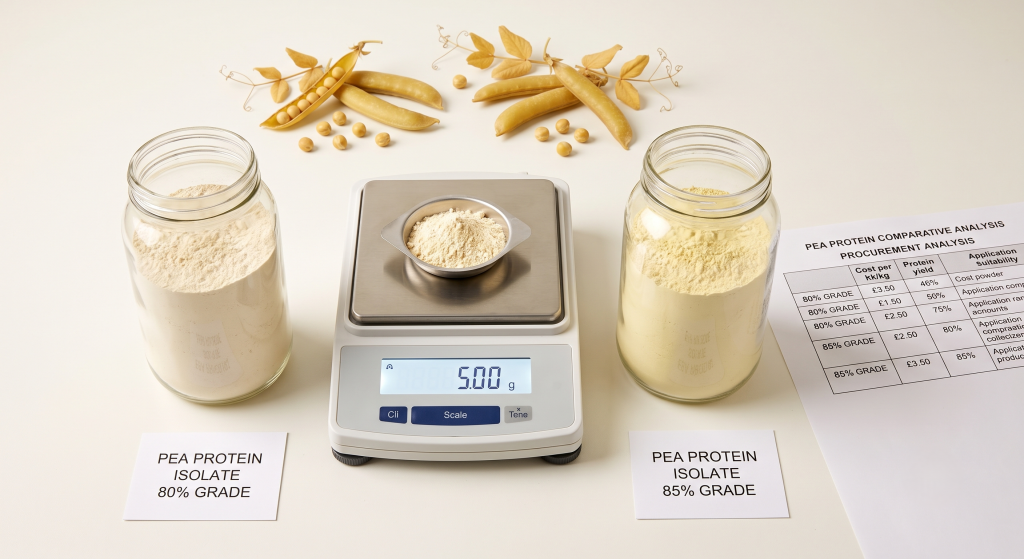
When reviewing supplier quotes, purchasing directors should look beyond the sticker price per metric ton. Evaluating ingredients based on cost per unit of active protein yields a clearer picture of value.
Strategic Sourcing Considerations
Dosing Efficiency: Because the 85% grade contains more protein per gram, you use less total ingredient to hit front-of-pack claims (e.g., “20g protein per serving”). This leaves more space in the formulation for other active ingredients or fillers.
Freight and Storage Savings: Shipping higher-purity ingredients means you pay less freight per unit of active protein, supporting broader initiatives like calculating sustainability ROI with pea protein sourcing.
Yield Consistency: Higher-purity isolates generally feature tighter batch-to-batch consistency, reducing time spent recalibrating automated dosing equipment on the factory floor.
Why Food Manufacturers Source Pea Protein from Amerta Pacific
Whether your facility requires high-volume 80% isolate for extrusion or high-solubility 85% isolate for beverage lines, Amerta Pacific offers dependable supply streams backed by rigorous quality assurance.
The Amerta Pacific Supply Advantage
Proprietary Physical Purification: Our non-chemical extraction preserves natural functional properties without leaving solvent residues.
Strict Heavy Metal Screening: Every lot is tested to ensure compliance with strict international food safety standards.
Tailored Contract Sourcing: We offer flexible supply contracts, consistent batch lot allocation, and door-to-door export handling to keep your production runs moving on schedule.
Frequently Asked Questions (FAQ)
Q: Is there a taste difference between 80% and 85% pea protein isolate? A: Yes. The additional washing steps used to produce the 85% grade remove more volatile organic compounds (such as hexanals), resulting in a noticeably milder, less “beany” flavor profile than the 80% grade.
Q: Can I blend 80% and 85% pea protein isolates in a single formulation? A: Absolutely. Many R&D teams blend both grades to achieve an optimal balance between target viscosity, flavor profile, and raw material cost.
Q: Do both grades carry the same allergen-free status? A: Yes. Both 80% and 85% pea protein isolates from Amerta Pacific are naturally non-GMO, gluten-free, soy-free, and major allergen-free.
Q: How does the gelling property compare between the two grades? A: The 85% grade typically forms a clearer, firmer gel upon heating due to its higher protein concentration and lower lipid interference, making it better suited for structured gel matrices.
Streamline Your Ingredient Sourcing with Amerta Pacific
Selecting the right pea protein grade doesn’t have to involve trial and error. Amerta Pacific supplies high-purity pea protein isolates tailored to meet your target functional needs and production budget.
Ready to evaluate both grades for your next pilot batch? Contact the Amerta Pacific Procurement Team today to request a technical data sheet (TDS), compare pricing structures, or order bench-test sample kits.