
Cassava Flour in Gluten-Free Cookie and Biscuit Manufacturing: Dough Handling, Spread Control, and Snap Texture
In industrial biscuit and cookie manufacturing, removing wheat gluten disrupts the structural mechanics of the entire baking line. Traditional soft wheat flour provides a balanced starch-protein matrix that allows doughs to release cleanly from rotary molds, hold geometric definition on wire-cut lines, and bake to a precise diameter and stack height. When R&D teams formulate gluten-free cookies using rice or corn flours, they frequently encounter sticky doughs that foul die rolls, excessive oven spread that causes cookies to fuse on the baking band, and a gritty, sandy mouthfeel. Cassava flour (Manihot esculenta) solves these operational challenges by acting as a single-ingredient, clean-label wheat flour replacement. Milled from the whole peeled root, its natural fiber structure and low gelatinization temperature deliver the dough cohesion, spread control, and crisp “snap” required for high-speed commercial bakeries.
Direct Answer: Cassava flour optimizes gluten-free cookie and biscuit manufacturing by providing high cold-water absorption and rapid starch gelatinization during baking. This sets the dough structure early in the oven tunnel to control lateral spread, prevents sticking on rotary molders and wire-cut machines, and creates a crisp, non-gritty snap texture that resists post-baking breakage.
Dough Rheology and Machineability: Rotary Molding, Wire-Cut, and Sheeting
Industrial biscuit lines operate on tight mechanical tolerances. A dough must be cohesive enough to hold together under pressure, yet non-elastic enough to release cleanly from engraved brass rollers or wire-cut dies.
Eliminating Stickiness and Die Fouling
Unlike extracted pure starches, whole cassava flour retains approximately 2% to 4% native dietary fiber alongside its starch granules. This cellular fiber network absorbs free water rapidly during the mixing phase, creating a short, pliable dough with low tackiness.
Rotary Molded Biscuits: Cassava flour forms a cohesive mass that compresses cleanly into intricate mold cavities and releases onto the cotton extraction web without “tailing” or leaving dough plugs behind.
Wire-Cut Cookies: In higher-fat, higher-sugar wire-cut formulations, cassava flour prevents the dough from smearing across the cutting wire, ensuring uniform piece weights and clean edge definition.
Laminated and Sheeted Crackers: The natural hydrocolloid binding capacity of cassava prevents sheet tearing on continuous gauge rollers, utilizing the same structural mechanics detailed in our guide to cassava flour in gluten-free tortilla and flatbread manufacturing.
Oven Spread Control: Dimensional Stability for Automated Packaging
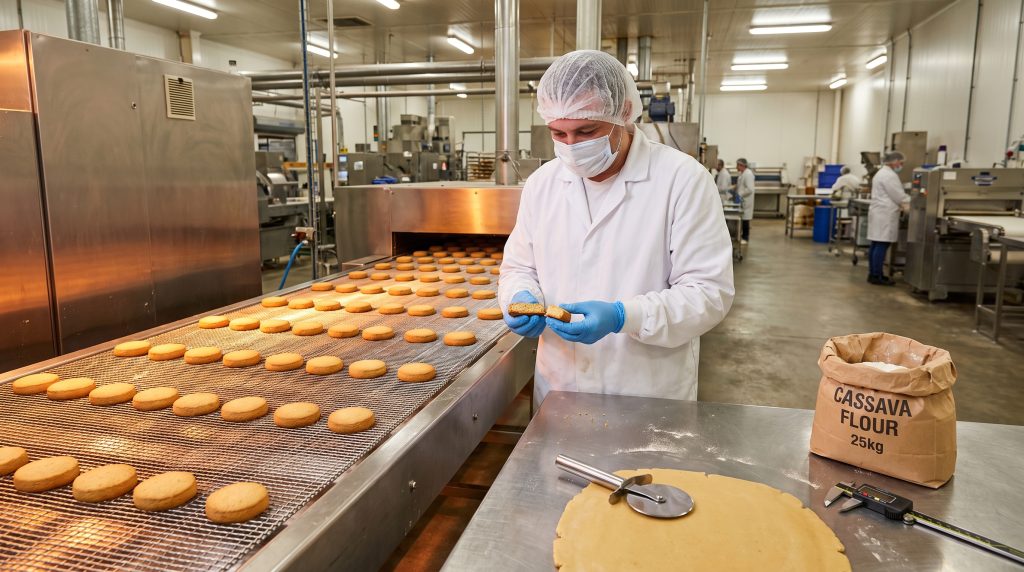
For biscuit manufacturers, controlling the “spread factor” (the ratio of cookie diameter to thickness) is critical. If a cookie spreads by even two millimeters beyond specification in the oven tunnel, the finished pieces will jam automated flow-wrappers, chute feeders, and tray loaders.
Thermal Setting Mechanics vs. Cereal Flours
Cookie spread occurs during the first stage of baking as solid fats melt and dissolved sugars lower the dough viscosity, causing the dough puck to expand outward until starch gelatinization and protein coagulation arrest the flow. Because rice and corn flours have high gelatinization temperatures (70°C to 85°C), the dough spreads excessively before the structure sets.
Cassava flour gelatinizes at a significantly lower temperature (62°C to 72°C). As the dough enters the first heat zone of the tunnel oven, the cassava starch swells early, rapidly increasing internal dough viscosity and locking the cookie’s diameter and stack height in place.
| Functional Parameter | Cassava Flour Base | White Rice Flour Base | Soft Wheat Flour (Control) |
| Gelatinization Temp. | 62°C – 72°C | 72°C – 82°C | 58°C – 65°C |
| Oven Spread Factor | Controlled / Predictable | Excessive (Flat, thin edges) | Standard Baseline |
| Mouthfeel & Bite | Crisp snap / Clean melt | Gritty / Sandy / Hard | Crisp / Tender crumb |
| Hydrocolloid Requirement | None to Minimal (0% – 0.2%) | High (Requires Xanthan/Guar) | None |
| Water Absorption | High (Requires +5%–10% hydration) | Low (Prone to dry batter) | Standard |
Engineering the "Snap" Texture and Preventing Checking
A premium biscuit requires an audible “snap” upon biting, followed by a smooth meltaway on the palate. However, gluten-free biscuits are notoriously prone to “checking”—the formation of microscopic hairline cracks as the biscuit cools after exiting the oven, which leads to catastrophic breakage during shipping.
Moisture Equilibration and Structural Integrity
Checking is caused by moisture gradients within the baked biscuit; the dry outer rim contracts faster than the moist center, pulling the structure apart. Because cassava flour has a high amylopectin-to-amylose ratio (~83:17), it forms a more flexible, amorphous glass matrix upon cooling compared to high-amylose grain flours.
This structural flexibility accommodates internal moisture equilibration after baking, virtually eliminating hairline checking. Furthermore, keeping the finished biscuit crisp over a 6-to-12-month shelf life requires strict control over raw material water activity and packaging barriers, building directly on the principles covered in our manual on cassava flour shelf life, moisture control, and storage protocols. This resistance to mechanical breakage in transit also makes cassava the premier base when scaling ethnic and traditional food manufacturing for export.
Quality Specifications for Bakery Procurement Managers
To maintain consistent spread rates and baking times across production shifts, procurement managers must enforce tight physical and chemical tolerances on incoming cassava flour shipments.
Critical COA Parameters for Biscuit Lines
Particle Size Distribution: >99% passing through a 100-mesh sieve (< 149 microns). Ultra-fine milling is mandatory to prevent a gritty mouthfeel in high-fat shortbreads and butter cookies.
Moisture Content: 10.0% – 12.0%. Uniform moisture ensures consistent dough hydration weights without requiring constant mixer water adjustments.
pH Level: 5.5 – 6.8. A neutral pH is vital in bakery applications; an overly acidic flour (caused by wild fermentation during poor drying) will prematurely trigger sodium bicarbonate leavening in the mixer rather than in the oven.
Whiteness Index: >88%. Ensures a clean, bright base that undergoes predictable, golden Maillard browning when paired with reducing sugars.
Why Industrial Bakeries Partner with Amerta Pacific
Scaling gluten-free cookie and biscuit lines requires an ingredient partner that eliminates raw material variability. Amerta Pacific supplies premium, bakery-grade cassava flour engineered for high-speed automated dough handling and precise thermal performance.
The Amerta Pacific Bakery Advantage
Unfermented, Neutral pH: Our rapid flash-drying process prevents wild fermentation, delivering a neutral pH flour that never interferes with your chemical leavening systems (baking soda/ammonium bicarbonate).
Micro-Milled Smoothness: Precision-milled to 100-mesh standards, guaranteeing zero grittiness and smooth release from rotary dies.
Scalable B2B Supply: Available in 25 kg multi-wall bags and 1,000 kg FIBC bulk totes with full GFSI-aligned safety certifications, Non-GMO verification, and lot-specific COAs.
Frequently Asked Questions (FAQ)
Q: Do I need to add xanthan gum or guar gum when baking cookies with cassava flour? A: In most rotary-molded and wire-cut cookie formulations, no. Because cassava flour has high natural water-binding capacity and high amylopectin content, it provides sufficient dough cohesion and structure on its own, allowing you to eliminate expensive gums from your ingredient label.
Q: How do I adjust fat and water levels when replacing wheat flour 1:1 with cassava flour? A: Because cassava flour absorbs more water than soft pastry wheat flour, R&D teams typically need to increase dough hydration by 5% to 10% (or slightly increase the liquid egg/fat phase) to achieve the exact same dough machinability and viscosity.
Q: Can cassava flour be used for both hard sweet biscuits and soft-baked chewy cookies? A: Yes. For hard, snappy biscuits, bake to a low final moisture content (1.5%–2.5%). For soft-baked chewy cookies, pair cassava flour with humectants (such as invert sugar syrup or soluble tapioca fiber) and pull the cookies at a slightly higher moisture threshold (6%–8%); the low retrogradation rate of cassava will keep the cookie soft over its shelf life.
Q: Why are my cassava flour cookies browning faster than my wheat control? A: If your cassava flour has a high residual simple sugar content from specific root cultivars, it can accelerate Maillard browning. Sourcing a standardized, washed cassava flour and lowering the final oven zone temperature by 5°C to 8°C will restore a golden-blonde color profile.
Upgrade Your Gluten-Free Bakery Line with Amerta Pacific
Eliminate sticky doughs, lock in precise cookie dimensions, and deliver the crisp, clean snap consumers expect from premium biscuits. Amerta Pacific provides the standardized, ultra-fine cassava flour your industrial bakery needs to scale gluten-free production profitably.
Ready to test our bakery-grade cassava flour on your production line? Contact the Amerta Pacific Bakery Technical Team today to request a Technical Data Sheet (TDS), review granulometry and pH specifications, or order trial samples for your R&D test bakery.