
Pea Protein Isolate Heat Stability in Retort and UHT Processing: Preventing Gelation and Sedimentation in Shelf-Stable Products
Pea protein isolate requires precise buffer calibration, high-shear homogenization, and optimized pH management to survive the extreme thermal stress of Ultra-High Temperature (UHT) and retort processing without irreversibly gelling or precipitating. When formulating shelf-stable plant-based milks, protein shakes, and clinical liquid diets, process engineers must control the thermal denaturation of pea globulins to maintain a smooth, low-viscosity suspension over a prolonged ambient shelf life.
Direct Answer: To prevent gelation and sedimentation during UHT (>135°C) or retort (121°C) processing, formulators must utilize a highly soluble pea protein isolate, stabilize the liquid matrix with buffer salts (like dipotassium phosphate) to maintain a neutral pH, and employ dual-stage homogenization to minimize particle size before and after thermal shock.
Thermal Denaturation Mechanics: Why Plant Proteins Gel
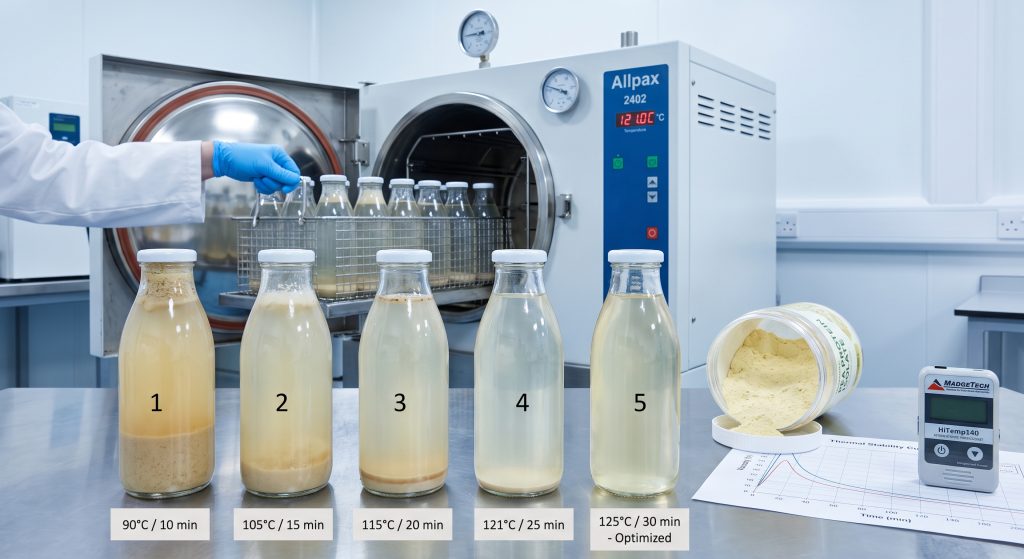
Native pea protein consists primarily of legumin (11S) and vicilin (7S) globulins. At ambient temperatures, these proteins remain tightly folded. However, when subjected to the intense heat profiles of industrial sterilization, the protein structures rapidly unfold, exposing hydrophobic core regions.
If unmanaged, these unfolded proteins cross-link with one another, forming a rigid three-dimensional gel network within the holding tubes of a UHT plant. This catastrophic viscosity spike can foul heat exchangers, halt production lines, and result in a coagulated, unmarketable beverage. Managing this unfolding process is the foundational challenge of thermal processing, directly building upon the baseline hydration principles outlined in our guide on pea protein isolate solubility and dispersibility in RTD beverages.
Process Engineering: Buffers, Homogenization, and Hydrocolloids
Preventing thermal aggregation requires a multi-pronged formulation strategy that stabilizes the protein before it enters the heat exchanger.
Critical Mitigation Strategies
| Processing Defect | Primary Cause | R&D Formulation Solution |
| Heat-Induced Gelation | Uncontrolled protein cross-linking at >90°C. | Add chelating buffer salts (citrates/phosphates) to adjust pH away from the isoelectric point (pH 4.5) to a stable 7.0–7.4. |
| Sedimentation (Sludge) | Agglomerated protein particles falling out of suspension. | Utilize dual-stage homogenization (e.g., 200/50 bar) post-heating to shear aggregated proteins back into micro-particles. |
| Flocculation (Separation) | Electrostatic instability in the liquid matrix. | Introduce a yield-stress hydrocolloid (gellan gum) to permanently suspend the protein particulates. |
| Maillard Browning | Protein reacting with reducing sugars under high heat. | Use non-reducing sweeteners or pair with thermally resilient bulkers sourced from a high-stability soluble tapioca fiber supplier. |
Applying these buffer strategies ensures your liquid matrix remains fluid, which is highly critical when formulating high-density pea protein isolate in sports nutrition RTD BCAA products.
Raw Material Selection: The Importance of Isolate Purity
Process engineering cannot fix a fundamentally incompatible raw material. Standard 80% pea protein isolates often contain residual starches and insoluble fibers that swell uncontrollably under UHT conditions, exacerbating viscosity issues.
For thermal liquid processing, a highly refined 85% pea protein isolate is mandatory. The advanced filtration used to achieve this purity removes the insoluble fractions, resulting in a protein base with a higher Nitrogen Solubility Index (NSI) and superior thermal resilience. This same structural purity is required when creating fermented matrices, as seen in formulations utilizing pea protein isolate in functional yogurt and dairy alternatives.
Why Beverage Manufacturers Source from Amerta Pacific
Formulating shelf-stable liquid nutrition requires an ingredient partner who understands the mechanical tolerances of industrial UHT and retort systems. Amerta Pacific supplies ultra-refined, high-solubility pea protein isolate engineered to withstand commercial sterilization.
The Amerta Pacific UHT Advantage
High Thermal Stability: Our isolates are processed to maintain structural integrity under extreme heat, preventing heat exchanger fouling.
Micro-Particulated Mesh: Exceptionally fine particle sizes ensure rapid dispersion and prevent gritty sedimentation during prolonged ambient storage.
Clean Flavor Profile: Advanced extraction removes volatile off-notes that are typically exacerbated by high-heat processing, preserving your delicate flavor systems.
Frequently Asked Questions (FAQ)
Q: Can I process acidic pea protein beverages (pH < 4.5) through a UHT line? A: Processing native pea protein at an acidic pH is highly problematic, as it approaches the protein’s isoelectric point where solubility is lowest, causing immediate precipitation upon heating. Acidic RTD beverages require specially hydrolyzed pea proteins or advanced encapsulation technology.
Q: Does retort processing (canning) affect pea protein differently than UHT? A: Retort processing subjects the product to a lower temperature (typically 121°C) but for a significantly longer duration (15 to 40 minutes) compared to the rapid flash-heating of UHT. This prolonged heat exposure increases the risk of Maillard browning and nutritional degradation, requiring strict buffer control.
Q: Why do I need dipotassium phosphate in my UHT plant milk? A: Dipotassium phosphate acts as a powerful buffer and chelating agent. It binds free calcium ions and stabilizes the pH of the beverage, preventing the pea proteins from coagulating when they hit the extreme heat of the sterilizer.
Q: Should homogenization occur before or after UHT heating? A: For high-protein plant beverages, dual-stage homogenization is typically recommended after the UHT heating step (downstream). This breaks apart any protein aggregates that formed during thermal shock, ensuring a silky, smooth mouthfeel in the final package.
Secure Your UHT Processing with Amerta Pacific
Do not let heat-induced gelation or sedimentation ruin your shelf-stable beverage lines. Amerta Pacific delivers the ultra-refined, high-solubility pea protein isolate required to formulate premium, smooth, and thermally resilient RTD beverages.
Ready to optimize your liquid formulations for UHT and retort? Contact the Amerta Pacific Ingredient Specialists today to request a Technical Data Sheet (TDS), review thermal stability specifications, or order bench-test samples to run through your pilot plant homogenizer.