
Tapioca Starch vs. Corn Starch: Which Should Your Factory Be Buying in 2026?
For procurement managers and directors in the food, textile, and paper industries, the choice between tapioca starch and corn starch is no longer just about price per ton. As we move through 2026, shifting consumer demands for “clean label” ingredients and the need for superior functional performance have changed the landscape. While both are primary thickening agents, their molecular structures offer vastly different results on the production line.
The Direct Answer: Which is Better for Industrial Use?
For 2026 industrial manufacturing, tapioca starch is the superior choice over corn starch due to its higher freeze-thaw stability, neutral flavor profile, and clearer finish. While corn starch remains a traditional binder, tapioca offers better performance in clean-label products and gluten-free formulations, maximizing both quality and shelf-life.
Understanding the Functional Differences
To optimize your factory’s output, you must understand how these starches behave under heat, shear, and acid.
Viscosity and Texture
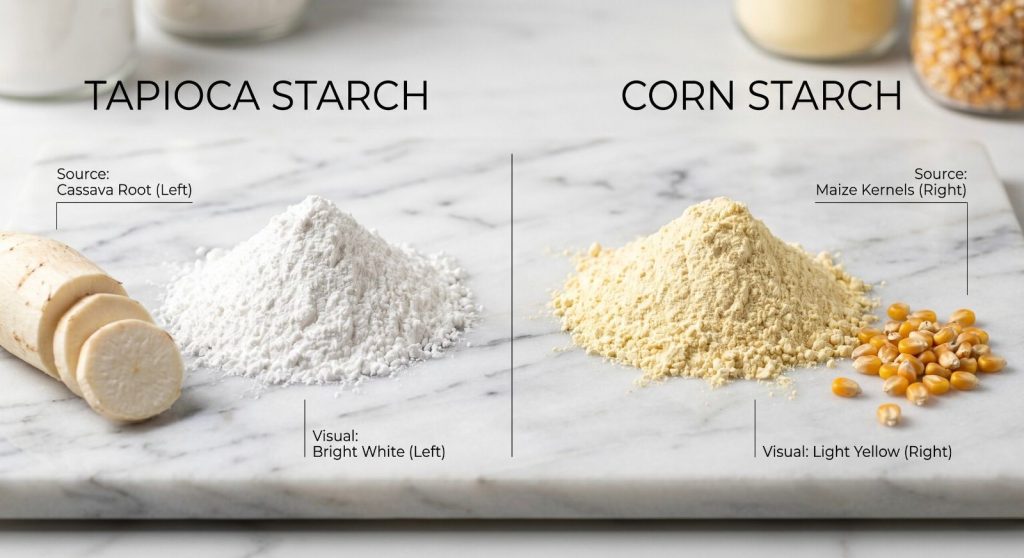
Tapioca starch (derived from the cassava root) reaches its peak viscosity faster and at a lower temperature than corn starch. It creates a smooth, translucent gel that is highly desirable in sauces, fillings, and adhesives. Conversely, corn starch creates an opaque, matte finish and a somewhat “short” or crumbly texture once cooled.
Flavor Profile and Clarity
One of the greatest pain points for food manufacturers is the “cereal” aftertaste often associated with corn starch. Tapioca starch is completely flavor-neutral. This allows your product’s intended flavors to shine without requiring masking agents. Furthermore, its high clarity makes it the gold standard for fruit fillings and high-end paper coatings.
Why Procurement Managers Are Pivoting to Tapioca in 2026
The global supply chain in 2026 rewards flexibility and quality. Here is why savvy Directors are shifting their bulk orders toward tapioca.
Superior Freeze-Thaw Stability: If your factory produces frozen foods, corn starch is a liability. It tends to “weep” (syneresis) when thawed. Tapioca starch maintains its molecular bond during temperature fluctuations, ensuring your product looks and tastes fresh after months in cold storage.
Non-GMO and Clean Label: Consumer sentiment in 2026 is hyper-focused on transparency. While much of the world’s corn supply is genetically modified, tapioca is naturally non-GMO. Transitioning to tapioca simplifies your marketing claims and satisfies strict regulatory requirements.
Gluten-Free Dominance: As the gluten-free market continues its decade-long expansion, tapioca starch has become the foundational ingredient for high-quality flour blends, providing the “chew” that corn starch lacks.
Industrial Performance Comparison
| Feature | Tapioca Starch | Corn Starch |
| Clarity | High / Transparent | Low / Opaque |
| Flavor | Neutral | Slight Cereal Taste |
| Texture | Stringy / Smooth | Short / Heavy |
| Freeze-Thaw | Excellent | Poor |
| Gelling Temp | Low (59-70°C) | High (75-80°C) |
Read also for : 4 Clean-Label Thickening Agents for Gluten-Free Baking in 2026
Financial Analysis: The ROI of Starch Selection
From a procurement perspective, corn starch often appears cheaper on a raw commodity sheet. However, a Senior SEO Strategist and Procurement Director must look at the Total Cost of Quality (TCQ).
Using inferior corn starch in high-moisture applications often leads to higher spoilage rates, product recalls due to texture degradation, and the need for additional stabilizers (which increases your ingredient list and cost). By sourcing high-purity tapioca starch, factories often reduce the need for secondary additives, effectively lowering the cost per unit while elevating the premium status of the end product.
Sourcing Excellence with Amerta Pacific
At Amerta Pacific, we understand that your factory’s reputation relies on the consistency of your raw materials. We specialize in the high-volume supply of premium tapioca starch, meticulously processed to meet the rigorous standards of 2026’s global market.
Our tapioca starch offers:
- Unmatched Purity: Minimized protein and lipid content for maximum clarity.
- Supply Chain Security: Reliable bulk fulfillment to keep your production lines running without interruption.
- Expert Consulting: We don’t just ship pallets; we help your R&D team determine the exact mesh size and viscosity profile needed for your specific machinery.
Whether you are reformulating an existing line or launching a new 2026 product series, Amerta Pacific is the bridge between raw cassava excellence and your factory’s success.
Frequently Asked Questions (FAQ)
Q: Can I replace corn starch with tapioca starch 1:1? A: In most industrial applications, a 1:1 ratio works well, but because tapioca has higher thickening power, you may actually be able to reduce the total starch volume by 10-15% to achieve the same viscosity, saving on long-term costs.
Q: Is tapioca starch more sustainable than corn starch? A: Yes. Cassava plants require fewer pesticides and less water than industrial corn crops. For factories looking to hit 2026 ESG (Environmental, Social, and Governance) targets, switching to Amerta Pacific’s tapioca is a significant step forward.
Q: How does tapioca starch affect the shelf life of baked goods? A: Tapioca starch helps retain moisture more effectively than corn starch, preventing staling and extending the shelf life of packaged baked goods.
Upgrade Your Production Standard Today
Stop settling for the limitations of traditional fillers. In 2026, the competitive edge belongs to factories that prioritize ingredient performance and consumer trust.
Ready to optimize your supply chain? Contact Amerta Pacific today for a custom quote on bulk tapioca starch and discover how our quality standards can transform your bottom line.