
Tapioca Starch in Paper and Textile Industry: Non-Food B2B Applications and Industrial Grade Sourcing Guide
While tapioca starch is widely recognized for its food-grade texturizing properties, its high binding capacity, film-forming ability, and cost efficiency make it a critical raw material in heavy industrial applications. In paper mills and textile manufacturing facilities, industrial-grade tapioca starch (extracted from Manihot esculenta) serves as a high-performance binder, surface sizing agent, and warp sizing component. For procurement managers and industrial purchasing directors, transitioning from corn or potato starches to tapioca offers distinct rheological advantages that improve machine speeds, reduce fiber breakage, and optimize overall plant operational expenditure (OpEx).
Direct Answer: Industrial tapioca starch enhances paper production by improving surface strength, internal fiber bonding, and printability during surface sizing. In textile manufacturing, it acts as a smooth, flexible warp sizing agent that increases yarn tensile strength, reduces abrasion during high-speed weaving, and washes out cleanly during desizing.
Tapioca Starch in Paper Manufacturing: Surface Sizing and Internal Binding
Modern high-speed paper machines demand surface sizing agents that provide high film clarity, consistent viscosity, and rapid water release during drying. Industrial tapioca starch fulfills these demands better than many cereal starches.
                  [Industrial Tapioca Starch Slurry]
                                  │
         ┌────────────────────────┴────────────────────────┐
         ▼                                                 ▼
[Wet-End Internal Addition]                       [Surface Size Press]
 • Enhances dry strength (mullen)                  • Creates continuous surface film
 • Improves filler retention (PCC/GCC)             • Reduces linting & dusting
 • Increases burst & tensile index                 • Enhances ink holdout & printability
Key Processing Benefits for Paper Mills
Superior Surface Film Formation: Tapioca’s low amylose content (15%–18%) forms a clear, continuous film across the paper web, preventing ink feathering during offset or digital printing.
Higher Internal Fiber Bonding: When added at the wet end, native or cationic tapioca starch binds cellulose fibers and mineral fillers (like calcium carbonate), increasing the burst and tensile index of linerboard and packaging paper.
Low Retrogradation in Size Presses: Unlike corn starch, which can set back or gel as it cools in size press loops, tapioca starch maintains a stable fluid viscosity, preventing nozzle clogging and streak defects.
These high-performance binding characteristics build upon the same native starch rheology utilized in high-shear food systems, such as tapioca starch in instant noodle manufacturing.
Tapioca Starch in Textile Manufacturing: Warp Sizing and Finishing
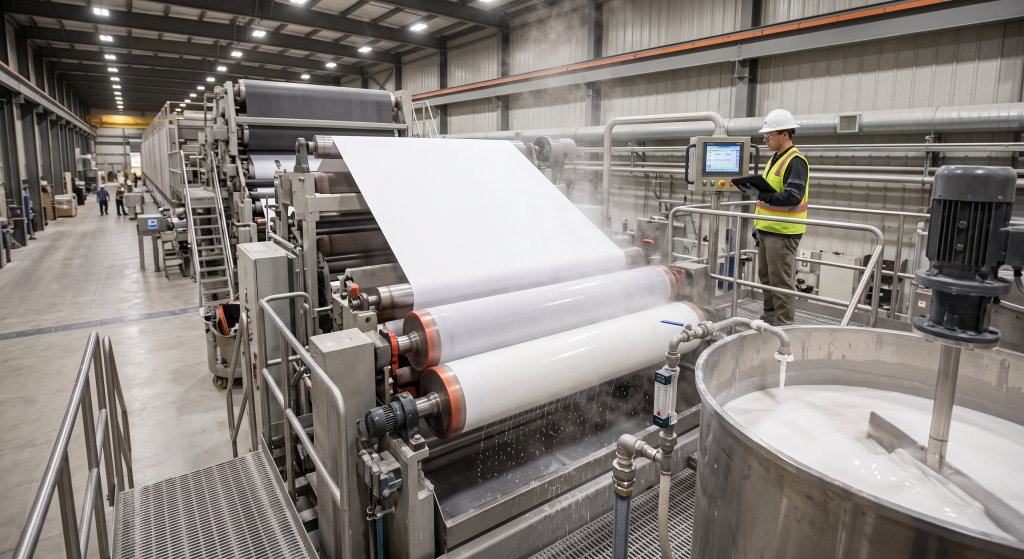
In high-speed shuttleless weaving, warp yarns endure extreme tension and friction. Applying a starch-based size protects the yarn from fraying and snapping.
Advantages of Tapioca in Warp Sizing
High Elasticity and Flexibility: Tapioca starch forms a tough, flexible coating around cotton, synthetic, or blended fibers. This film flexes with the yarn under mechanical strain rather than cracking off as dust.
Smooth Surface Finish: It lays down loose surface fibers, creating a smooth yarn profile that glides through harnesses and reeds without snagging.
Easiest Desizing Efficiency: Because tapioca starch gel is water-soluble and highly retrogradation-resistant, it washes off rapidly during the hot water desizing process, leaving zero harsh chemical residues behind before dyeing.
Technical Specification Benchmark for Industrial Grade Sourcing
Purchasing directors sourcing industrial-grade tapioca starch must look at distinct parameters compared to food-grade specifications. While microbiological purity requirements are relaxed, physical viscosity and purity parameters remain stringent to prevent processing equipment downtime.
Technical Procurement Checklist
| Technical Parameter | Industrial Paper/Textile Grade | Operational Significance |
| Starch Purity (Dry Basis) | ≥ 83.0% – 85.0% | High purity guarantees maximum film-forming efficiency. |
| Moisture Content | ≤ 13.5% | Prevents clumping during bulk pneumatic transport. |
| pH (10% Slurry) | 4.5 – 7.0 | Prevents corrosion in chemical preparation tanks. |
| Viscosity (6% solution) | 500 – 800 BU (Brabender Units) | Dictates penetration depth into yarn bundles or paper webs. |
| Pulp / Sand Residue | ≤ 0.20% | Minimizes blade wear on paper coaters and size presses. |
| Whiteness Index | ≥ 88% – 90% | Preserves brightness in high-grade printing papers. |
Adopting natural, renewable cassava-based binders aligns industrial manufacturers with long-term ESG goals, supporting the industry-wide shift toward the future of clean label cassava ingredients.
Cost Optimization: Why Industrial Buyers Switch to Cassava
For large-scale paper mills and textile plants, raw material cost stability is paramount. Corn starch prices are frequently tied to volatile agricultural markets and biofuel demands. In contrast, cassava yields higher starch tonnage per hectare, offering a more stable price-to-performance ratio.
Much like the cost-saving strategies deployed in commercial food production—such as cassava starch cost optimization in sauce manufacturing—replacing potato or synthetic polymer sizes with industrial tapioca starch delivers substantial annual savings on raw materials without sacrificing tensile strength or sizing efficiency.
Why Global Industrial Manufacturers Partner with Amerta Pacific
Sourcing industrial starch at scale requires a supplier capable of handling multi-container export logistics, volume security, and consistent lot-to-lot specifications. Amerta Pacific supplies high-purity industrial tapioca starch tailored specifically for paper, textile, and adhesive manufacturing facilities.
The Amerta Pacific Supply Advantage
High Volume Scalability: We aggregate and process native cassava starch directly from primary farming hubs, ensuring uninterrupted supply for high-capacity industrial mills.
Customized Viscosity Grading: We provide tailored viscosity grades matching your exact cooker settings, whether your mill uses enzymatic conversion, thermal cooking, or chemical modification.
Seamless Export Logistics: We handle complete shipping logistics, container loading, and port documentation to keep your plant operating on schedule.
Frequently Asked Questions (FAQ)
Q: How does native tapioca starch compare to corn starch in paper size pressing? A: Tapioca starch has a lower gelatinization temperature and significantly higher film clarity than corn starch. It resists retrogradation better, ensuring a smoother size press application and fewer viscosity spikes in recycling loops.
Q: Can native tapioca starch be enzymatically modified on-site at paper mills? A: Yes. Native tapioca starch reacts predictably with standard alpha-amylase enzymes, allowing paper mill technicians to easily convert high-viscosity starch into low-viscosity surface sizing solutions on-site.
Q: Is industrial tapioca starch compatible with synthetic sizing agents like AKD or ASA? A: Absolutely. Tapioca starch works synergistically with Alkyl Ketene Dimer (AKD) and Alkenyl Succinic Anhydride (ASA) sizing agents, improving emulsion stability and overall sizing retention on the paper web.
Q: What packaging formats are available for high-volume industrial buyers? A: Amerta Pacific supplies industrial tapioca starch in standard 25 kg multi-wall paper bags, as well as 850 kg and 1,000 kg FIBC super sacks designed for automated bulk-unloading hoppers.
Power Your Industrial Operations with Amerta Pacific
Optimize your mill’s production efficiency, reduce yarn breakage, and lower your raw material costs with high-performance cassava solutions. Amerta Pacific delivers reliable, industrial-grade tapioca starch engineered to meet the demands of global paper and textile manufacturing.
Ready to secure volume supply contracts or evaluate technical specifications? Contact the Amerta Pacific Industrial Sales Team today to request technical datasheets, discuss contract pricing, or arrange industrial sample shipments for mill trials.