
Mastering Boba Production: How Tapioca Starch Drives QQ Texture and Shelf Stability
The global bubble tea boom has transformed boba (tapioca pearls) from a niche topping into an international foodservice commodity. For ingredient manufacturers and R&D teams, scaling pearl production while maintaining authentic quality is an ongoing challenge. Consumers demand a very specific sensory experience—a phenomenon known as the “QQ” texture, which describes a perfect equilibrium of softness, chewiness, and springy resistance. To achieve this on an industrial scale, tapioca starch is the non-negotiable core ingredient. Extracted from the cassava root, its unique viscoelastic properties allow manufacturers to extrude durable pearls that survive aggressive boiling, absorb rich syrups, and resist hardening in ice-cold milk teas.
Direct Answer: Tapioca starch acts as the primary structural polymer in boba manufacturing. When heated, its high amylopectin content forms an elastic, cohesive gel that creates the signature bouncy “QQ” texture. This highly cross-linked starch matrix prevents the pearl’s exterior from dissolving during boiling (cooking loss) and resists cold-temperature hardening (retrogradation) when submerged in iced beverages.
Decoding the Science of QQ: Viscoelasticity in Boba Dough
Achieving a bouncy, resilient chew without turning the pearl into a hard rubber ball requires precise control over starch gelatinization during the dough-mixing phase.
Unlike cereal starches (like corn or wheat) that form brittle, opaque pastes, native tapioca starch boasts a unique carbohydrate architecture: roughly 82% to 85% highly branched amylopectin. When tapioca starch is hydrated with boiling water in an industrial mixer, these branched networks swell and interlock. Rather than a rigid structure, they create a flexible, highly cohesive dough. As this dough is extruded and mechanically rolled into spheres, the amylopectin matrix provides the necessary tensile strength so the raw pearls maintain their perfect spherical geometry without cracking or crumbling on the conveyor belt.
This same viscoelastic elasticity is the primary driver behind the chewiness utilized in tapioca starch instant noodle manufacturing.
Eliminating Cooking Loss and Surface Sliminess
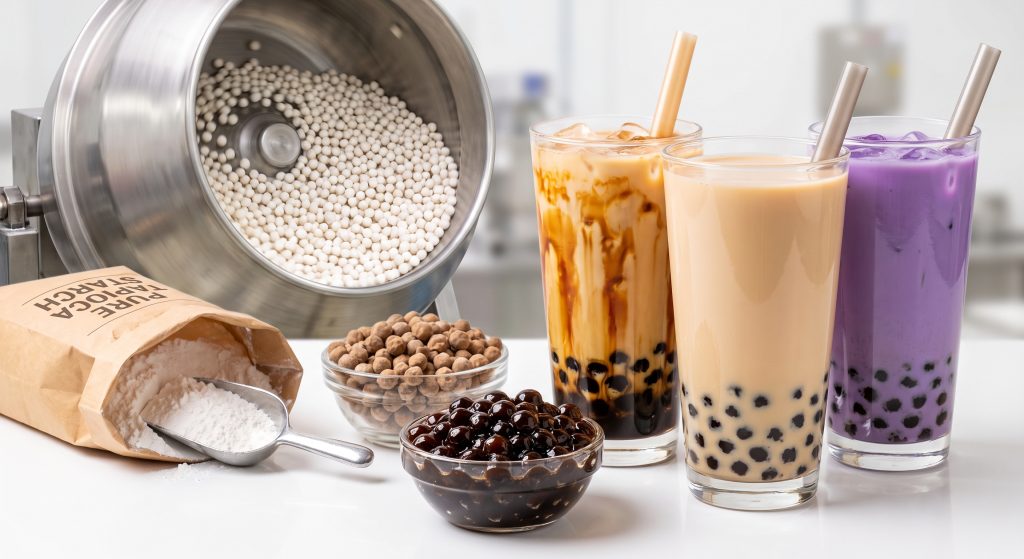
For bubble tea cafes, boiling boba is a labor-intensive daily operation. If a manufacturer cuts costs by blending tapioca with inferior starches, the pearls will suffer from severe “cooking loss” or sloughing.
When a low-quality pearl hits boiling water, its outer layers dissolve rapidly. This turns the boiling pot into a thick, cloudy sludge, leaving the remaining pearls misshapen, slimy, and glued together. Premium native tapioca starch solves this operational nightmare through rapid surface sealing:
Immediate Film Formation: At 100°C, high-purity tapioca starch instantly forms a tightly cross-linked surface barrier.
Moisture Entrapment: This exterior film locks the internal moisture inside the core, ensuring the pearl cooks evenly from the outside in.
High Syrup Uptake: A smooth, distinct, non-slimy exterior allows the cooked pearl to efficiently absorb and hold onto brown sugar or honey marinades, carrying those caramelized flavors directly into the consumer’s beverage.
These videos illustrate the industrial extrusion and rolling processes where dough consistency and surface tension are finalized before the boiling stage:
Surviving the Cold Tea Test: Halting Retrogradation
The ultimate quality check for a boba pearl happens at the bottom of an iced beverage. Cold temperatures accelerate starch retrogradation a chemical process where gelatinized starch molecules forcibly realign into rigid crystalline structures, squeezing out water and turning hard.
If a boba pearl retrogrades too quickly, its center becomes chalky and inedible within minutes of hitting the ice. Tapioca starch possesses a naturally low retrogradation rate compared to potato or maize starches. A properly formulated, 100% tapioca-based pearl will maintain a soft, chewy core for hours in cold milk tea, ensuring sensory perfection from the first sip to the last.
Utilizing clean, unmodified native tapioca to achieve this shelf stability aligns perfectly with modern consumer preferences, leading the future of clean label cassava as a hero ingredient.
Strict Procurement Specs for Automated Extrusion
For procurement managers sourcing tapioca starch for automated pearl manufacturing, relying on generic “food grade” labels is a recipe for jammed extruders and inconsistent doughs. You must verify strict physical parameters on the Certificate of Analysis (COA):
Peak Viscosity (700 – 900 BU): Verified via Brabender testing. A tightly controlled viscosity guarantees the dough achieves the exact tackiness needed for rolling without gumming up the cutting blades.
Moisture Content (<13.0%): Prevents microbiological growth during ocean transit and ensures precise dry-weight calculations when dosing water into commercial mixers.
Low Ash Content (<0.20%): Indicates a meticulous, multi-stage cyclone washing process that removes trace root fibers, preventing any gritty textures in the final pearl.
Neutral pH (5.0 – 7.0): An unfermented, neutral starch base will not interfere with the uptake of delicate fruit flavors, black tea extracts, or natural colorants.
Why Global Boba Manufacturers Source from Amerta Pacific
Scaling your boba production requires a starch supplier that treats rheology as a precise science. Amerta Pacific supplies premium, highly refined native tapioca starch engineered specifically to meet the extreme thermal and mechanical demands of the global bubble tea industry.
The Amerta Pacific Ingredient Advantage
Standardized Amylopectin Ratios: We select specific cassava cultivars to guarantee the exact viscoelasticity required for a flawless “QQ” bounce.
Absolute Flavor Neutrality: Our advanced extraction process strips away earthy off-notes, delivering an odorless base that lets your premium brown sugar and caramel syrups shine.
Uninterrupted Supply Chain: We support high-tonnage contract manufacturing with secure logistics, offering standard 25 kg bags and automated-ready ,1000 kg FIBC super sacks.
Frequently Asked Questions (FAQ)
Q: Why do my raw, dried tapioca pearls crack in the packaging before they are cooked? A: Cracking is typically caused by uneven hydration during dough mixing or an overly aggressive drying process. Using a finely milled, uniform tapioca starch ensures even water absorption, creating a cohesive dough that dries smoothly without internal stress fractures.
Q: Do I need to use modified starch to make instant or quick-cook boba? A: Traditional fresh-cooked boba relies entirely on native tapioca starch. However, for “instant” retail boba (which hydrates in under 3 minutes) or frozen microwavable pearls, formulators often blend native starch with hydroxypropylated modified tapioca starch to survive the freeze-thaw cycle and speed up hydration.
Q: Does native tapioca starch affect the color of black boba pearls? A: Native tapioca starch is naturally bright white. To achieve the iconic black boba appearance, manufacturers dose the dough with caramel color or dark brown sugar. A pure, bright white starch is essential because it absorbs these dark pigments uniformly without dulling the final sheen.
Q: How does tapioca starch impact the total boiling time? A: Native tapioca starch requires a rolling boil (100°C) to fully gelatinize the core of a standard 8mm pearl—typically requiring 20 to 30 minutes of boiling, followed by a steeping period. Its precise gelatinization threshold ensures the pearl cooks evenly without the exterior dissolving before the interior finishes.
Elevate Your Boba Production with Amerta Pacific
Do not let inconsistent starch quality ruin your brand with severe cooking loss or hard, chalky pearls. Amerta Pacific delivers the highly refined, viscoelastic tapioca starch required to manufacture authentic, market-leading boba.
Ready to lock in the ultimate QQ texture for your production line? Contact the Amerta Pacific Ingredient Specialists today to request a comprehensive Technical Data Sheet (TDS), review our Brabender viscosity curves, or order trial samples for your extrusion facility.