
How Soluble Tapioca Fiber Performs in Extruded Snacks and Puffed Cereal: A Process Engineering Guide
In high-temperature, short-time (HTST) extrusion cooking, maintaining a crisp texture, uniform cell structure, and an optimal expansion ratio is a delicate balancing act. When food manufacturers fortify extruded snacks and puffed cereals with traditional dietary fibers like bran or inulin, they frequently encounter processing failures, including collapsed cells, dense structures, and high machine wear. To overcome these limitations, process engineers and R&D teams are increasingly adopting soluble tapioca fiber (resistant dextrin). Produced via controlled enzymatic treatment of cassava starch, this highly functional ingredient allows brands to hit high-fiber targets without disrupting the melt rheology necessary for high-speed extrusion lines.
Direct Answer: Soluble tapioca fiber optimizes extruded snacks by maintaining melt fluidity and preventing premature starch gelatinization inside the extruder barrel. Its highly branched molecular structure supports uniform bubble nucleation at the die, ensuring excellent expansion, crispness, and structural stability in high-fiber puffed food systems.
Extrusion Mechanics: Overcoming the High-Fiber Expansion Barrier
Traditional insoluble fibers disrupt the continuous starch matrix inside an extruder, causing steam to escape prematurely and resulting in dense, unappealing textures. Soluble tapioca fiber behaves entirely differently due to its unique structural and physical properties.
Managing Melt Viscosity and Specific Mechanical Energy (SME)
During extrusion, raw material blends are subjected to high shear and temperatures exceeding 100°C. Soluble tapioca fiber exhibits low viscosity under these high-temperature conditions. This provides significant advantages on the factory floor:
Lower Specific Mechanical Energy (SME): The ingredient acts as a processing aid, reducing friction inside the barrel. This prevents motor overload and protects the mechanical integrity of the screws.
Controlled Water Binding: Unlike intact starches or gums that swell instantly and choke the feed zone, soluble tapioca fiber hydrates gradually, ensuring a uniform mass flow rate.
Preserved Expansion Ratio: Because the fiber integrates cleanly into the molten starch phase, it allows the melt to stretch smoothly as it exits the die, maximizing volumetric expansion.
To ensure your production line uses a material standardized for these demanding thermal conditions, it is critical to select a verified, high-stability soluble tapioca fiber supplier.
Process Parameter Optimization for R&D Engineers
Integrating resistant dextrin into a puff or cereal matrix requires precise calibration of screw speed, moisture injection, and barrel temperatures to hit the target piece density.
Operational Engineering Matrix
The table below outlines the operational adjustments needed when transitioning from a standard corn/wheat grain base to a high-fiber functional formulation:
| Process Parameter | Standard Grain Matrix | High-Fiber Matrix (15% Soluble Tapioca Fiber) | Engineering Rationale |
| Feed Moisture | 16% – 18% | 14% – 16% | Tapioca fiber reduces required water input, lowering subsequent drying costs. |
| Barrel Temperature (Die Zone) | 140°C – 150°C | 135°C – 145°C | Lower temperature prevents flash-burning of sugars while maintaining optimal expansion. |
| Screw Speed (RPM) | 350 – 400 RPM | 320 – 360 RPM | Reduced shear requirements protect the fiber matrix and optimize cell cell-wall thickness. |
| Piece Density (g/L) | 60 – 80 g/L | 65 – 85 g/L | Delivers a light, crispy bite identical to standard non-fortified puffs. |
This thermal resilience makes the ingredient highly versatile, mirroring its performance in alternative high-heat sectors like industrial baking, as shown in our resistant dextrin keto baking formulation guide.
Why Industrial Snack Brands Partner with Amerta Pacific
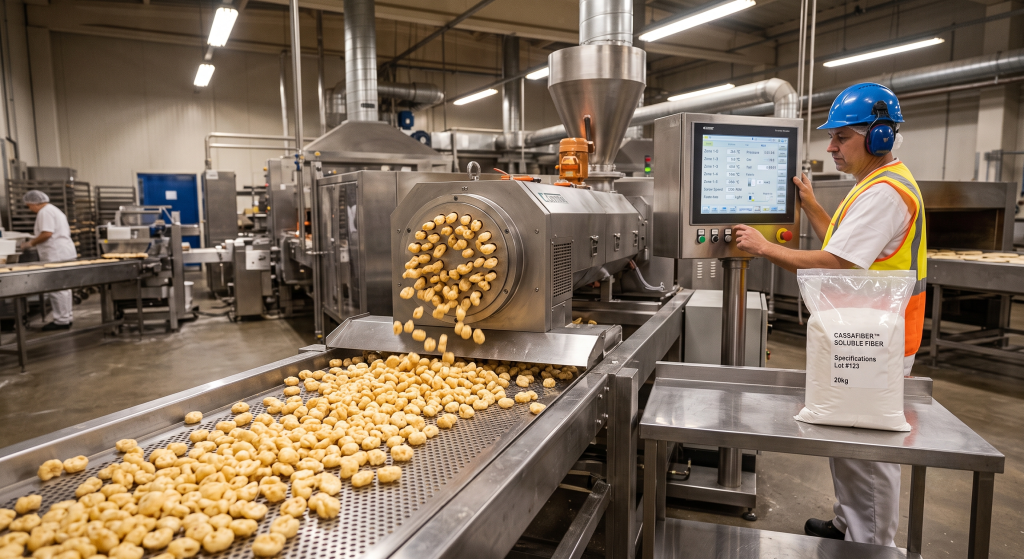
Sourcing functional fibers for high-volume extrusion lines requires excellent batch uniformity. A slight shift in the molecular weight distribution of the fiber can cause the extrusion melt to surge, leading to inconsistent piece sizes. Amerta Pacific supplies premium soluble tapioca fiber manufactured under strict quality controls to guarantee consistent performance.
The Amerta Pacific Engineering Advantage
Standardized Dextrose Equivalent (DE): Controlled polymerization ensures a tight DE range, providing predictable melt behavior batch after batch.
Low Hygrosocopicity: Our powder is engineered to resist caking, ensuring smooth pneumatic conveying and accurate dry-dosing into the extruder feed hopper.
Allergen-Free & Clean Label: 100% non-GMO, gluten-free, and grain-free, satisfying consumer demand for clean-label snacks.
Frequently Asked Questions (FAQ)
Q: Does soluble tapioca fiber degrade or lose its fiber content under high-shear extrusion? A: No. The specialized highly branched chemical bonds of our soluble tapioca fiber are thermally and mechanically stable. Analytical testing confirms that the dietary fiber count remains intact after passing through high-shear twin-screw extruders.
Q: What is the maximum inclusion rate of soluble tapioca fiber in puffed snacks? A: While traditional fibers cap out at 5% before ruining expansion, soluble tapioca fiber can be incorporated at rates up to 15% to 20% of the total dry blend, enabling “Excellent Source of Fiber” claims.
Q: How does tapioca fiber affect the color profile of puffed cereals? A: Because it has low reducing sugar content, it minimizes unwanted Maillard browning inside the barrel. This ensures that your puffed cereals and snacks maintain their bright, natural grain color without looking burnt.
Q: Is soluble tapioca fiber compatible with both single-screw and twin-screw extruders? A: Yes. However, twin-screw extruders offer superior mixing and moisture control, which helps maximize the texturizing benefits of the fiber at higher inclusion rates.
Optimize Your Extrusion Line with Amerta Pacific
Achieving the perfect puff no longer requires compromising on nutritional profiles. Amerta Pacific delivers high-performance soluble tapioca fiber engineered to withstand the rigorous thermal and mechanical demands of modern snack manufacturing.
Ready to enhance your snack texture and optimize your process engineering? Contact the Amerta Pacific Engineering Support Team today to request a comprehensive Technical Data Sheet (TDS), arrange a pilot plant sample delivery, or consult with our food scientists on your upcoming product run.