
Soluble Tapioca Fiber in Diabetic-Specific Food Products: Glycemic Index Management and Regulatory Claim Framework
With the global prevalence of Type 2 diabetes and metabolic syndrome rising rapidly, the demand for specialized, low-glycemic foods has moved from a niche medical category to a mainstream health sector. For R&D teams, regulatory affairs specialists, and health food buyers, formulating for diabetic consumers presents a dual challenge: replacing fast-digesting carbohydrates with functional bulking agents while navigating strict regulatory requirements for front-of-pack labeling. Soluble tapioca fiber (resistant dextrin) has established itself as an essential tool in diabetic nutrition. Produced through the controlled enzymatic hydrolysis of non-GMO cassava starch, this non-digestible carbohydrate provides necessary bulk, sweetness synergy, and texture without triggering significant blood glucose or insulin spikes.
Direct Answer:
Soluble tapioca fiber aids diabetic product development by providing an ultra-low Glycemic Index (GI < 15) and minimal caloric contribution (~2.0 kcal/g). Its non-digestible $\alpha\text{-1,4}$ and $\alpha\text{-1,6}$ glucosidic linkages resist enzymatic breakdown in the small intestine, flattening postprandial glucose curves and supporting FDA/EFSA-compliant claims for dietary fiber and blood glucose reduction.
Physiological Mechanics: Glycemic Control and Insulin Sensitivity
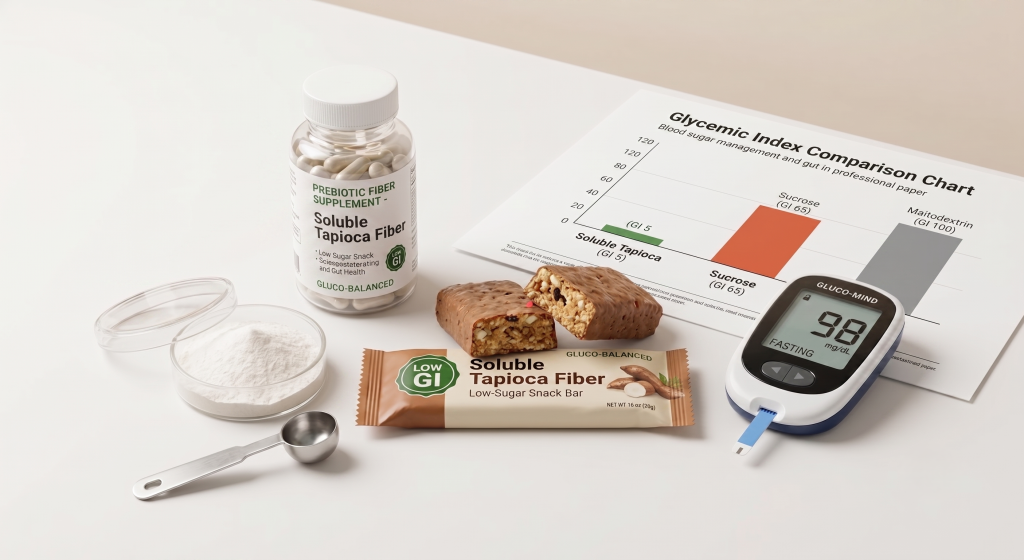
Unlike native starches or maltodextrins that quickly hydrolyze into free glucose in the upper gastrointestinal tract, resistant dextrin passes through the stomach and small intestine largely intact.
Upon ingestion, the soluble tapioca fiber matrix resists upper GI enzymatic digestion, triggering a dual-action physiological pathway. First, it actively blunts postprandial glucose response by extending gastric emptying time, slowing the breakdown of co-ingested starches, and preventing sharp insulin spikes. Simultaneously, as the intact fiber reaches the large intestine, it is fermented into beneficial short-chain fatty acids (SCFAs), stimulating endogenous GLP-1 release and enhancing peripheral insulin sensitivity over time.
Impact on Postprandial Blood Glucose Curves
Glucose Attenuation: When integrated into carbohydrate-rich formulations, soluble tapioca fiber increases intestinal viscosity and slows gastric emptying. This delays the rate of glucose absorption, flattening the postprandial glycemic peak.
Incretin and GLP-1 Modulation: As the fiber enters the colon, beneficial gut microbiota ferment the matrix into short-chain fatty acids (SCFAs), particularly propionate and butyrate. These metabolites stimulate L-cell secretion of GLP-1, helping improve natural insulin response and peripheral glucose clearance.
Low Insulinemic Response: Because it requires minimal to no insulin for clearance, it preserves pancreatic beta-cell function, making it an ideal ingredient for long-term diabetic dietary management.
These physiological benefits build directly upon the broader metabolic pathways detailed in our analysis of soluble tapioca fiber in weight management and satiety dosage.
Regulatory Claim Framework: Navigating Global Fiber and Blood Glucose Standards
To market a diabetic-friendly food product successfully, regulatory compliance is just as critical as sensory performance. Soluble tapioca fiber meets key international criteria for dietary fiber definitions and health claim substantiation.
Global Regulatory Landscape at a Glance
| Regulatory Body | Fiber Definition Compliance | Authorized / Permitted Health Claims |
| US FDA | Recognized as isolated/synthetic non-digestible carbohydrate with beneficial physiological effect. | “Helps reduce postprandial blood glucose levels”; “Good/Excellent Source of Fiber” (at 3g/6g per RACC). |
| EFSA (Europe) | Compliant under Regulation (EC) No 1924/2006 for non-digestible carbohydrates. | “Consumption of foods containing resistant dextrin induces a lower blood glucose rise after meals.” |
| Health Canada | Approved as a novel dietary fiber source. | “Helps lower the glycemic response when replacing sugars in food.” |
Formulators targeting low-sugar, low-glycemic profiles can leverage this fiber as a primary bulking agent for resistant dextrin sugar reduction strategies.
Formulating Diabetic Foods: Viscosity, Stability, and Net Carbs
From a product development standpoint, replacing high-GI ingredients (such as sucrose, maltodextrin, or glucose syrup) with alternative fibers often introduces processing hurdles like excessive gelation, off-flavors, or gastrointestinal intolerance.
Technical Comparison of Diabetic-Friendly Ingredients
The table below highlights why soluble tapioca fiber is preferred over alternative bulkers in diabetic food matrices:
| Parameter | Soluble Tapioca Fiber | Native Inulin / FOS | Polyols (Maltitol / Sorbitol) |
| Glycemic Index (GI) | Extremely Low (5 – 15) | Low (0 – 14) | Variable (35 for Maltitol; 9 for Sorbitol) |
| Net Carbohydrate Impact | Minimal (~0.2g per gram) | Zero | Partial (Requires complex deduction) |
| GI Tolerance (Max / Day) | High (Up to 30g) | Low (< 10g causes gas/bloating) | Low to Moderate (Laxative warning limits) |
| Process / Acid Stability | High (Stable at pH > 2.5) | Low (Hydrolyzes to fructose at low pH) | High |
This structural stability against heat and acid ensures that the dietary fiber content listed on the nutrition facts panel remains fully intact after processing. For a deeper breakdown of structural differences, review our B2B comparison of resistant dextrin vs. inulin.
Furthermore, its gentle fermentation profile supports a healthy gut microbiome without the severe discomfort associated with rapidly fermenting fibers, as outlined in the science of prebiotics and resistant dextrin in microbiome health.
Why Health Brands and Medical Food Buyers Source from Amerta Pacific
Developing compliant, high-efficacy diabetic food lines requires a consistent ingredient supply backed by rigorous analytical verification. Amerta Pacific delivers premium soluble tapioca fiber engineered to meet international dietary fiber specifications.
The Amerta Pacific Supply Advantage
High Chemical Purity: Standardized to ≥ 85% to 90% dietary fiber content (AOAC 2001.03 / 2011.25 methods), ensuring consistent net carb and fiber calculations.
Neutral Organoleptic Profile: Provides a clean, slightly sweet taste (~10% to 15% the sweetness of sucrose) with zero lingering aftertaste, eliminating the need for heavy flavor-masking agents.
Complete Regulatory Support: Fully documented with complete Certificates of Analysis (COA), Non-GMO, Halal, Kosher, and allergen-free certifications for rapid global regulatory approval.
Frequently Asked Questions (FAQ)
Q: Does soluble tapioca fiber impact net carbohydrate calculations on diabetic food labels?
A: In jurisdictions like the United States, dietary fiber is subtracted from total carbohydrates to calculate “net carbs.” Because soluble tapioca fiber resists human digestion, the fiber portion is excluded from net carb totals, making it suitable for low-glycemic and keto-friendly labeling.
Q: Will soluble tapioca fiber cause blood sugar spikes in insulin-dependent diabetics?
A: Clinical studies show that resistant dextrin produces a negligible glycemic response ($\text{GI} < 15$), causing no sudden blood glucose spikes or significant insulin demand.
Q: Can soluble tapioca fiber replace maltodextrin in diabetic meal replacement shakes?
A: Yes. It can replace high-GI maltodextrin on a 1:1 basis in dry powder blends, delivering the same mouthfeel, dispersion, and solubility without the associated blood sugar spike.
Q: How stable is soluble tapioca fiber in low-pH diabetic functional beverages?
A: Unlike inulin—which hydrolyzes into simple fructose in acidic environments—soluble tapioca fiber maintains its glycosidic bonds down to pH 2.5, preserving its low-glycemic fiber profile throughout the beverage’s shelf life.
Innovate Your Diabetic Product Line with Amerta Pacific
Deliver genuine therapeutic value, exceptional taste, and fully compliant health claims to diabetic consumers. Amerta Pacific supplies high-purity soluble tapioca fiber engineered to meet the strict technical and regulatory standards of global metabolic nutrition brands.
Ready to evaluate technical specifications and optimize your low-GI formulations? Contact the Amerta Pacific Technical Team today to request a Technical Data Sheet (TDS), review regulatory documentation, or order bench-test samples for your upcoming trials.