
Soluble Tapioca Fiber in Weight Management Products: Clinical Claims, Satiety Benefits, and Dosage Strategy
As the metabolic health and active lifestyle sectors evolve, consumers are looking beyond simple calorie restriction toward functional ingredients that actively support appetite control and metabolic balance. For R&D teams and nutraceutical manufacturers, soluble tapioca fiber (commonly classified as resistant dextrin) has become a primary ingredient for weight management formulations. Produced via the controlled enzymatic hydrolysis of non-GMO cassava starch, this low-viscosity, highly soluble dietary fiber allows brands to deliver strong, clinically supported health claims while maintaining exceptional taste, clarity, and processing stability.
Direct Answer: Soluble tapioca fiber aids weight management by slowing gastric emptying, modulating glycemic response, and promoting the release of satiety hormones like GLP-1 and PYY through short-chain fatty acid (SCFA) production in the gut. Its excellent digestive tolerance enables high functional dosing without causing gastrointestinal distress.
Mechanisms of Action: How Soluble Tapioca Fiber Promotes Satiety
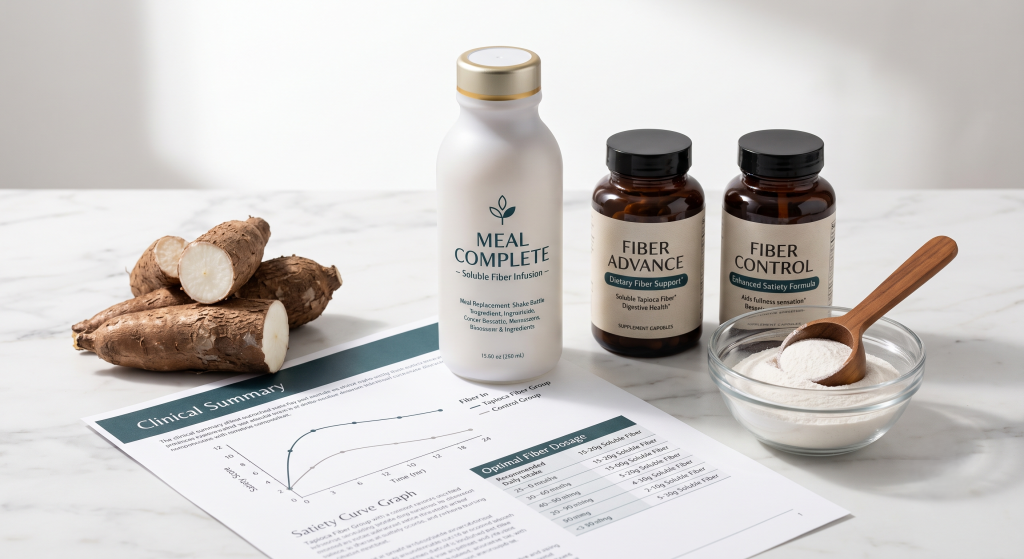
Integrating soluble tapioca fiber into a functional food or beverage alters the body’s digestive and hormonal response to nutrient intake. Unlike traditional bulking fibers that can feel heavy or unpalatable, resistant dextrin operates on a systemic level.
Physiological Pathways to Appetite Suppression
Delayed Glucose Absorption: Soluble tapioca fiber slows the digestion of co-ingested carbohydrates, smoothing out postprandial blood glucose spikes and subsequent insulin crashes that trigger premature hunger.
Short-Chain Fatty Acid (SCFA) Generation: Because it resists upper gastrointestinal digestion, the fiber reaches the colon intact. Here, beneficial microflora ferment the carbohydrate matrix into critical SCFAs like acetate, propionate, and butyrate. This mechanism is central to the science of prebiotics and resistant dextrin in microbiome health.
Hormonal Satiety Signatures: The increased concentration of SCFAs stimulates L-cells in the distal gut to secrete Glucagon-Like Peptide-1 (GLP-1) and Peptide YY (PYY). These hormones send direct signal pathways to the brain, signaling fullness and reducing the urge to snack.
Comparative Ingredient Advantages: Why Tapioca Outperforms
When formulating weight management powdered mixes, functional beverages, or meal-replacement bars, product developers frequently compare resistant dextrin to other prebiotic options like inulin or fructooligosaccharides (FOS).
Digestive Tolerance and Stability Benchmark
The primary limitation of traditional prebiotics in weight management products is gas and bloating at functional doses. Soluble tapioca fiber features a complex, highly branched molecular structure that results in a much slower, more gradual fermentation curve.
| Ingredient Characteristic | Native Inulin / FOS | Soluble Tapioca Fiber (Resistant Dextrin) | Formulation Matrix Impact |
| Gastrointestinal Tolerance | Low (Gas/Bloating at > 5g) | Exceptionally High (Up to 30g/day tolerated) | Permits clinical efficacy dosing without consumer complaints |
| Acid & Thermal Stability | Poor (Hydrolyzes into simple sugars) | High (Stable at low pH and high heat) | Maintains stable fiber counts in RTD beverages and baked bars |
| Glycemic Index (GI) | Very Low | Low (Typically 5–15) | Prevents rapid blood glucose spikes |
| Viscosity & Sensory Impact | Creamy / Variable | Ultra-low viscosity, clean and clear | Invisible texturizer; perfect for clear liquid formulations |
For a comprehensive breakdown of these structural and functional differences, review our detailed B2B comparison of resistant dextrin vs. inulin.
Clinical Dosing Strategies for Product Formulators
To substantiate front-of-pack claims such as “Helps support satiety” or “Promotes healthy blood sugar levels,” R&D teams must align inclusion rates with active clinical benchmarks.
Formulating for Specific Health Objectives
Glycemic Management Support: Including 5g to 8g per serving alongside carbohydrate-dense meals helps lower the overall glycemic impact of the food system. This makes it an essential tool when designing foods centered around resistant dextrin for sugar reduction.
Satiety and Appetite Control: Clinical literature indicates that an intake of 10g to 15g per day, split across two servings, effectively triggers the hormonal pathways required to suppress appetite and prolong the intervals between meals.
Daily Dietary Fiber Enrichment: Due to its clean taste and minimal impact on viscosity, formulators can easily add 3g to 5g per serving to common pantry items to earn an FDA “Good Source of Fiber” designation. You can explore additional incorporation methods in our guide on boosting soluble tapioca fiber in food formulations.
Why Premium Wellness Brands Source from Amerta Pacific
Formulating effective health products requires a reliable raw material supplier that understands clean labels, purity standards, and global logistics. Amerta Pacific supplies premium soluble tapioca fiber engineered for modern nutraceutical manufacturing.
The Amerta Pacific Supply Advantage
Guaranteed Fiber Content: Every lot is standardized to contain a minimum of 85% to 90% soluble dietary fiber on a dry basis.
Superior Process Workability: Our soluble fiber offers excellent cold-water solubility, rapid dispersion, and high clarity, making it compatible with high-speed automated bottling and powder-blending lines.
Transparent Supply Chain: 100% plant-based, non-GMO, and naturally gluten-free, backed by complete technical documentation and Certificates of Analysis (COA).
Frequently Asked Questions (FAQ)
Q: Does soluble tapioca fiber degrade during high-heat processing like extrusion or retort? A: No. Unlike inulin, which breaks down into simple fructose under heat and acid, soluble tapioca fiber retains its branched glycosidic bonds during pasteurization, UHT processing, and extrusion, ensuring your finished product maintains its labeled fiber content.
Q: Can soluble tapioca fiber be used in keto or low-carb weight management products? A: Yes. Because a vast majority of the ingredient resists human enzymatic digestion, it contributes minimal net carbohydrates and has an exceptionally low caloric value (~2.0 kcal/g), making it ideal for keto-certified and low-GI profiles.
Q: How does soluble tapioca fiber affect the clarity and mouthfeel of clear functional beverages? A: It dissolves completely clear in water and creates no sandy or gritty mouthfeel. At standard functional doses (5g–10g), it remains virtually unnoticeable, preserving the intended flavor profile of the beverage.
Q: What is the maximum daily tolerance limit for soluble tapioca fiber? A: Clinical evaluations demonstrate excellent digestive tolerance with daily intakes up to 30 grams, showing significantly lower rates of flatulence and abdominal discomfort compared to standard soluble fibers like chicory root.
Innovate Your Metabolic Health Products with Amerta Pacific
Deliver genuine functional value and verifiable clinical benefits to your customers. Amerta Pacific provides high-purity soluble tapioca fiber tailored to meet the strict production and nutritional requirements of the global weight management sector.
Ready to upgrade your functional formulation and request premium samples? Contact the Amerta Pacific Ingredient Specialists today to schedule a technical consultation, obtain complete specification sheets, or secure material samples for your next pilot batch.