
How to Reduce Off-Flavor in Pea Protein: Processing Tips for Beverage Manufacturers
For R&D teams and beverage formulators in the plant-based sector, pea protein isolate is a highly attractive ingredient due to its excellent amino acid profile, clean label status, and hypoallergenic nature. However, commercializing a successful ready-to-drink (RTD) plant beverage or powdered shake comes with a major hurdle: mitigating undesirable flavor notes. Raw pea protein frequently introduces distinct “beany,” “earthy,” and bitter profiles that consumers reject.
To mask these off-flavors, manufacturers often make the mistake of over-indexing on artificial sweeteners and heavy masking agents. This approach inflates the Cost of Goods Sold (COGS) and ruins the clean label profile. Managing these notes requires a deeper look at how processing techniques and deliberate formulation choices can neutralize flavors at a molecular level.
The Direct Answer: Mitigating Pea Protein Off-Flavors
To reduce off-flavor in pea protein beverages, formulators must target volatile lipid oxidation products, specifically hexanal, by utilizing high-purity isolates with low lipoxygenase activity. Processing adjustments—including high-shear homogenization, thermal vacuum stripping, and precise pH adjustment above the isoelectric point—disrupt protein-odorant bonds to unlock a neutral sensory profile.
The Chemistry Behind the "Beany" Profile
Before you can eliminate an off-flavor, your development team must understand what causes it. The sensory profile of legumes is not a single defect but a combination of volatile organic compounds.
Lipid Oxidation (Hexanal): The primary culprit behind the “grassy” or “beany” note is the oxidation of unsaturated fatty acids, catalyzed by the enzyme lipoxygenase. This reaction produces aldehydes, primarily hexanal, which bind tightly to the hydrophobic regions of the pea globulin proteins.
Saponins and Phenols: These naturally occurring compounds are responsible for the lingering bitterness and astringency felt on the back of the throat.
Volatile Organic Compounds (VOCs): Pyrazines and alcohols introduce the dry “earthy” or “cardboard” aroma that often dominates unflavored plant protein bases.
Processing Strategies to Remove Flavor Defects
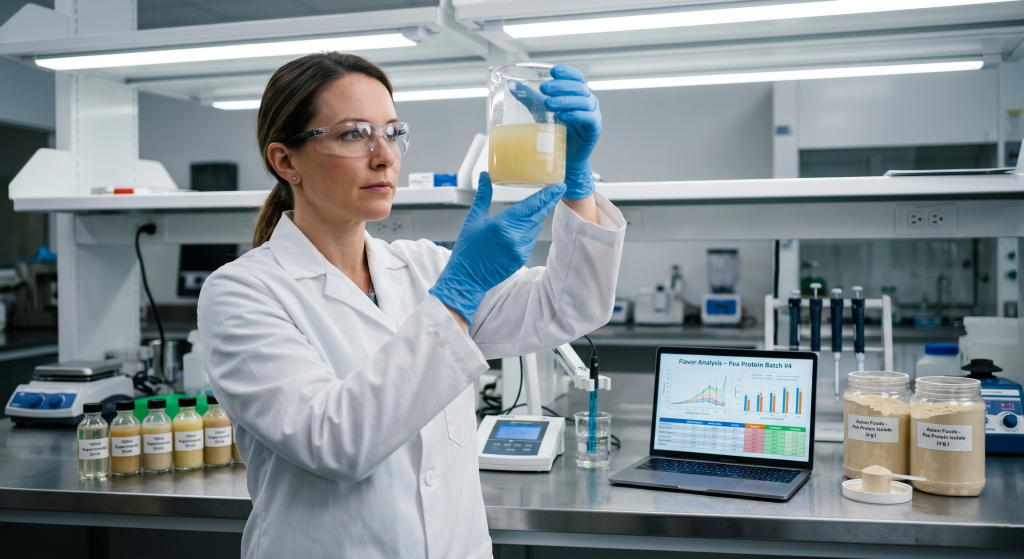
Relying solely on flavors to hide defects is an expensive, inefficient fix. Instead, leverage your factory’s processing hardware to strip away these volatile flavor compounds during the liquid blending stage.
High-Shear Homo-genization and Thermal De-aeration
Because volatile compounds like hexanal are trapped within the folded structure of the protein, standard agitation cannot release them. Passing the hydrated protein slurry through a two-stage high-shear homo-genizer at $15-20\text{ MPa}$ physically unfolds the protein matrix.
Following this with vacuum de-aeration or thermal flash stripping applies negative pressure to the heated liquid, drawing out the liberated volatile compounds and venting them safely out of your production system.
Thermal Treatment and Enzymatic Hydrolysis
Applying a controlled thermal step (such as HTST or UHT pasteurization) deactivates residual lipoxygenase enzymes early in the process, halting further lipid degradation. Additionally, treating the slurry with food-grade endopeptidases breaks down specific bitter peptide chains, shortening the molecular structures and significantly reducing perceived throat astringency.
Formulation Adjustments for Flavor Optimization
Beyond physical processing, the chemical environment of your beverage matrix dictates how intensely the human palate perceives flavor defects.
Shifting the pH Matrix
Pea protein’s structure changes dramatically based on the acidity of the fluid. In the highly acidic range, proteins fold tightly, trapping off-flavors. By maintaining your beverage formulation in a neutral window (pH 6.8 to 7.2), you maximize protein solubility and surface charge. This open structure allows volatile compounds to volatilize out during pasteurization rather than remaining bound to the protein core.
Strategic Ion Blending
Adding trace amounts of sodium chloride (NaCl) or potassium chloride (KCl) does more than enhance saltiness; sodium ions physically block bitter taste receptors on the human tongue. A subtle addition of 0.05% to 0.1% salt can naturally mask legume bitterness without altering the intended sweet flavor profile of a vanilla or chocolate beverage.
Functional Comparison of Flavor-Optimization Tactics
| Mitigation Technique | Primary Target Compound | Operational Difficulty | Nutritional/Label Impact |
| Vacuum De-aeration | Volatile Aldehydes (Hexanal) | Moderate (Requires vacuum equipment) | None / Maintains 100% clean label |
| Enzymatic Hydrolysis | Bitter Peptides / Saponins | High (Requires strict incubation time) | Improves solubility and digestion |
| Sodium Addition ($NaCl$) | Bitterness Perception | Low (Simple dry-mix addition) | Adds minor sodium to panel |
| Chemical Masking Agents | General Off-Notes | Low (Drop-in liquid/powder) | Increases ingredient deck complexity |
Read other article: An effective pea protein isolate dosage varies by application: 20 to 25 grams per serving for sports nutrition powders, 10 to 15 grams for ready-to-drink (RTD) beverages, 5 to 10 grams for baked goods and nutritional bars, and 15 to 20 grams for meat alternatives to mimic animal muscle tissue. [Read more..]
Start with a Clean Baseline: Amerta Pacific Pea Protein
The most effective way to minimize off-flavors in your final beverage is to start with a raw material that is inherently clean. A heavily oxidized, poorly processed protein isolate cannot be saved by advanced factory hardware.
At Amerta Pacific, we supply premium Pea Protein Isolate specifically engineered for high-end beverage and liquid applications. Our manufacturing partners utilize gentle, low-temperature isolation technologies that prevent lipid oxidation before the powder ever reaches your facility. By minimizing lipoxygenase activity during extraction, our isolate features an incredibly neutral sensory profile and superior cold-water solubility.
Sourcing from Amerta Pacific gives your R&D team a massive advantage:
Minimal Beany Baseline: Drastically reduces your reliance on expensive masking agents and chemical flavor modulators.
High Protein Density (80%+): Delivers clean nutritional targets without adding unnecessary carbohydrate or lipid fractions.
Batch Uniformity: Strict quality control guarantees consistent particle size and surface charge, ensuring your processing line runs predictably every day.
Read other article: Pea protein isolate in senior nutrition provides a highly digestible, allergen-free macro-nutrient source essential for muscle preservation. [Read more..]
Frequently Asked Questions (FAQ)
Q: Why does pea protein leave an astringent, dry mouthfeel in RTD drinks? A: Astringency is caused by the cross-linking of polyphenols and proteins with the proteins in human saliva, causing them to precipitate. Using a highly purified isolate like Amerta Pacific’s removes these residual polyphenols, ensuring a smooth, clean release in the mouth.
Q: Can I use cyclodextrins to mask pea protein off-flavors? A: Yes. Cyclodextrins have a hydrophobic cavity that encapsulates volatile flavor molecules like hexanal, preventing them from interacting with taste buds. However, this adds an extra ingredient to your label, which may conflict with true clean-label initiatives.
Q: How does flavor stability hold up over a 12-month beverage shelf life? A: If residual lipids oxidize over time, off-flavors will worsen. To prevent this, ensure your beverage packaging provides an absolute oxygen barrier and include natural antioxidants, like tocopherols (Vitamin E), to protect the matrix from long-term rancidity.
Elevate Your Beverage Line's Sensory Appeal
Winning the plant-based beverage market requires delivering a product that mirrors the smooth, clean flavor profile of traditional dairy. By combining advanced mechanical stripping techniques with an inherently superior, low-odor isolate, your R&D team can produce high-protein drinks that delight consumers and keep your ingredient labels simple.
Ready to eliminate off-flavors from your development pipeline? Contact Amerta Pacific today to consult with our technical specialists, order premium product samples for bench testing, and secure stable wholesale pricing for your upcoming production campaigns.