
Pea Protein Isolate vs. Soy Protein Isolate: The 2026 B2B Case for Switching
For purchasing directors and procurement managers in the plant-based food and beverage sector, ingredient selection directly dictates regulatory compliance, manufacturing uptime, and corporate margin health. For decades, soy protein isolate was the industrial default for building protein density in sports nutrition powders, ready-to-drink (RTD) shakes, and meat alternatives.
However, entering 2026, the commercial landscape has shifted permanently. Volatile global supply chains, strict international labeling mandates, and a massive consumer flight from major allergens have eroded soy’s historical dominance. Shifting your factory’s raw material pipeline toward pea protein isolate is no longer just an innovative R&D experiment—it is an essential strategic procurement pivot to de-risk your business.
The Direct Answer: Why Procurement Is Switching
When comparing pea protein isolate vs soy protein isolate under 2026 manufacturing conditions, pea protein isolate is the superior commercial choice. It completely eliminates major allergen labeling requirements, bypasses the complex documentation trails required for non-GMO soy, and provides a stable, predictable pricing structure less exposed to global grain commodity speculation.
The Allergen Liabilities of Industrial Soy
The most immediate financial risk to an automated food production line is allergen cross-contamination. Soy is legally classified as a major allergen across all principal global regulatory frameworks, including the FDA in the United States and the European Food Safety Authority (EFSA) in the EU.
          [2026 Ingredient Compliance Risk Analysis]
                              │
     ┌────────────────────────┴────────────────────────┐
     ▼                                                 ▼
[Soy Protein Isolate Matrix]                      [Pea Protein Isolate Matrix]
 ├── Mandated Major Allergen Label                 ├── Hypoallergenic Classification
 ├── Intense line cleaning shutdowns               ├── Simplifies scheduling & changeovers
 └── Non-GMO identity verification costs           └── Naturally non-GMO crop background
Maintaining soy on a shared production line requires extensive, auditable sanitation wash-downs and prolonged equipment downtime to prevent cross-contact. A failure in this protocol risks catastrophic product recalls, regulatory fines, and permanent brand damage.
Pea protein isolate is inherently hypoallergenic. It does not trigger mandatory top-allergen warning declarations on your packaging. Switching to pea protein simplifies your factory scheduling, slashes changeover clean-up times, and allows your brand to capture the lucrative “free-from” market segment using a single, clean ingredient deck.
Resolving the Non-GMO Sourcing Burden
For procurement teams supplying into premium retail channels or European export markets, verifying non-GMO status is a costly administrative burden.
The Soy Identity Crisis: The vast majority of the world’s industrial soybean crop is genetically modified. Securing high-purity, non-GMO soy protein isolate requires rigid Identity Preservation (IP) testing protocols, driving up your raw material premiums and tracking paperwork.
The Naturally Clean Pea Baseline: Yellow peas (Pisum sativum), the biological source of pea protein isolate, are naturally non-GMO. There are no commercially viable, genetically altered yellow pea varieties in global agricultural production. Sourcing pea protein automatically satisfies non-GMO procurement audits without requiring premium identity-preservation tracking fees.
Functional and Commercial Metric Comparison
Evaluating ingredient value requires looking past the raw spot price per metric ton to examine the Total Cost of Quality (TCQ).
| Procurement & Technical Metric | Premium Pea Protein Isolate | Industrial Soy Protein Isolate | Factory Line & Budget Impact |
| Allergen Status | Hypoallergenic / Clean | Major Global Allergen | Pea eliminates warning labels and recall risks |
| GMO Exposure | Naturally Non-GMO | High Risk / Requires IP tracking | Pea reduces compliance and auditing costs |
| Protein Purity Baseline | 80% – 85% | 90% | Highly comparable nutritional formulation delivery |
| Supply Chain Pricing | Stable / Regionally Diverse | High Volatility (Traded on CME) | Pea protects quarterly operational budgets |
| Water Binding & Emulsification | Strong / Low Cold Viscosity | High / Gel-Heavy | Pea flows easily through automated RTD lines |
To reduce off-flavor in pea protein beverages, formulators must target volatile lipid oxidation products, specifically hexanal, by utilizing high-purity isolates with low lipoxygenase activity. Processing adjustments including high-shear homogenization, thermal vacuum stripping, and precise pH adjustment above the isoelectric point disrupt protein-odorant bonds to unlock a neutral sensory profile. [Read More]
Price Stability and Geopolitical Supply Security
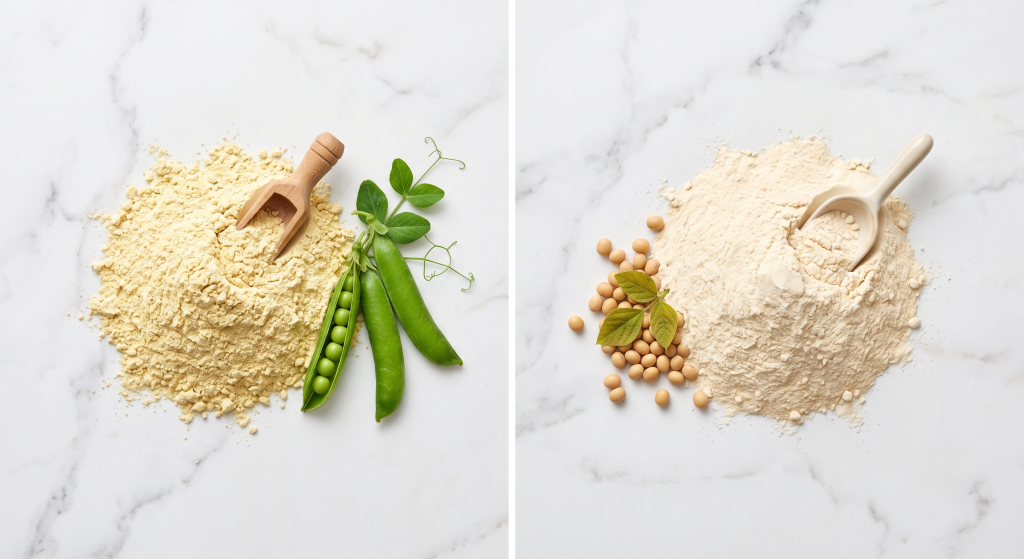
Soybeans are a highly financialized global commodity heavily traded on the Chicago Board of Trade (CBOT) and other speculative derivative exchanges. Consequently, industrial soy protein isolate prices fluctuate rapidly based on energy markets, international biofuel quotas, and geopolitical trade tariffs.
Yellow peas are largely insulated from speculative commodity index funds. Cultivated widely across predictable, stable agricultural zones, pea crop yields remain steady and cost-effective. Building a 12-to-24-month contract model around pea protein isolate gives your purchasing department a level of budgetary predictability that soy cannot match, shielding your net margins from sudden inflationary spikes.
Streamline Your Plant Protein Supply with Amerta Pacific
Transitioning your factory’s raw material pipeline requires a reliable B2B supplier capable of delivering uncompromised batch uniformity. Minor variations in an isolate’s particle size, surface charge, or flavor baseline can cause automated mixing machinery to stall or alter the mouthfeel of your finished product.
At Amerta Pacific, we eliminate procurement friction by supplying premium, industrial-grade Pea Protein Isolate designed for large-scale food and beverage manufacturing. We manage a transparent, verified supply infrastructure that prioritizes rigorous quality control at every phase of processing.
Our bulk distribution network guarantees:
Guaranteed 80%+ Protein Concentration: Ensuring precise recipe calculations to safely fulfill your front-of-pack nutritional targets.
Neutral Sensory Profile: Advanced, gentle extraction methods that minimize the bitter, leguminous notes common in low-grade plant proteins, reducing your R&D flavor-masking costs.
Seamless Import Logistics: Every container arrives at your factory gate with a comprehensive documentation package, including detailed Certificates of Analysis (COA), non-GMO verifications, and valid Halal compliance.
Frequently Asked Questions (FAQ)
Q: Can pea protein isolate achieve the same emulsification stability as soy in meat alternatives? A: Yes. The globulin proteins (legumin and vicilin) inside pea protein isolate denature and cross-link efficiently under processing heat and shear. This forms a highly stable oil-and-water emulsion that perfectly replicates the chew and bite of traditional meat products.
Q: How does the digestibility of pea protein compare to soy protein isolate? A: Pea protein isolate features an exceptional true digestibility score of over 90%, making it highly comparable to soy and dairy proteins. The isolation process removes the indigestible oligosaccharides found in raw legumes, eliminating consumer complaints regarding bloating or gastric discomfort.
Q: What are the standard volume purchasing and packaging configurations for export? A: Our standard industrial configurations include 25kg multi-wall moisture-resistant paper bags packed on uniform pallets, as well as 850kg to 1,000kg bulk jumbo bags equipped with integrated lifting loops for seamless automated silo discharge.
Future-Proof Your Manufacturing Infrastructure
Do not expose your factory’s profit margins to the regulatory liabilities of major allergens or the pricing chaos of volatile grain markets. Making the strategic switch to a high-purity pea protein isolate matrix allows your procurement team to protect corporate budgets, simplify factory compliance, and confidently scale your plant-based portfolio to meet modern consumer expectations.
Ready to de-risk your plant protein supply chain? Contact Amerta Pacific today to submit your formal Request for Proposal (RFP), coordinate targeted sample delivery for your R&D lab, and secure stable wholesale pricing contracts for the upcoming manufacturing cycles.