
Gluten-Free Pasta That Doesn't Fall Apart: The Cassava Flour and Tapioca Starch Blend Formula
For R&D teams and plant operations managers in the commercial pasta sector, eliminating gluten is a massive structural challenge. Traditional pasta relies entirely on the gliadin and glutenin proteins in wheat to create a highly elastic, cohesive network. This network traps starch granules, allowing pasta to withstand mechanical extrusion, high-temperature drying, and commercial boiling without losing its shape.
When you remove wheat, you remove that defensive matrix. Most gluten-free alternatives—especially those relying solely on rice or corn flour—suffer from severe quality defects. They become highly brittle in the box, crack during transit, and leach excessive starch into cooking water, turning into a mushy, structurally compromised product on the consumer’s plate. Resolving this requires a deliberate, functional blend of cassava flour and tapioca starch.
The Direct Answer: The Ultimate Gluten-Free Pasta Matrix
To produce industrial gluten-free pasta that mimics the al dente bite of wheat durum, formulators must combine cassava flour and tapioca starch in a precise 70:30 to 80:20 ratio. Cassava flour provides the necessary whole-root fiber matrix and structural bulk, while tapioca starch delivers rapid, high-strength gelation to bind the dough and completely eliminate cooking loss.
The Synergy Between Cassava and Tapioca
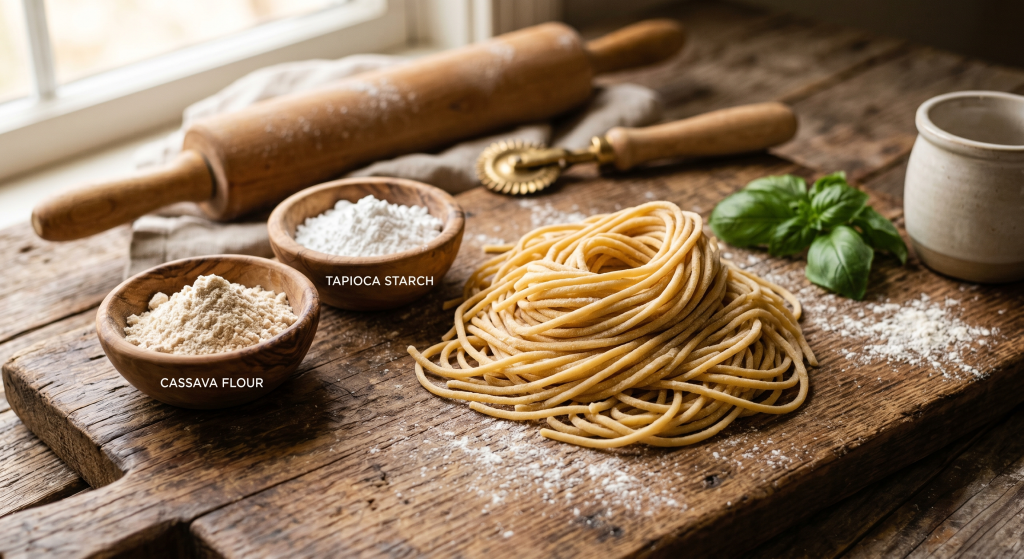
Relying on a single alternative flour rarely works at scale. True structural stability is achieved through the synergistic interplay between a whole-root matrix and a highly purified starch fraction.
The Role of Cassava Flour (The Structural Foundation)
Premium, high-mesh cassava flour acts as the direct surrogate for semolina. Because it utilizes the entire root, it retains native structural fibers and complex carbohydrates. This creates a dense, sturdy dough sheet that can withstand the intense pressures of commercial screw extruders without tearing or shearing apart at the die plate.
The Role of Tapioca Starch (The Elastic Binder)
While cassava provides bulk, it needs an elastic anchor to prevent brittleness. Native tapioca starch possesses a significantly lower gelatinization temperature (59-70 celcius) than corn or rice starch.
During thermal processing or steam-pre-cooking phases, the tapioca starch fraction activates rapidly, forming a highly flexible, translucent gel network. This gel acts as an internal adhesive, wrapping around the cassava flour particles and locking them into place.
Operational Advantages on High-Speed Production Lines
Shifting your factory’s formulation to a cassava-tapioca blend yields immediately measurable improvements across your entire manufacturing line.
Drastic Reduction in Cooking Loss: When pasta leaches solids into boiling water, it indicates structural collapse. The tapioca starch fraction seals the pasta’s outer surface, keeping cooking loss well under the critical 8% industrial threshold.
Enhanced Die Clearance and Extrusion Speed: The natural lubrication properties of tapioca amylopectin reduce internal mechanical friction within the extruder barrel, lowering energy consumption and preventing heat-induced dough discoloration at the die face.
Structural Resilience Post-Drying: Gluten-free pasta frequently develops micro-cracks during the critical drying phase (70-90 Celcius). The high moisture-holding capacity of this root-derived blend ensures uniform water evaporation, drastically reducing package breakage and retail floor scrap.
Ideal Blend Ratios and Performance Metrics
| Ingredient Component | Percentage in Dry Mix | Primary Functional Contribution | Impact on End Product |
| Premium Cassava Flour | 70% – 80% | Fiber Matrix & Density | Provides the al dente chew and structural volume |
| Native Tapioca Starch | 20% – 30% | Rapid Gelation & Elasticity | Prevents dry cracking and eliminates boiling mushiness |
| Water Input | Adjusted to 32-34% | Hydration & Plasticization | Ensures uniform dough flow through extrusion dies |
Sourcing Security with Amerta Pacific
Formulating premium, non-shattering gluten-free pasta requires raw materials with uncompromising consistency. If your cassava flour contains irregular fiber sizes or your tapioca starch exhibits fluctuating peak viscosities, your automated extrusion lines will suffer from continuous pressure variations and product defects.
At Amerta Pacific, we supply industrial-grade Cassava Flour and Tapioca Starch precisely milled and monitored for high-throughput food manufacturing. Our multi-step processing standards guarantee uniform particle distribution (100-120 mesh) and completely clean allergen profiles, giving your R&D and production teams complete peace of mind.
By choosing Amerta Pacific as your primary wholesale partner, you ensure:
Dedicated Allergen-Free Sourcing: Absolute protection against cross-contamination to safely back up your “Certified Gluten-Free” claims.
Predictable Viscosity Baselines: Continuous laboratory testing ensures that every single container behaves identically inside your mixing chambers.
Streamlined Procurement Logistics: Direct export management from primary processing hubs straight to your factory floor, stabilizing your inventory flow.
Read other article: Integrating tapioca starch into your formulation is one of the most effective strategies to optimize your Cost of Goods Sold (COGS). By modifying the physical properties of dough, this sustainable ingredient delivers measurable cost savings across the entire production lifecycle.. [Read more..]
Frequently Asked Questions (FAQ)
Q: Can this blend be run on standard wheat pasta extrusion machinery? A: Yes. However, because gluten-free dough lacks native protein elasticity, we highly recommend utilizing a vacuum-equipped extruder with a pre-gelatinization or steaming barrel to fully activate the tapioca starch binder prior to die shaping.
Q: How does this root blend affect the flavor profile of the pasta? A: Unlike legume or corn-based flours, which introduce distinct earthy or sweet cereal notes, the cassava-tapioca blend is entirely neutral. It absorbs sauces perfectly and delivers the clean, classic taste profile that consumers look for.
Q: What is the optimal storage protocol for maintaining raw material consistency? A: Both ingredients should be stored off the floor on clean pallets in a cool, well-ventilated warehouse environment where relative humidity stays below 60%. Under these conditions, the functional properties remain stable for up to 24 months.
Dominate the Premium Gluten-Free Market
Winning over modern consumers requires delivering a gluten-free pasta that commands respect on the fork. By moving away from brittle, single-grain alternatives and adopting a balanced cassava and tapioca root formula, your factory can reliably manufacture high-yield, premium pasta that maintains structural perfection from the box to the bite.
Ready to calibrate your next gluten-free production run? Contact Amerta Pacific today to connect with our technical application team, order specific ingredient samples for your R&D kitchen, or secure competitive bulk pricing contracts for the upcoming year.