
How Tapioca Starch Reduces COGS in Noodle and Pasta Manufacturing
For purchasing and operations managers in the commercial noodle and pasta sector, balancing profit margins against product quality is a continuous challenge. Fluctuating wheat prices, high energy costs, and production line inefficiencies directly impact your bottom line. To stay competitive, operations must look beyond raw ingredient costs and evaluate how functional ingredients affect overall yield.
Integrating tapioca starch into your formulation is one of the most effective strategies to optimize your Cost of Goods Sold (COGS). By modifying the physical properties of dough, this sustainable ingredient delivers measurable cost savings across the entire production lifecycle.
The Direct Answer: How Tapioca Starch Lowers Production Costs
Tapioca starch reduces COGS in noodle and pasta manufacturing by increasing water binding capacity, which directly boosts final product yield. Its high binding efficiency reduces processing breakage and floor scrap, while allowing manufacturers to reduce reliance on expensive vital wheat gluten without sacrificing noodle elasticity or bite.
The Financial Mechanics of Tapioca Starch in Production
Every fraction of a percent optimized during dough preparation yields massive financial returns at scale. Tapioca starch functions as a highly efficient process aid that targets major cost centers in the plant.
Boosting Yield via High Water Absorption
Tapioca starch exhibits an exceptional water-binding capacity compared to standard wheat flour or corn starch. During the mixing and gelatinization phases, tapioca particles absorb and retain a higher volume of water.
- Increased Dough Weight: More bound water means a higher total dough weight from the same volume of dry ingredients.
- Maintained Moisture Levels: The starch safely locks in moisture, ensuring the final product meets weight specifications without becoming soggy or structurally weak.
Because water is your lowest-cost input, maximizing water retention safely increases your total cases produced per batch, driving down your unit COGS.
Minimizing Material Waste and Floor Scrap
In high-speed noodle sheeting or pasta extrusion lines, product breakage represents direct profit loss. Brittle dough leads to frayed edges, structural snapping, and excessive floor scrap that must be reworked or discarded.
Tapioca starch creates a highly elastic, flexible starch matrix. This increased dough elasticity allows the sheet to withstand high mechanical shear during rolling, cutting, and hanging. By reducing line breakages by even 2-3%, a high-volume factory saves thousands of dollars monthly in eliminated waste and recovered labor hours.
Operational Efficiencies on the Factory Floor
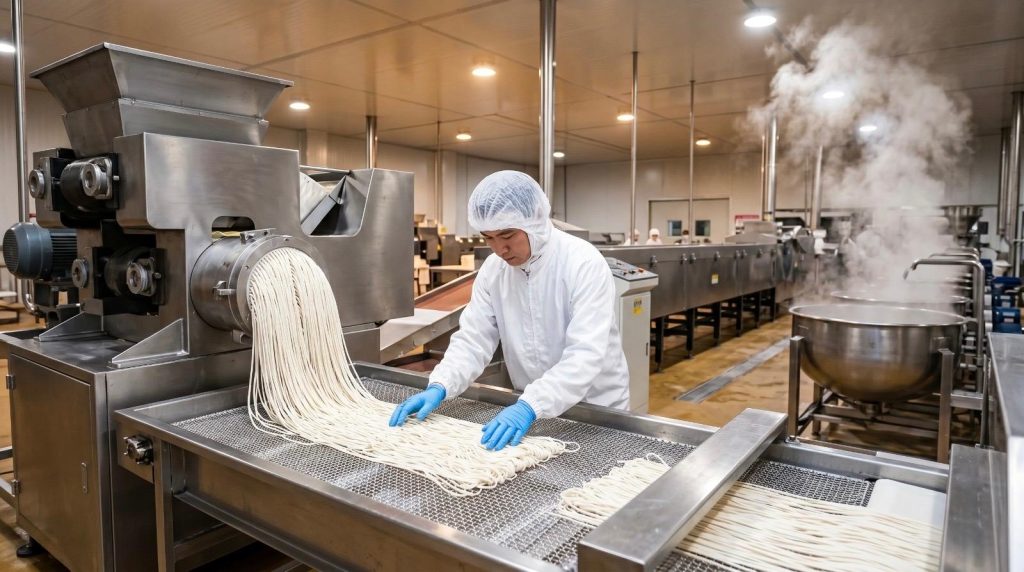
Beyond direct material yield, optimizing your recipe with tapioca starch introduces distinct operational advantages that appeal directly to Operations Managers.
Lower Cooking Loss: When starch leaches into cooking water during commercial par-boiling or instant noodle steaming, it represents a loss of sellable mass. Tapioca’s high gelatinization stability keeps the starch locked within the noodle structure, minimizing solids lost in the processing water.
Accelerated Drying and Frying Times: For instant noodle manufacturers, tapioca starch creates a more porous microstructure when heated. This allows for faster moisture removal during the frying or drying stage, lowering energy consumption and increasing line throughput speed.
Extended Shelf Life and Freshness: Tapioca prevents retrogradation (the hardening of starch molecules over time). This ensures that packaged noodles retain their ideal texture longer on retail shelves, reducing commercial returns due to staling or product degradation.
Substituting Costly Ingredients: Tapioca vs. Wheat Gluten
Historically, manufacturers relied heavily on vital wheat gluten to provide the necessary tensile strength and chewiness (Al Dente quality) in pasta and noodles. However, wheat gluten is susceptible to volatile global market pricing, heavily inflating your formulation costs.
Tapioca starch offers a cost-stable, functional alternative. While it does not contain protein, its unique amylose-to-amylopectin ratio mimics the elasticity and clean bite of gluten when gelatinized.
| Performance Metric | Premium Wheat Gluten | Industrial Tapioca Starch | Cost/Benefit Impact on COGS |
| Price Volatility | High market fluctuations | Relatively stable | Predictable procurement forecasting |
| Water Binding | Moderate | Exceptional | Higher total product yield per batch |
| Elasticity Profile | Firm / Chewy | Elastic / Springy | Reduces reliance on high-protein flours |
| Line Scrap Rate | Low | Extremely Low | Minimizes mechanical downtime and rework |
By substituting a percentage of expensive high-protein wheat flour or vital wheat gluten with a optimized blend of standard flour and tapioca starch, purchasing managers can realize immediate raw material cost savings of up to 10-15% per batch.
Partnering with Amerta Pacific for Margin Optimization
Optimizing your COGS requires more than just buying cheaper ingredients; it requires sourcing highly consistent, functional raw materials that perform predictably on your machinery.
At Amerta Pacific, we supply premium-grade bulk tapioca starch specifically tailored for industrial food manufacturing. We work directly with your procurement and operations teams to ensure our starch matches your exact specifications for viscosity, particle size, and moisture content.
Our wholesale distribution network guarantees:
Volume-Based Pricing: Competitive, stable tier pricing to safeguard your quarterly budgets against inflation.
Strict Quality Control: Consistent starch gelatinization profiles, eliminating batch-to-batch variance that disrupts automated production lines.
Reliable Logistics: Just-in-time delivery to minimize your warehousing costs and keep your capital liquid.
Frequently Asked Questions (FAQ)
Q: Does adding tapioca starch affect the texture or mouthfeel of the noodles? A: Yes, but positively. Tapioca starch imparts a desirable springiness, smooth surface texture, and a cleaner bite. It prevents the pasty or gummy texture often caused by excessive alternative fillers.
Q: How does tapioca starch handle high-temperature pasta extrusion? A: It excels under high shear and temperature. Tapioca starch has a lower gelatinization temperature than corn or wheat starch, meaning it activates faster during processing, protecting the dough structure during extrusion.
Q: Can tapioca starch be used in both fresh and dried noodle applications? A: Absolutely. In fresh noodles, it maintains color brightness and prevents discoloration. In dried or instant noodles, it improves rehydration speeds for the end consumer while maintaining structural integrity during packaging.
Protect Your Margins and Enhance Product Quality
Do not let volatile wheat markets dictate your factory’s profitability. Transitioning to a formulation optimized with tapioca starch allows you to simultaneously lower your production costs, maximize your line throughput, and deliver the premium texture that your consumers demand.
Ready to calculate your exact cost savings? Contact Amerta Pacific today to speak with our technical sourcing specialists, request industrial samples, and secure your bulk pricing contract.