
The Procurement Checklist: 10 Questions to Ask Any Cassava Flour Supplier Before Signing a Contract
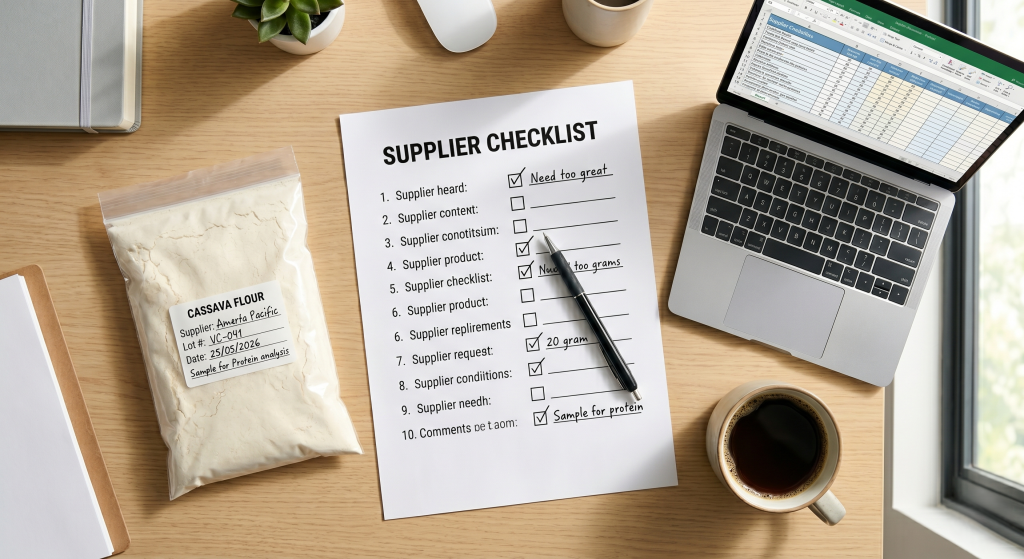
For global procurement managers and ingredient buyers, sourcing commercial cassava flour requires navigating a highly fragmented agricultural market. Unlike heavily standardized grain commodities, cassava flour quality, safety, and functional behaviors vary drastically depending on regional processing technologies and soil chemistry. Securing a low spot-price per ton means nothing if a batch causes factory machinery downtime, clogs automated extruders, or fails strict microbial testing at the border.
Before committing capital to a long-term wholesale supply contract, your purchasing department must execute thorough due diligence. This 10-question technical checklist ensures your future cassava flour supplier can meet international manufacturing standards, handle supply chain disruptions, and deliver predictable ingredient performance.
The Direct Answer: The Ultimate Supplier Verification Strategy
To safeguard your production line, you must vet a cassava flour supplier across four core pillars: agricultural traceability, technical specification limits (moisture, ash, cyanide), international food safety certifications (HACCP, ISO), and logistical scalability. If a supplier fails to provide transparent documentation for these parameters, they represent a severe compliance risk to your factory.
Section 1: Technical and Quality Specifications
The physical properties of cassava flour directly dictate how dough handles on your automated production line. Use these initial questions to evaluate raw technical compliance.
1. What is the maximum moisture content guaranteed per batch?
For commercial cassava flour, the international industry standard for moisture content is less than or equal to 13%. Anything higher accelerates mold growth, drastically reduces product shelf life, and causes clump formation in storage silos, which can jam pneumatic feeding lines.
2. Can you provide the precise starch and ash content specifications?
High-quality, food-grade cassava flour should maintain a minimum starch content of 80-85%. The ash content—which indicates the level of residual minerals or soil dust remaining after washing—must be strictly under 1.5-2.0%. High ash values signify poor root peeling and washing, which introduces a gritty texture into your final product.
3. What are your specific cyanogenic glucoside limits, and how are they measured?
Cassava roots naturally contain hydrogen cyanide compounds ($HCN$) that must be removed through thorough peeling, grating, and drying. Your supplier must guarantee that total residual cyanide levels remain safely under 10 parts per million (ppm) to comply with global food safety authorities (including the FDA and WHO).
Section 2: Manufacturing Standards and Certifications
A supplier’s facility must match the audit requirements of your internal quality control department and external regulatory compliance bodies.
4. Which internationally recognized food safety certifications does your plant hold?
Never accept unverified baseline claims. A dependable industrial exporter must supply current documentation for HACCP (Hazard Analysis Critical Control Point) and ISO 9001:2015. If your factory feeds into major retail brands, prioritize suppliers holding FSSC 22000 or BRC credentials.
5. What mesh size options do you offer, and how do you ensure particle uniformity?
For industrial baking, pancake mixes, and extrusion cooking, particle size distribution must be completely uniform. Ask if they provide 80-mesh, 100-mesh, or 120-mesh variants. Inconsistent mesh sizes alter the flour’s water absorption speed, disrupting automated water-to-dry ingredient blending cycles.
6. Are your processing lines completely free from cross-contamination with major allergens?
Cassava flour is a prime functional substitute for gluten-free products. However, if the processing facility also handles wheat, soy, or corn on shared machinery, cross-contamination is a constant threat. Ensure the plant runs a dedicated, allergen-free facility to protect your “Certified Gluten-Free” packaging claims.
Section 3: Supply Chain and Logistical Reliability
A raw material is only valuable if it arrives on time. Ensure your sourcing partner possesses the logistical capability to scale with your demand.
7. What is your minimum order quantity (MOQ) and your maximum monthly production capacity?
Standard international trade orders for native cassava flour typically start at a Minimum Order Quantity of 1 Full Container Load (FCL), which translates to roughly 18 to 20 metric tons loaded in 25kg multi-wall bags. Understanding their peak monthly capacity helps you assess whether they can absorb a sudden surge in your manufacturing volume.
8. How do you mitigate raw cassava root supply fluctuations during the rainy season?
Cassava harvesting can slow down during heavy regional rainy seasons, when mud makes field extraction difficult. Inquire whether your supplier works with centralized agricultural cooperatives or maintains climate-controlled raw root storage facilities to protect production schedules from seasonal shortages.
Section 4: Traceability and Contractual Operations
9. What complete trace-back documentation accompanies each shipped container?
Every export container must arrive with a standard documentation pack. Ensure your contract requires a lot-specific Certificate of Analysis (COA), a Phytosanitary Certificate from local agricultural authorities, and a clear Bill of Lading. You must be able to trace any single pallet back to its specific production date and batch run.
10. What are your standard international trade terms (Incoterms) and payment protocols?
Establish whether your supplier quotes on an FOB (Free On Board) baseline at their local shipping hub or if they can manage CIF (Cost, Insurance, and Freight) directly to your designated destination port. Standard payment terms typically require a Telegraphic Transfer (T/T) or an Irrevocable Letter of Credit (L/C) at sight.
Read other article: Sourcing Cassava from Indonesia provides a dual ESG advantage: it offers a significantly lower carbon and water footprint compared to traditional grains, while supporting smallholder farmer ecosystems. [Read more..]
Sourcing Security with Amerta Pacific
Navigating these 10 questions requires a transparent, experienced supply chain partner who understands the operational realities of global food manufacturing.
At Amerta Pacific, we act as your trusted procurement division on the ground. We handle the vetting, strict laboratory analysis, and export processing for premium, bulk Cassava Flour. We enforce rigid quality baselines across every agricultural tier, ensuring our flour meets the strict moisture, mesh uniformity, and purity standards your automated factory lines require.
When your purchasing team partners with Amerta Pacific, you secure:
Guaranteed Specification Sheets: Every shipment arrives with comprehensive, lot-specific COA verification.
Allergen-Safe Infrastructure: Completely segregated processing to confidently support your gluten-free labeling.
Streamlined International Logistics: Direct container management from premier export hubs, reducing shipping friction and protecting your factory’s production schedule.
Frequently Asked Questions (FAQ)
Q: What is the average lead time for an international order of cassava flour? A: Once payment structures are confirmed, ex-factory production and packaging take approximately 14 to 21 days. Port customs handling and local transit add an additional 3 to 7 days before ocean freight departure.
Q: Can cassava flour completely replace wheat flour in industrial baking? A: Yes, in many gluten-free applications. Because of its excellent binding capacity and neutral flavor, it functions as a 1:1 wheat flour replacement in cookies, brownies, and specific snack profiles without requiring complex hydrocolloid additions.
Q: What is the optimal storage protocol for bulk cassava flour bags? A: It should be stored off the ground on clean pallets in a cool, well-ventilated warehouse environment with a relative humidity level under 60-65%. Under these conditions, the flour maintains its full functional properties for up to 24 months.
Build a Reliable, Risk-Free Ingredient Strategy
Do not expose your factory to unexpected supply chain disruptions or sub-standard raw materials. By incorporating this 10-question procurement checklist into your sourcing workflow, you filter out unstable operations and build a resilient supply chain that protects both your product quality and your bottom line.
Ready to upgrade your industrial cassava flour supply? Contact Amerta Pacific today to submit your Request for Proposal (RFP), request physical product samples for laboratory testing, or lock in stable bulk pricing contract terms for the upcoming year.