
What is Native Tapioca Starch? A Technical Spec Sheet for Food Manufacturers
For food scientists and R&D managers, the search for the “perfect” texturizer often leads back to a staple of the industry: native tapioca starch. Extracted from the cassava root (Manihot esculenta), this ingredient has transitioned from a simple thickener to a strategic asset for clean-label formulation. In an era where consumers demand transparency and “kitchen cupboard” ingredients, native tapioca starch provides the functional performance required for complex food systems without the need for chemical modification.
Direct Answer: Native tapioca starch is a pure carbohydrate extracted from the cassava root. It serves as a versatile thickening, binding, and stabilizing agent in food manufacturing. Key technical attributes include high paste clarity, a neutral flavor profile, and superior peak viscosity compared to other native starches like corn or wheat.
Understanding the Technical Profile of Native Tapioca Starch
To the naked eye, native tapioca starch is a fine, bright white powder. To a food scientist, it is a complex polymer matrix of amylose and amylopectin. Unlike corn starch, which contains roughly 25-28% amylose, tapioca starch typically sits at a lower 15-18% amylose content.
Molecular Composition and Its Impact
This lower amylose content is a critical technical differentiator. It results in a starch that:
- Resists Retrogradation: Formulations are less likely to “weep” (syneresis) or become rubbery over time.
- Provides High Clarity: When cooked, tapioca starch forms a translucent paste, making it ideal for fruit fillings and clear sauces.
- Ensures Neutrality: It lacks the “cereal” or “earthy” aftertaste associated with corn or potato starches, allowing delicate food flavors to shine.
Critical Technical Specifications for Food R&D
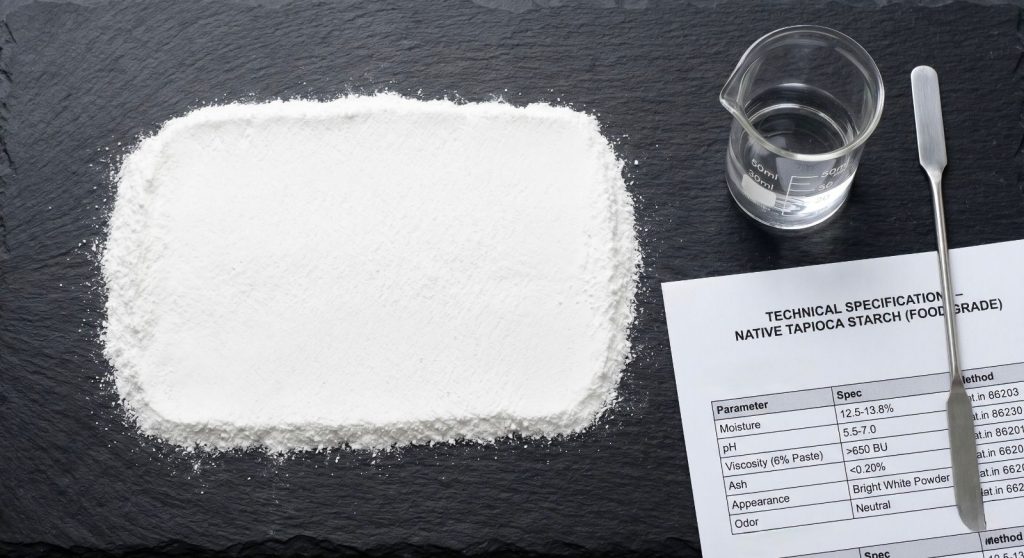
When evaluating a supplier like Amerta Pacific, procurement and R&D teams must look beyond the price per metric ton. The technical specification sheet is the blueprint for how that starch will behave in your production line.
Standard Specification Benchmark
Below are the typical parameters required for high-grade food applications:
| Parameter | Specification Limit | Significance |
| Starch Content | ≥ 85% | Higher purity ensures consistent thickening power. |
| Moisture | ≤ 13.0% | Controls microbial stability and shelf life. |
| pH (10% slurry) | 5.0 – 7.0 | Impacts interaction with acidic or alkaline ingredients. |
| Ash Content | ≤ 0.2% | Indicates the level of mineral purity. |
| Pulp / Fiber | ≤ 0.10 ml/100g | Ensures a smooth, non-gritty mouthfeel. |
| Whiteness | ≥ 92% | Essential for maintaining the visual integrity of the end product. |
| Viscosity (6% sol) | ≥ 600 BU (Brabender Units) | Determines the structural strength of the gel. |
Particle Size (Mesh) Distribution
For most industrial food applications, a 100-mesh sieve pass rate of 99% is standard. However, for specialized coatings or fine confectionery, a 150-mesh or even 200-mesh specification may be required to ensure total solubility and prevent sedimentation in low-viscosity liquids.
Functional Performance in Food Systems
Native tapioca starch is a “low-temperature” starch, meaning it begins the gelatinization process earlier than many of its competitors
Gelatinization and Viscosity
The gelatinization temperature for native tapioca typically ranges between 62°C and 72°C. For a food scientist, this lower energy threshold means faster processing times and reduced thermal degradation of other sensitive ingredients in the mix.
Once gelatinized, it reaches a high peak viscosity but is sensitive to prolonged shear and high acidity. If your manufacturing process involves high-shear blending or retort processing, the specific botanical origin and processing quality of the starch—such as the premium standards maintained by Amerta Pacific—become the deciding factors in batch stability
Texture and Mouthfeel
Native tapioca provides a “long” texture. In the world of rheology, this means the starch paste is cohesive and slightly elastic. This makes it an indispensable tool for:
- Dairy-Free Creams: Creating a rich, fatty mouthfeel without the fat.
- Gluten-Free Baking: Acting as the primary binder to mimic the structure of gluten.
- Noodles and Pasta: Providing the characteristic “chew” or “al dente” texture.
Strategic Sourcing: Why Procurement Teams Choose Amerta Pacific
For a Procurement Manager, the technical spec sheet is only as good as the consistency of the supply chain. Native starch quality can fluctuate based on soil conditions, harvest timing, and processing technology.
Amerta Pacific bridges the gap between raw agricultural output and the rigorous demands of global food manufacturing. By implementing strict quality control protocols at the source, we ensure that every shipment matches the COA (Certificate of Analysis) exactly.
Why our native starch stands out:
- Clean Label Compliance: 100% Non-GMO and free from chemical modification.
- Microbiological Purity: Low TPC (Total Plate Count), yeast, and mold counts, making it safe for sensitive dairy and infant food applications.
- Supply Chain Stability: We leverage our regional logistics expertise to ensure your R&D projects aren’t stalled by raw material shortages.
Frequently Asked Questions (FAQ)
Q: Is native tapioca starch gluten-free? A: Yes. It is naturally gluten-free and is one of the safest ingredients for Celiac-safe food production, provided it is processed in a dedicated facility.
Q: How does native starch differ from modified tapioca starch? A: Native starch is physically extracted and dried. Modified starches undergo chemical, enzymatic, or physical treatments to enhance stability against heat, acid, or freeze-thaw cycles. Native starch is preferred for “Clean Label” branding.
Q: What is the shelf life of native tapioca starch? A: When stored in a cool, dry environment (relative humidity < 70%), native tapioca starch typically has a shelf life of 24 months.
Q: Can native tapioca starch replace corn starch 1:1? A: In many applications, yes. However, because tapioca has higher thickening power and a different texture (stringy vs. short), R&D should conduct pilot batches to calibrate the exact ratio.
Optimize Your Formulation with Amerta Pacific
Navigating the technical nuances of starch functionality requires more than just a datasheet; it requires a partner who understands the science of food manufacturing. Whether you are reformulating for a clean label or scaling a new product line, Amerta Pacific provides high-purity native tapioca starch that meets the world’s most stringent technical standards.
Ready to elevate your product quality? Contact the Amerta Pacific Technical Team today to request a technical data sheet (TDS), safety data sheet (SDS), or to order samples for your next R&D trial.