
Sourcing Tapioca Starch from Indonesia: MOQ, Lead Time, and Certification Guide
For global procurement managers, diversifying the raw ingredient supply chain is a top strategic priority in 2026. Sourcing tapioca starch from Indonesia offers distinct advantages, including competitive pricing, premium root quality from mineral-rich soils, and a robust export infrastructure. However, international logistics requires a clear understanding of regional trade baselines to prevent supply chain bottlenecks.
Navigating foreign supplier compliance, handling shipping timelines, and understanding minimum order volumes can introduce friction into your procurement pipeline. This guide outlines the operational baselines for establishing a reliable supply of Indonesian tapioca starch.
The Direct Answer: Sourcing Indonesian Tapioca Starch Baselines
When sourcing tapioca starch from Indonesia, international procurement managers should expect a standard Minimum Order Quantity (MOQ) of one Full Container Load (FCL), equivalent to 18 to 20 metric tons. Average factory production lead times range from 14 to 21 days, with essential global certifications including HACCP, FSSC 22000, and Halal.
Navigating Minimum Order Quantities (MOQs)
In commercial starch trading, transaction volumes dictate shipping and manufacturing efficiencies. Indonesian suppliers structure their pricing and minimum commitments around container capacities to maximize ocean freight economy.
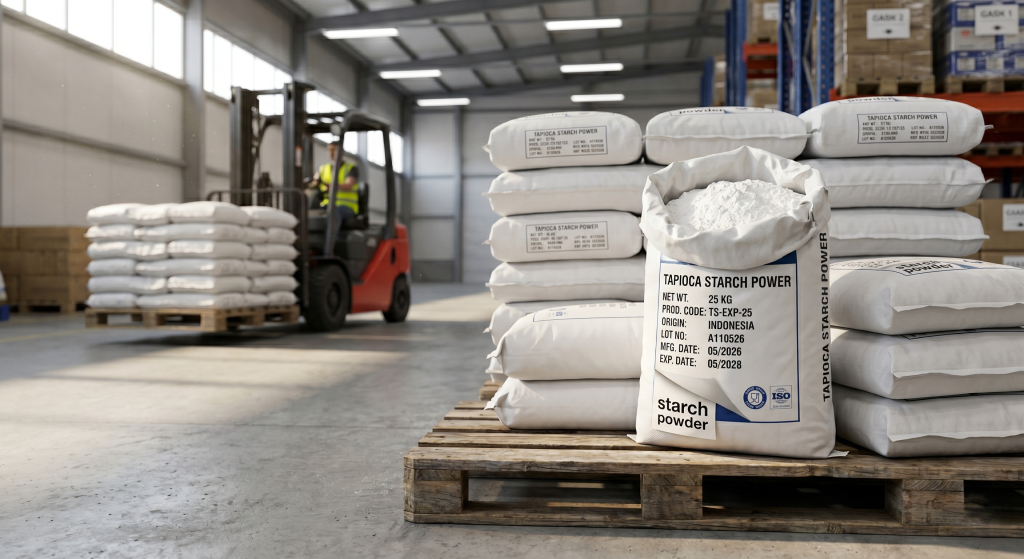
Standard Bulk Orders: The baseline MOQ for food-grade and industrial native tapioca starch is typically 1 Full Container Load (FCL). A standard 20-foot container accommodates approximately 18 to 20 metric tons when packed in standard 25kg or 50kg woven polypropylene (PP) or multi-wall paper bags.
Modified and High-Purity Grades: For specialized modified starches (such as acid-resistant or freeze-thaw stable variants), some suppliers may adjust MOQs to 5 to 10 metric tons for initial trial formulations. However, ordering below full container thresholds significantly elevates per-ton shipping costs.
Sample Shipments: For R&D validation and viscosity testing, reputable trading partners provide smaller air-freight samples ranging from 1kg to 5kg prior to contract execution.
Production and Export Lead Times in 2026
Effective inventory management depends on precise lead-time forecasting. Sourcing from Southeast Asia requires accounting for both agricultural processing windows and maritime freight schedules.
Ex-Factory Production Timelines
Once a Letter of Credit (L/C) or advanced payment is secured, the typical ex-factory production window spans 14 to 21 days. This phase includes harvesting the cassava roots, starch extraction, flash drying, quality control lab testing, and packaging. High seasonal rain patterns can occasionally affect harvest speeds, making it vital to secure supply contracts early in the quarter.
Customs and Port Handling
After leaving the processing plant, local transit and customs clearance at major Indonesian export hubs—such as Tanjung Priok in Jakarta or Tanjung Perak in Surabaya—takes approximately 3 to 7 days. This includes the preparation of export declarations, phytosanitary inspections, and bill of lading generation.
Ocean Freight Transit
Maritime transit times vary significantly by destination country:
- To ASEAN Regions: 3 to 7 days.
- To East Asian Hubs (China, Japan, South Korea): 10 to 15 days.
- To North America (West Coast): 20 to 28 days.
- To Europe: 30 to 45 days.
For B2B manufacturers, switching to a cassava base is not just a cost-saving measure; it is a performance upgrade. Read about Value Engineering: Reducing COGS in Sauces with Native Cassava Starch
Vital Certifications for Global Compliance
Procurement managers cannot risk border rejections or compliance audits. When vetting an Indonesian supplier, verify their certificate portfolio to guarantee seamless entry into your domestic market.
Food Safety & Management Standards
Ensure your sourcing partner operates facilities aligned with international food safety initiatives. Essential credentials include HACCP (Hazard Analysis Critical Control Point) and ISO 9001:2015. For supply chains feeding into major multinational brands, look for FSSC 22000 certification, which validates strict automated hygiene controls.
Dietary and Religious Compliance
Indonesia maintains strict statutory bodies governing dietary standards. A credible exporter must provide a Halal Certification issued by BPJPH, which is globally recognized and satisfies both domestic laws and international Middle Eastern or Southeast Asian markets. For European and American buyers, a valid Kosher Certificate is equally critical for clean-label food applications.
Technical and Export Documentation
Every shipment must be accompanied by three foundational technical documents:
- Certificate of Analysis (COA): Detailing moisture content (typically under 13%), starch content (minimum 85%), pH levels, and ash content.
- Phytosanitary Certificate: Issued by the Indonesian Agricultural Quarantine Agency, confirming the material is free from agricultural pests.
- Material Safety Data Sheet (MSDS): Essential for handling, transport compliance, and warehouse safety management.
Overcoming Sourcing Friction with Amerta Pacific
Managing multiple international entities, local freight forwarders, and quality control inspectors introduces significant execution risk for busy purchasing departments.
Amerta Pacific acts as your dedicated procurement partner on the ground in Indonesia. We eliminate the administrative and logistical complexities of international trade by managing the entire supply chain from source to port. We vet agricultural processors, enforce stringent quality criteria, and manage all export documentation seamlessly.
By choosing Amerta Pacific, your procurement team gains:
- Verified Quality Assurance: Every batch undergoes comprehensive laboratory analysis to guarantee consistent viscosity and purity before container loading.
- Streamlined Logistics: We coordinate inland freight and port customs clearance directly out of major transport hubs, optimizing shipping lanes to minimize your lead times.
- Transparent Compliance: We provide full documentation packages—including COAs, Halal, and Phytosanitary certificates—tailored exactly to your country’s import regulations.
Frequently Asked Questions (FAQ)
Q: What is the standard shelf life of Indonesian tapioca starch? A: Properly stored in a cool, dry warehouse environment in its original unopened packaging, native tapioca starch maintains its functional properties for up to 24 months from the production date.
Q: Can Amerta Pacific accommodate custom packaging requirements? A: Yes. While standard export uses 25kg or 50kg PP bags, we can facilitate jumbo bulk bags (850kg to 1,000kg) equipped with lifting loops, depending on your factory’s automated discharge systems.
Q: What payment terms are standard when sourcing from Indonesia? A: Standard international trade terms involve an Irrevocable Letter of Credit (L/C) at sight or a Telegraphic Transfer (T/T) structure, typically requiring an advance deposit with the remainder payable against the Bill of Lading copy.
Secure Your 2026 Starch Supply Chain
Do not allow shipping delays or compliance gaps to halt your factory’s production. Establishing a reliable, high-yield supply chain starts with partnering with an exporter who understands the operational realities of global procurement.
Ready to simplify your Indonesian sourcing strategy? Contact Amerta Pacific today to submit your Request for Proposal (RFP), request physical product samples, or lock in competitive bulk pricing for the upcoming quarter.