
How Soluble Tapioca Fiber Earns the "High Fiber" Nutrition Label Claim in the US, EU, and ANZ
For regulatory compliance managers, purchasing teams, and R&D directors in the functional food sector, navigating international labeling laws is a complex operational task. When formulating fiber-fortified bars, snacks, or beverages, you cannot assume an ingredient that qualifies as a dietary fiber in one country will automatically pass inspection in another. Global food authorities have heavily tightened their enforcement frameworks over the past several years.
To legally print words like “Source of Fiber” or “High Fiber” on front-of-pack labeling, your ingredients must survive strict physiological and chemical scrutiny. Soluble tapioca fiber (specifically when produced as non-digestible digestion-resistant tapioca dextrin) has emerged as an internationally compliant macro-ingredient. Here is how it successfully aligns with the current regulatory standards of the US, EU, and ANZ markets.
The Direct Answer: Earning Global Fiber Claims
Soluble tapioca fiber earns “high fiber” label status globally by demonstrating true resistance to human enzymatic digestion in the small intestine. Because it passes intact into the large bowel to undergo beneficial prebiotic fermentation, the FDA (US), EFSA (EU), and FSANZ (ANZ) legally recognize it as a valid dietary fiber for nutritional panels.
The United States Market: Meeting Strict FDA Mandates
The US Food and Drug Administration (FDA) fundamentally changed the fiber landscape when it issued a strict rule requiring isolated or synthetic carbohydrates to prove a validated “physiological health benefit” before being classified as dietary fiber.
Moving Past the Isomaltooligosaccharide (IMO) Hurdle
Historically, many manufacturers used cheap Isomaltooligosaccharides (IMOs) derived from starch and labeled them as fiber. The FDA rejected IMOs because the human body easily breaks them down into glucose, spiking blood sugar.
Premium soluble tapioca fiber is manufactured using a controlled enzymatic treatment that forms indigestible alpha-1,4 and alpha-1,6 glycosidic bonds, along with random cross-linked linkages. Because human salivary and pancreatic amylase enzymes cannot split these specific configurations, the ingredient passes through the upper digestive tract unchanged.
Validated Health Benefits
To satisfy the FDA, soluble tapioca fiber delivers clear physiological benefits:
Attenuated Blood Glucose: It slows down the absorption of carbohydrates, preventing sudden post-meal insulin spikes.
Improved Laxation: It increases fecal bulk and supports bowel regularity without causing gas or bloating.
The European Union (EU): Aligning with EFSA Guidelines
The European Food Safety Authority (EFSA) and the European Commission manage fiber claims through a clear, unified definition across all member states.
          [EU/EFSA Functional Dietary Fiber Framework]
                               │
     ┌─────────────────────────┴─────────────────────────┐
     ▼                                                   ▼
[Chemical Structure Baseline]              [Nutritional Profile Impact]
 ├── Carbohydrate polymers with             ├── Resists upper digestion
 │   3 or more monomeric units             ├── Undergoes colonic fermentation
 └── Edible plant origin (Cassava)         └── Low caloric payload (2 kcal/g)
In the EU, dietary fiber includes all carbohydrate polymers with three or more monomeric units that are neither digested nor absorbed in the human small intestine. Because soluble tapioca fiber is a plant-derived polymer extracted from cassava root, it automatically fulfills the primary origin criteria.
Hitting the Quantum Thresholds
To legally leverage nutrition claims under EU Regulation No 1924/2006, your final product must hit the following targets:
“Source of Fiber”: Must contain at least 3 grams of fiber per 100g or at least 1.5g of fiber per 100 kcal.
“High Fiber”: Must contain at least 6 grams of fiber per 100g or at least 3g of fiber per 100 kcal.
Because soluble tapioca fiber syrup or powder boasts a dry-basis fiber content of 90% or greater, formulators can easily hit the 6g threshold without ruining the product’s moisture balance or flavor profile.
Australia and New Zealand (ANZ): FSANZ Compliance
Food Standards Australia New Zealand (FSANZ) regulates nutrition content claims under Schedule 4 of the Food Standards Code.
Like its global counterparts, FSANZ requires rigorous validation that an isolated carbohydrate behaves as a true dietary fiber. Soluble tapioca fiber complies fully with the FSANZ definition as a fraction of edible plant matter that resists digestion, increases stool volume, and stimulates microflora growth in the large intestine.
| Regulatory Region | Governing Body | “High Fiber” Target per Serving/100g | Caloric Value Assignment |
| United States | FDA | $\ge$ 5.6g per Reference Amount (RACC) | 2.0 kcal / gram |
| European Union | EFSA / EC | $\ge$ 6g per 100g of final product | 2.0 kcal / gram (8 kJ/g) |
| Australia & NZ | FSANZ | $\ge$ 7g per serving (Excellent Source) | 2.0 kcal / gram (8.5 kJ/g) |
Sourcing Regulatory-Compliant Fiber with Amerta Pacific
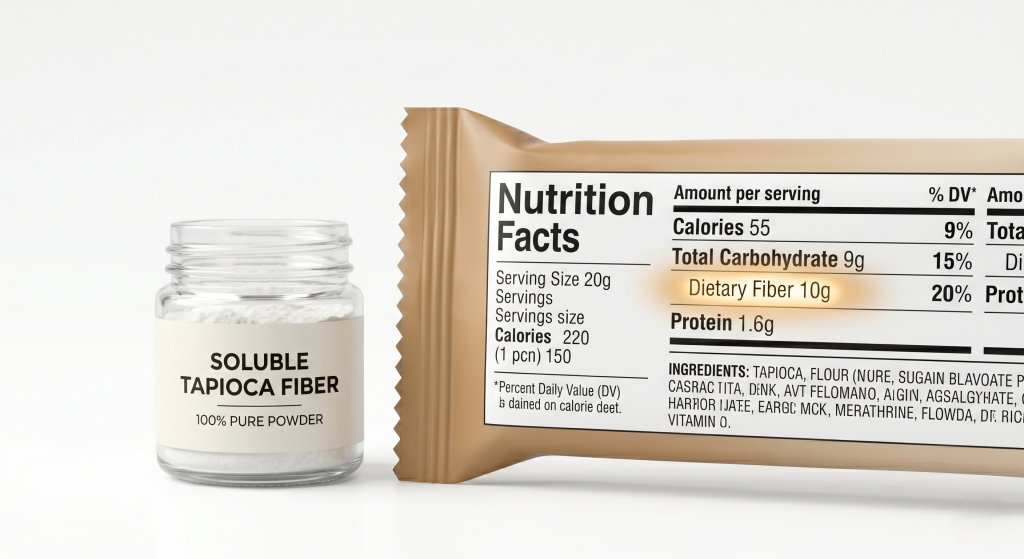
Formulating a product for cross-border international retail requires an ingredient supplier that understands compliance paperwork. Using a low-grade or poorly documented starch derivative can lead to customs holds, regulatory fines, and expensive packaging recalls.
At Amerta Pacific, we supply premium, industrial-grade Soluble Tapioca Fiber (syrup and powder formats) engineered to pass the absolute strictest global food audits. Our manufacturing partners use advanced chromatographic separation techniques to guarantee high fiber fractions and stable molecular weight distribution in every single batch.
Partnering with Amerta Pacific provides your compliance and procurement teams with:
Certified 90%+ Dietary Fiber Content: Ensuring your R&D calculations reliably translate to compliant, defensible nutrition facts panels.
Comprehensive Compliance Packages: Immediate access to full Certificates of Analysis (COA), analytical testing methodology proof, and non-GMO statements.
Flawless Clean-Label Appeal: Completely hypoallergenic, gluten-free, and corn-free, allowing for highly marketable ingredient decks.
Frequently Asked Questions (FAQ)
Q: Can soluble tapioca fiber be used in keto-certified products in the US? A: Yes. Because true digestion-resistant tapioca fiber does not spike blood glucose or impact insulin levels, its carbohydrate fraction can be subtracted from total carbohydrates to calculate “Net Carbs,” making it ideal for keto-certified formulations.
Q: How is the fiber content of soluble tapioca fiber measured in a laboratory? A: To verify compliance for the FDA, EFSA, and FSANZ, the ingredient should be analyzed using the AOAC 2009.01 or AOAC 2011.25 analytical methods. These advanced multi-enzyme tests accurately quantify low-molecular-weight and high-molecular-weight soluble dietary fibers.
Q: Does temperature during food processing degrade the fiber content? A: No. Soluble tapioca fiber exhibits exceptional heat and acid stability. It will not break down or revert into simple sugars during industrial pasteurization, UHT treatment, or high-temperature baking processes.
Protect and Power Your International Brand Strategy
Expanding your functional product line into lucrative global markets requires raw materials that are completely beyond regulatory reproach. Utilizing an inherently stable, scientifically recognized plant fiber allows your brand to confidently print powerful nutrition claims, simplify your global ingredient sourcing, and capture market share across the US, EU, and ANZ.
Ready to secure your global regulatory compliance? Contact Amerta Pacific today to consult with our technical specialists, request formal specification documentation, and secure competitive volume contracts for your upcoming production calendar.