
Soluble Tapioca Fiber in Functional Gummy Supplements: Gelatin vs Pectin Matrix Compatibility Guide for Manufacturers
In the rapidly expanding nutraceutical sector, functional gummies have evolved from a novelty format into a dominant delivery vehicle for vitamins, minerals, active botanicals, and prebiotics. However, as consumers demand sugar-free and low-sugar formulations, formulators face a major technical hurdle: replacing the bulk, solids, and mouthfeel of corn syrup and sucrose without destroying the hydrocolloid gel network. Soluble tapioca fiber (resistant dextrin) has become the gold-standard functional bulking agent for low-sugar gummy manufacturing. Its high solubility, low hygrosocopicity, and high thermal stability allow formulators to achieve high fiber loads and zero-sugar claims while preserving the elasticity and clarity of both gelatin and pectin gelling matrices.
Direct Answer:
Soluble tapioca fiber replaces sugar solids in functional gummies without compromising gel setting times or structural integrity. It integrates seamlessly into gelatin matrices to preserve elastic chew and works synergistically with pectin by maintaining solid levels (65-78 degree Brix) and pH tolerance required for precise thermal gelation.
Hydrocolloid Matrix Compatibility: Gelatin vs. Pectin
Choosing between gelatin and pectin dictates processing temperatures, depositing speeds, and the ultimate textural profile of a functional gummy. Soluble tapioca fiber exhibits unique interactions within both hydrocolloid systems.
                  [Soluble Tapioca Fiber + Hydrocolloid Base]
                                       │
                ┌──────────────────────┴──────────────────────┐
                ▼                                             ▼
     [Gelatin Matrix System]                       [Pectin Matrix System]
   (Thermoreversible / Elastic)                (Irreversible / Firm Break)
                │                                             │
   • Preserves "bounce" & clarity             • Supports rapid gelling (high Brix)
   • Prevents cold-flow deformation           • Stable across low pH processing
   • Lowers water activity (Aw < 0.62)        • Ideal for vegan / plant-based lines
Technical Comparison: Matrix Performance with Resistant Dextrin
| Formulation & Process Parameter | Gelatin Matrix System | Pectin Matrix System | Manufacturing Impact |
| Gelling Temperature Range | 30°C – 35°C (Cooling required) | 75°C – 85°C (Rapid set) | Pectin sets faster, requiring higher deposit temperatures. |
| Brix Threshold for Setting | 60-68 Brix | 72-78 Brix | Soluble tapioca fiber provides needed solids without crystalizing. |
| Optimal Processing pH | 4.0 – 6.0 | 3.2 – 3.5 | Tapioca fiber remains completely stable across acidic pH profiles. |
| Textural Profile | Elastic, bouncy, elastic chew | Firm, clean bite, quick melt | Fiber preserves characteristic mouthfeel in both matrices. |
| Vegan / Clean Label Status | Non-Vegan (Animal-derived) | 100% Plant-Based | Pectin + Tapioca Fiber delivers a 100% vegan, high-fiber claim. |
Overcoming Processing Challenges: Water Activity, Cooking, and Depositing
Replacing bulk sugar with functional fiber alters the boiling point, cooking viscosity, and final water activity of the gummy slurry.
Preventing Moisture Migration and Cold Flow
Two common processing defects in low-sugar gummy manufacturing are syneresis (sweating) and cold flow (gummies losing shape over time):
Water Activity Control: Functional gummies must maintain an between 0.58 and 0.62. Soluble tapioca fiber binds free water effectively, keeping low and preventing active nutraceutical degradation or microbial growth.
Viscosity Management During Cooking: Because soluble tapioca fiber has a low molecular weight and low viscosity under heat, the slurry flows smoothly through jet cookers and starchless depositing nozzles without tailing or clogging.
Browning Prevention: Unlike fructooligosaccharides (FOS) or reducing sugars, resistant dextrin does not undergo premature Maillard browning during high-temperature cooking, preserving bright visual clarity.
This heat and acid tolerance is essential for modern confectionery lines, as highlighted in our dedicated guide on low-sugar gummy formulations with soluble tapioca fiber.
Nutritional and Digestive Advantages in Supplement Formulations
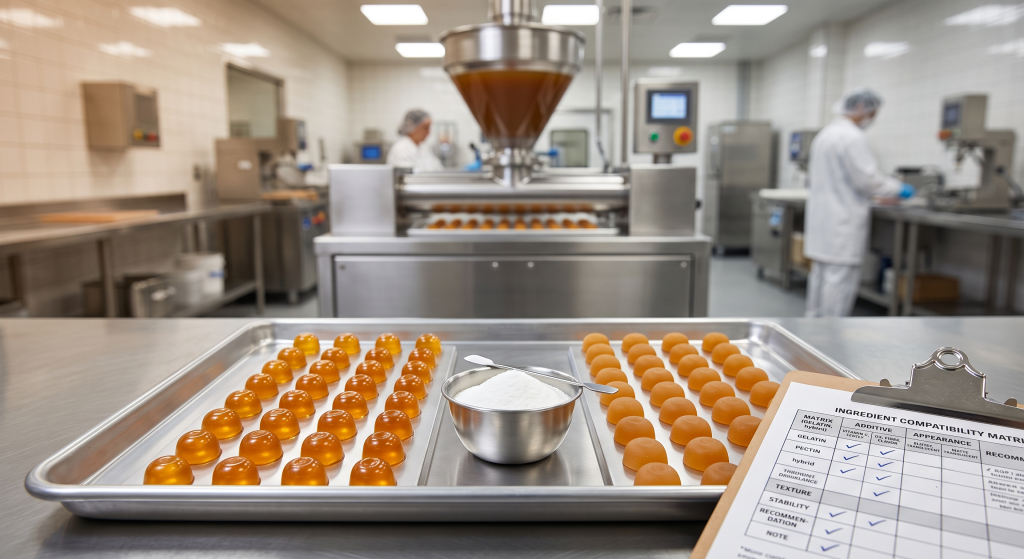
Functional gummy brands often target gut health, immune support, or metabolic wellness. Integrating soluble tapioca fiber adds a dual benefit: sugar reduction and prebiotic enrichment.
Gentle Digestion vs. Traditional Prebiotics
Many low-sugar gummies rely on inulin or chicory root fiber, which frequently cause severe consumer complaints like gas, bloating, and abdominal cramping at effective doses.
Soluble tapioca fiber offers superior gastrointestinal tolerance up to 30 grams per day due to its slow, gradual fermentation curve in the colon. This allows supplement brands to deliver a functional prebiotic dose per serving without digestive discomfort. For a deeper breakdown of digestibility and microflora support, explore our B2B comparison of resistant dextrin vs inulin and the underlying science of prebiotics and resistant dextrin in microbiome health.
Why Supplement Manufacturers Partner with Amerta Pacific
Formulating high-margin, low-sugar gummies requires raw materials with exceptional purity and tight technical parameters. Amerta Pacific supplies high-purity soluble tapioca fiber specifically refined for demanding confectionery and nutraceutical applications.
The Amerta Pacific Manufacturing Edge
Ultra-High Clarity: Our soluble fiber dissolves completely clear in water, ensuring vibrant, translucent colors in both starch-molded and starchless gummy lines.
Guaranteed High Fiber Yield: Standardized to ≥ 85% to 90% dietary fiber on a dry basis, giving formulators exact dosing control for front-of-pack claims.
Consistent Batch Viscosity: Our controlled polymerization ensures consistent slurry viscosity batch after batch, protecting automated depositing lines from downtime.
To secure material engineered specifically to withstand rigorous thermal processing, select a verified high-stability soluble tapioca fiber supplier.
Frequently Asked Questions (FAQ)
Q: Does soluble tapioca fiber affect the setting time of pectin gummies?
A: No. Because soluble tapioca fiber contributes to total soluble solids (Brix) without competing aggressively for water required by hydrocolloid polymers, pectin sets reliably within standard cooling tunnels.
Q: Can soluble tapioca fiber be used in sugar-free gummies with sugar alcohols?
A: Yes. Soluble tapioca fiber works synergistically with polyols like maltitol, erythritol, or sorbitol. It helps reduce the cooling effect of polyols while adding natural prebiotic fiber to the nutrition panel.
Q: What is the recommended inclusion rate for soluble tapioca fiber in gummies?
A: Standard inclusion rates range from 15% to 35% of the total recipe weight, depending on target sugar reduction goals and desired fiber content per gummy serving.
Q: Will tapioca fiber stick to starch molds during curing?
A: No. Its low hygroscopicity prevents excess moisture absorption from Mogul starch beds, ensuring clean demolding and minimal dusting requirements.
Elevate Your Gummy Manufacturing with Amerta Pacific
Overcome sugar reduction challenges and deliver high-performance functional gummies that consumers love. Amerta Pacific provides high-purity soluble tapioca fiber tailored to meet the strict technical standards of modern nutraceutical production.
Ready to optimize your gummy matrix and request factory samples? Contact the Amerta Pacific R&D Support Team today to request a Technical Data Sheet (TDS), review formulation guidelines, or order bench-test samples for your next trial run.