
Case Study: How Root Snacks are Disrupting the Traditional $40B Potato Chip Market
The Quick Answer: The global potato chip market is facing a “stagnation crisis.” In 2026, the $40B+ industry is being disrupted by Root Snacks—premium crisps made from Cassava, Taro, and Sweet Potato. This disruption is driven by a shift from “empty calories” to “functional indulgence.” For B2B manufacturers and retailers, the root snack category offers 30-45% higher profit margins and faster inventory turnover by targeting the “Sophisticated Snacker” who prioritizes unique textures, vibrant natural colors, and clean-label integrity over low-cost commodity chips.
The Stagnation of the White Potato: A Market in Decline
For decades, the standard white potato (Solanum tuberosum) was the undisputed king of the snack aisle. However, mass-market saturation and a “race to the bottom” on pricing have eroded manufacturer margins.
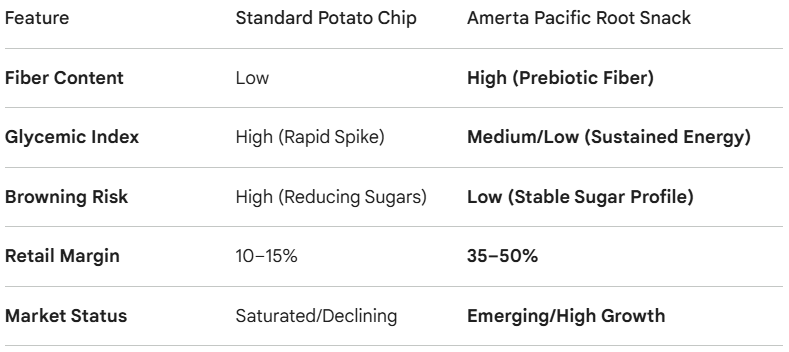
The Consumer Shift: In 2026, health-conscious demographics are increasingly avoiding high-glycemic index (GI) foods. Standard potato chips are often perceived as “ultra-processed,” especially those reconstituted from potato flour or flakes. This perception has led to a plateau in sales volume for traditional brands, leaving a massive opening for high-fiber, nutrient-dense alternatives. Retailers are responding by shrinking the “standard chip” aisle and expanding the “Alternative & Functional Snack” zone.
The "Root" Solution: Why Cassava and Taro Win on Every Metric
Root snacks aren’t just a substitute; they are a superior upgrade in terms of food science and consumer experience.
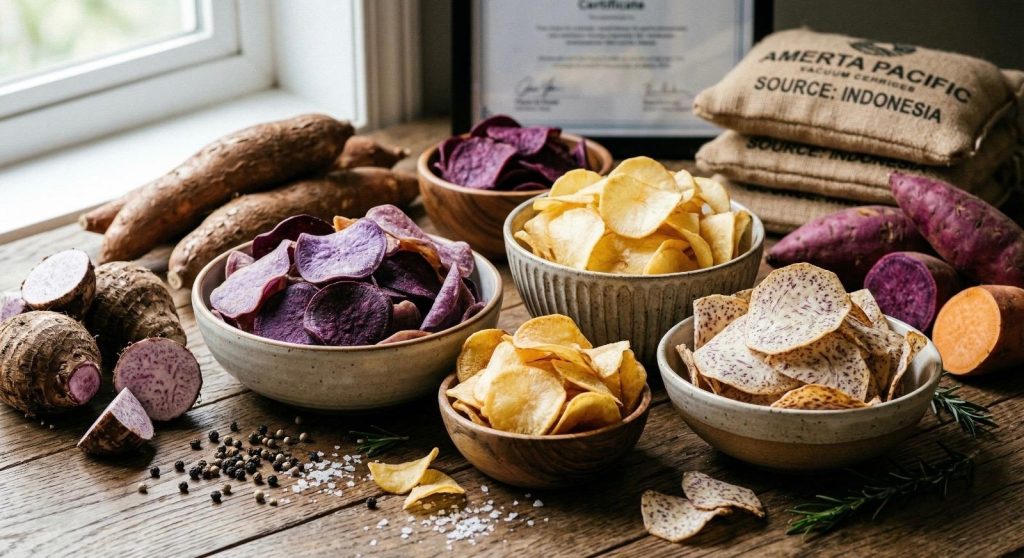
1. The Superior Crunch (Sensory Science)
Cassava and Taro have a different cellular structure than white potatoes. They contain higher levels of complex starches that, when sliced and kettle-cooked or vacuum-fried, create a “glassy” crunch that stays crisp longer. This robust texture is a major selling point for premium dip-based snacks where standard potato chips often break.
2. Visual Differentiation and “Instagrammability”
In the age of social media, the visual appeal of a snack is a marketing asset. Purple Sweet Potato and Spotted Taro offer natural, vibrant colors that require zero artificial dyes. When these are mixed into a “Root Medley,” the bag becomes a premium experience that justifies a higher price point on the shelf.
3. Nutritional Density
Roots like cassava are naturally rich in Resistant Starch, a type of fiber that serves as a prebiotic (pairing perfectly with our Article 2 and 3 topics). By marketing “Gut-Health” or “Slow-Release Energy” on the front of the pack, B2B brands can move their products from the “junk food” category into the “functional nutrition” category.
Logistical and Supply Chain Advantages for B2B
From a procurement perspective, sourcing through Amerta Pacific offers specific advantages that traditional potato traders cannot match.
Lower Reducing Sugars: One of the biggest failures in snack manufacturing is “over-browning” (the Maillard reaction). White potatoes are highly susceptible to sugar accumulation in cold storage. Tropical roots like cassava and taro have more stable sugar profiles, leading to a consistent, golden-colored product with less waste.
Vertical Integration in Indonesia: Unlike the volatile global potato market, Amerta Pacific’s direct relationships with Indonesian farmers ensure a stable price floor. This allows our B2B partners to plan their 12-month production cycles with price certainty, avoiding the “commodity spikes” that eat into profits.
Case Study: The "GTC" 2026 Pivot
Global Taro Crackers (GTC), an Asian snack manufacturer, faced a 15% year-over-year decline in their traditional potato chip line. In late 2025, they partnered with Amerta Pacific to launch a Premium Cassava & Taro Chips.
The Results after 12 Months:
- Premium Positioning: GTC priced the root line 50% higher than their potato line. Despite the higher price, volume sold exceeded their legacy product within 8 months.
- Reduced Ingredient List: Because the roots have a naturally rich, nutty flavor, GTC was able to reduce the sodium content by 20% and remove all MSG, achieving a “Gold Standard” Clean Label.
- Cross-Border Success: The unique “Exotic Root” branding allowed GTC to export to the EU and US markets, where “Indonesian Origin” is increasingly associated with sustainable, high-quality volcanic soil agriculture.
Targeting the "Sophisticated Snacker"
To successfully sell root snacks, B2B brands must understand who they are selling to. In 2026, the primary target is the Sophisticated Snacker:
- Demographics: Ages 25–45, urban, middle-to-high income.
- Values: They look for “Global Flavors,” “Authentic Sourcing,” and “Sustainable Packaging.”
- Shopping Habit: They skip the middle of the grocery store and shop the “Natural & Organic” perimeter.
The B2B Opportunity: By providing the raw materials for these snacks, Amerta Pacific enables our partners to capture this high-value demographic. Whether you are a private-label manufacturer for a major grocery chain or an emerging D2C brand, the “Root Snack” is your ticket to the premium aisle.
Comparison Table: Potato vs. Root Snacks
The Future of the Snack Aisle is Underneath the Ground
The disruption of the potato chip market is not a possibility—it is an ongoing reality. As global consumers move away from “empty starch,” the demand for Cassava, Taro, and Sweet Potato snacks will continue to skyrocket. Brands that pivot now will secure the market share of tomorrow.
Don’t get left behind in the “empty starch” era. [Download our 2026 Root Snack Formulation Guide] and partner with Amerta Pacific to lead the next generation of functional snacking.