
Cassava Flour Cyanide (HCN) Limits, Testing Methods, and Codex Compliance: A Food Safety Guide for Importers
Sourcing industrial agricultural products across international borders requires a flawless approach to food safety and regulatory compliance. For importers, procurement managers, and Quality Assurance (QA) teams dealing with cassava products, managing cyanogenic glycosides is the absolute top priority. Raw cassava root naturally contains these compounds as a biological defense mechanism. However, when properly processed into high-quality commercial flour, the risk is entirely mitigated. Understanding the international regulatory thresholds, the biochemistry of the processing mitigation, and the analytical testing methods used to verify safety is critical for preventing customs rejections, product recalls, and severe brand damage.
Direct Answer: To comply with global food safety standards, importers must ensure that total hydrocyanic acid (HCN) in cassava flour does not exceed 10 mg/kg (ppm), as mandated by the Codex Alimentarius Standard 176-1989. Compliance is achieved through rigorous industrial processing—involving maceration, washing, and flash-drying—and must be verified on every batch via validated enzymatic or spectrophotometric testing on the Certificate of Analysis (COA).
The Biochemistry of Cassava: Managing Cyanogenic Glycosides
Raw cassava roots contain two primary cyanogenic glycosides: linamarin (approximately 95%) and lotaustralin (approximately 5%). In their intact state within the plant’s cellular vacuoles, these compounds are not inherently toxic. The risk arises when the plant tissue is mechanically damaged.
The Hydrolysis and Volatilization Process
When the cassava root is grated, crushed, or chewed, it releases an endogenous enzyme called linamarase. This enzyme rapidly hydrolyzes the linamarin into glucose, acetone, and free hydrogen cyanide (HCN). Because HCN is a highly volatile gas (with a boiling point of 25.6°C), industrial manufacturing takes advantage of this physical property to eliminate it.
Mechanical Disruption and Washing: Industrial pulping breaks the cell walls, forcing the linamarase to convert the glycosides into free HCN. Extensive washing then removes a massive portion of the water-soluble compounds.
Thermal Flash Drying: As the wet cassava mash is pumped into high-temperature pneumatic flash dryers, the remaining volatile HCN gas completely evaporates, leaving behind a safe, clean, and stabilized flour.
If this drying step is incomplete and moisture remains too high, residual enzymatic activity or mold growth can occur. Maintaining strict moisture thresholds is not only a safety factor but also dictates long-term stability, as outlined in our manual on cassava flour shelf life, moisture control, and storage protocols.
Codex Alimentarius and Global Regulatory Frameworks
For cross-border trade, the Codex Alimentarius serves as the universal baseline for food safety. Customs agencies in North America, Europe, and Asia heavily rely on these harmonized standards to evaluate incoming shipments of cassava-based ingredients.
International HCN Thresholds for Edible Cassava Flour
| Regulatory Body / Standard | Maximum Total HCN Limit | Procurement Significance |
| Codex Alimentarius (CXS 176-1989) | < 10 mg/kg | The global benchmark for “sweet” or processed edible cassava flour. |
| European Food Safety Authority (EFSA) | < 10 mg/kg | Strict adherence required for EU import clearance; frequently tested at port of entry. |
| US FDA | Follows Codex < 10 mg/kg | Classifies properly processed cassava as GRAS (Generally Recognized as Safe). |
| FSANZ (Australia/New Zealand) | < 10 mg/kg | Enforces mandatory testing limits for ready-to-eat cassava products and raw flours. |
Failing to meet these strict thresholds will result in immediate shipment impoundment. For brands formulating heritage foods for global distribution, verifying this compliance at the sourcing stage is the foundational step discussed in our cassava flour ethnic food manufacturing export guide.
QA Verification: Validating Supplier HCN Testing Methods
A Certificate of Analysis (COA) is a legally binding document, but its value depends entirely on the analytical methods the supplier employs. QA teams cannot accept generic “Pass/Fail” statements regarding cyanide; they must require quantitative data backed by recognized scientific methodology.
Accepted Analytical Testing for HCN
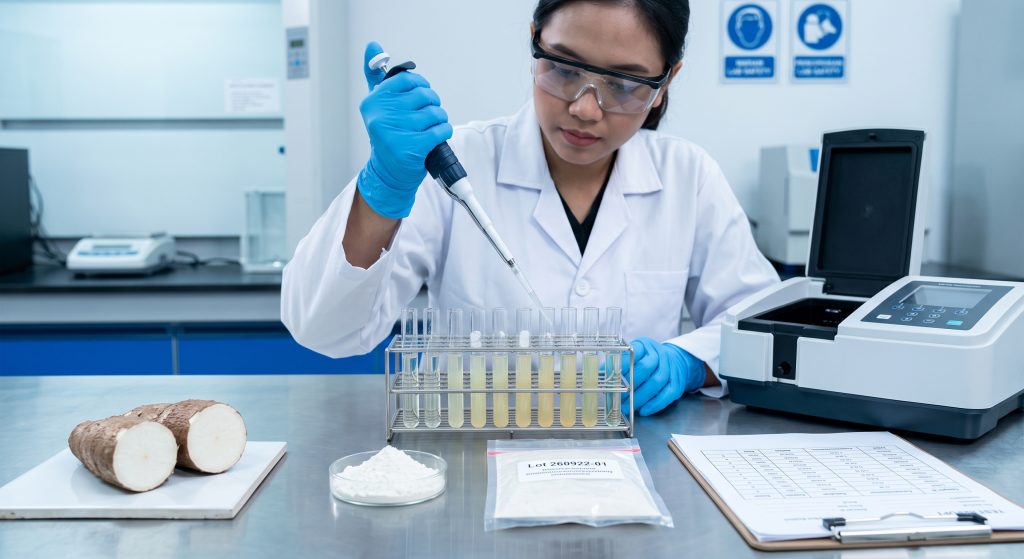
Spectrophotometric Method (Picrate Paper / Alkaline Picrate): A widely accepted industrial method where the evolved HCN gas reacts with picrate paper, turning it from yellow to varying shades of red. The color intensity is measured spectrophotometrically to provide an accurate quantitative ppm reading.
Enzymatic Assay: The most precise method for low-level detection. It utilizes added exogenous linamarase to ensure 100% of the bound glycosides are converted to free cyanide before measurement, ensuring no “hidden” cyanide remains in the flour matrix.
Silver Nitrate Titration: An older, volumetric method still used in some regions. While acceptable for bulk feed applications, it often lacks the strict sensitivity required to confidently verify levels below 10 mg/kg for human food grades.
Understanding how to audit and challenge these specific analytical testing methodologies is a core competency for procurement directors, closely mirroring the QA vetting processes detailed in our resistant dextrin COA and solubility fiber procurement guide.
Why Global Importers Trust Amerta Pacific for Food Safety
Sourcing safe, export-ready cassava flour requires an ingredient manufacturer that controls every step of the supply chain from root selection to final packaging. Amerta Pacific supplies premium, rigorously tested cassava flour that exceeds the strictest international food safety standards.
The Amerta Pacific Compliance Guarantee
Low-Cyanide Cultivar Selection: We source exclusively from “sweet” cassava cultivars naturally bred to contain exceptionally low baseline levels of cyanogenic glycosides.
Advanced Volatilization Technology: Our proprietary wet-milling and high-temperature flash drying systems guarantee the complete extraction and evaporation of HCN.
Certified Third-Party Testing: Every single production lot undergoes rigorous quantitative spectrophotometric testing, providing you with a transparent, Customs-ready COA proving HCN levels are well below 10 mg/kg.
Frequently Asked Questions (FAQ)
Q: Can baking or cooking cassava flour at the manufacturing facility further reduce HCN levels? A: Yes. Because HCN is highly volatile, the thermal processing involved in baking, frying, or extruding the final food product will drive off any microscopic residual cyanide. However, the raw flour itself must still test below 10 mg/kg before entering the factory floor.
Q: Is there a difference between “sweet” and “bitter” cassava regarding flour manufacturing? A: Yes. “Bitter” cassava contains significantly higher levels of cyanogenic glycosides (often > 500 mg/kg in raw form) and is typically reserved for industrial starch extraction, where heavy chemical processing removes the cyanide. Premium edible cassava flour is processed exclusively from “sweet” root varieties (usually < 50 mg/kg raw).
Q: Will prolonged storage reduce the HCN levels in cassava flour? A: No. Once the flour is dried to a stable moisture content (below 12%), enzyme activity ceases. The HCN level measured at the time of packaging will remain static throughout its shelf life.
Q: How often should an importer test incoming shipments for HCN? A: While reputable suppliers provide batch-specific COAs, QA best practices dictate that importers should conduct random third-party verification testing on at least 1 in every 5 incoming containers, particularly when onboarding a new supply route.
Secure Your Cassava Supply Chain with Amerta Pacific
Do not risk your brand’s reputation or face costly customs rejections due to non-compliant raw materials. Amerta Pacific delivers the ultra-safe, high-purity cassava flour you need to easily clear international borders and formulate with absolute confidence.
Ready to review our QA documentation and regulatory compliance? Contact the Amerta Pacific Regulatory and Sales Team today to request a comprehensive Technical Data Sheet (TDS), review our batch-specific COA testing protocols, or secure certified samples for your QA laboratory.