
Tapioca Starch in Plant-Based Cheese: Stretch, Melt, and Shred Performance Guide for Dairy Alternative Manufacturers
Replicating the functional mechanics of bovine casein is the single greatest technical hurdle in plant-based dairy formulation. In traditional dairy cheese, a three-dimensional network of calcium-linked casein micelles gives cheddar its clean shred and mozzarella its signature hot stretch and blistering melt. When formulating vegan cheese blocks, slices, and shreds, removing casein leaves an oil-in-water emulsion that lacks structural elasticity. For R&D teams, food formulators, and dairy alternative manufacturers, tapioca starch serves as the foundational structural polymer to bridge this gap. Extracted from the cassava root, its unique viscoelastic profile delivers the cohesive pull, smooth thermal melt, and mechanical shreddability required to scale commercial plant-based cheeses.
Direct Answer: Tapioca starch replicates the functional behavior of dairy casein in plant-based cheese by forming a thermo-responsive, viscoelastic gel matrix. Its high amylopectin content creates long, cohesive textures that deliver an authentic mozzarella-style stretch and smooth melt when heated, while providing sufficient cold-set firmness for clean industrial shredding and slicing.
The Rheology of Vegan Cheese: Achieving Stretch and Melt Without Casein
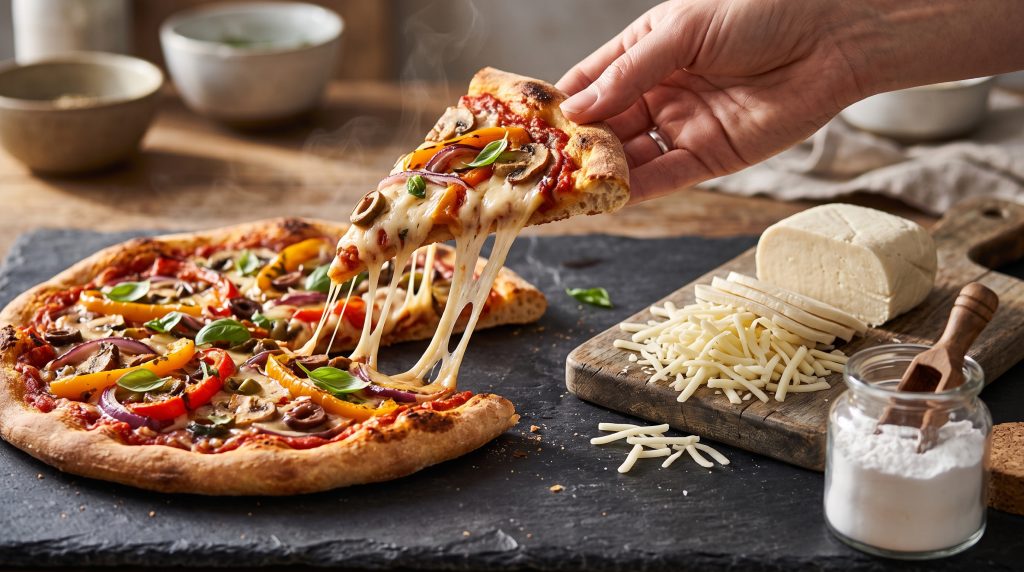
Most commercial plant-based cheeses are constructed from a base of water, solid plant lipids (typically refined coconut oil or shea butter), and functional starches. Without the right carbohydrate architecture,加热 (heating) a vegan cheese simply melts the coconut oil, resulting in an unappealing pool of translucent grease rather than a cohesive, stretchy melt.
Viscoelasticity and the “Mozzarella Pull”
Unlike cereal starches (such as corn or wheat) that contain high levels of linear amylose and form rigid, brittle, opaque gels, native tapioca starch consists of approximately 82% to 85% branched amylopectin.
Long Cohesive Texture: When gelatinized during the cheese cooking phase (62°C to 72°C), tapioca starch granules swell to form a clear, highly elastic, and stringy paste. When the finished cheese is reheated in a pizza oven, this starch matrix softens in tandem with the melting coconut oil, stretching into long, pliable strands without snapping prematurely.
Emulsion Stabilization: The gelatinized starch network physically traps melted fat globules during baking, preventing oiling-off (lipid separation) and ensuring a glossy, homogeneous surface melt.
Browning and Blistering: Tapioca starch promotes controlled surface dehydration during high-heat baking, creating the golden-brown blistering expected on gourmet pizzas and paninis.
For spreadable formats like vegan cream cheese or soft brie alternatives, the same starch-lipid interaction can be calibrated to improve spreadability and reduce caloric density, as detailed in our guide on using tapioca starch as a fat replacer in low-fat dairy and spreads.
Balancing Cold-Set Shred Performance with Hot Melt
A major pain point for dairy alternative manufacturers is the trade-off between cold-block firmness and hot-melt fluidity. If a vegan cheese block is too soft after cooling, it gums up high-speed industrial shredding blades and clumps inside retail pillow packs. Conversely, if it is over-stabilized with high-amylose starches to improve shredding, the cheese refuses to melt when heated by the consumer.
Starch Matrix Comparison in Plant-Based Cheese Systems
| Functional Parameter | Native Tapioca Starch | Potato Starch | Corn / Maize Starch | Formulation Impact in Vegan Cheese |
| Hot Stretch (Elasticity) | Exceptional (Long, cohesive pull) | Moderate to High | Poor (Short, brittle texture) | Tapioca is mandatory for mozzarella and provolone styles. |
| Thermal Melt Flow | Smooth, glossy, thermo-softening | High viscosity melt | Rigid (Resists remelting) | Tapioca ensures slices melt evenly over burgers and toast. |
| Cold Block Firmness | Moderate (Flexible gel) | Firm (High retrogradation) | Very Firm / Brittle | Often blended with potato starch or hydrocolloids for hard cheddar blocks. |
| Flavor Profile | Completely neutral | Slight earthy/root note | Distinct cereal/grain note | Preserves delicate cultured vegan butter and lactic acid flavors. |
| Gel Clarity | Highly translucent | Clear | Opaque / Cloudy | Allows clean expression of natural annatto or beta-carotene colors. |
To achieve the ideal balance in shredded cheese lines, formulators frequently utilize a synergistic starch system pairing the unmatched hot-stretch and melt of tapioca starch with a secondary rigid starch or hydrocolloid (such as kappa-carrageenan or locust bean gum) to optimize cold-blade machinability.
Formulating Clean-Label and Nutrient-Dense Dairy Alternatives
Early generations of vegan cheese relied heavily on chemically modified food starches (such as octenyl succinic anhydride [OSA] or acid-thinned starches) to force emulsification and cold-block setting. Today, retail buyers and consumers actively scrutinize ingredient decks, demanding recognizable, clean-label components.
Transitioning to Native Tapioca and Protein-Enriched Matrices
By optimizing shear rates, cooking temperatures, and cooling curves in scraped-surface heat exchangers or twin-screw extruders, R&D teams can replace chemically modified starches with high-purity native tapioca starch. This allows brands to declare simple “Tapioca Starch” on the packaging, aligning with the broader industry shift detailed in our analysis of the future of clean label cassava as a hero ingredient.
Furthermore, as consumers demand better nutritional parity with traditional dairy, formulators are moving beyond pure oil-and-starch blocks by introducing plant proteins. Integrating tapioca starch alongside clean plant proteins allows manufacturers to maintain meltability while boosting nutritional profiles, utilizing the same structural principles explored in our guide on pea protein isolate in functional yogurt and dairy alternatives.
Quality Benchmarks for Vegan Cheese Procurement
In continuous plant-based cheese manufacturing, minor deviations in starch viscosity or moisture content can ruin an entire production run, resulting in blocks that either fail to set in the cooling tunnel or weep moisture in the packaging.
Critical Specification Checklist for Buyers
Peak Viscosity Consistency: Must be verified via Brabender Viscoamylograph (typically 650 – 850 BU), ensuring predictable thickening and elasticity inside continuous cookers.
Whiteness Index: >90%. A pure white starch base is essential for mozzarella styles and ensures uniform color dosing when formulating yellow cheddars or goudas.
pH Level: 5.0 – 6.5. A clean, neutral pH ensures the starch does not buffer or interfere with the precise lactic acid and citric acid additions required to give vegan cheese its sharp, tangy bite.
Microbiological Purity: Low Total Plate Count (< 5,000 CFU/g) and strict control of yeast and mold (<100 CFU/g) to protect refrigerated shelf life in sliced and shredded formats.
Why Dairy Alternative Brands Partner with Amerta Pacific
Scaling plant-based cheese from kitchen benchtop prototypes to multi-ton industrial runs requires a starch supplier committed to analytical precision. Amerta Pacific supplies premium, dairy-alternative-grade tapioca starch engineered to deliver reliable rheological performance batch after batch.
The Amerta Pacific Manufacturing Advantage
Standardized Amylopectin Functionality: We source and process specific cassava cultivars to guarantee consistent viscoelasticity, ensuring your mozzarella shreds stretch identically every time.
Zero Sensory Interference: Our multi-stage cyclone washing process strips away trace proteins and lipids, delivering an odorless, flavorless starch that lets your cultured dairy notes shine.
Dedicated B2B Logistics: With flexible packaging from 25 kg bags to 1,000 kg FIBC bulk totes and comprehensive COA documentation, we secure your supply chain against costly production delays.
Frequently Asked Questions (FAQ)
Q: Can native tapioca starch create a sliceable vegan cheese block on its own? A: Native tapioca starch excels at creating elasticity, melt, and stretch, but it forms a relatively soft gel upon cooling. For firm, sliceable blocks or fine shreds, R&D teams typically blend tapioca starch (at 10%–18%) with a firmer gel-forming starch (like potato starch) or a small dose of carrageenan to achieve the necessary cold-set rigidity.
Q: At what temperature must the vegan cheese mass be cooked to fully activate tapioca starch? A: While tapioca starch begins gelatinizing between 62°C and 72°C, plant-based cheese emulsions containing high levels of coconut oil and lower water availability should be cooked to 80°C–85°C under high shear to ensure complete granule hydration and maximum stretch development.
Q: Why is my plant-based cheese oiling off when baked on a pizza? A: Oiling-off occurs when the starch-hydrocolloid matrix is not strong enough to hold the melted coconut oil in suspension at high temperatures. Increasing the ratio of tapioca starch or increasing shear during the initial cooking phase will tighten the emulsion and trap the lipid droplets effectively.
Q: Does tapioca starch cause retrogradation (hardening) in vegan cheese over refrigerated storage? A: Because tapioca starch has a low amylose content, it retrogrades much slower than corn or wheat starch. While some initial retrogradation during the first 24–48 hours of chilling is necessary to firm up the block for shredding, tapioca starch prevents the cheese from becoming overly brittle or crumbly over its shelf life.
Perfect Your Plant-Based Cheese Matrix with Amerta Pacific
Deliver the authentic stretch, silky melt, and clean shred that converts skeptical consumers into loyal buyers. Amerta Pacific provides the high-purity, rheologically standardized tapioca starch required to engineer market-leading vegan cheeses.
Ready to optimize your dairy alternative formulations? Contact the Amerta Pacific R&D Support Team today to request a Technical Data Sheet (TDS), review Brabender viscosity curves, or order bench-test samples for your next pilot trial.