
What Is the Difference Between Cassava Flour and Tapioca Starch? The Definitive B2B Answer
For food formulators, R&D teams, and procurement managers, confusing cassava flour with tapioca starch is a costly operational mistake. While both ingredients originate from the exact same plant—the cassava root (Manihot esculenta)—their manufacturing processes, chemical compositions, and functional behaviors on automated production lines are entirely distinct.
Using them interchangeably can result in catastrophic production failures, such as blocked extrusion dies, severe batch viscosity variations, or brittle textures in baked goods. To help your purchasing and development teams protect product quality and control formulation costs, this guide outlines the definitive technical and commercial differences between these two root-derived ingredients.
The Direct Answer: The Core Structural Distinction
The fundamental difference between cassava flour and tapioca starch lies in their composition: cassava flour is a whole-root flour containing native fibers, proteins, and minerals, whereas tapioca starch is a highly purified, isolated carbohydrate fraction stripped of all plant solids to achieve maximum starch purity.
Processing Mechanics: Whole Root vs. Pure Extraction
The physical and chemical divergence begins at the processing plant floor, where the raw cassava root is handled using completely different mechanical tracks.
                  [Raw Cassava Root Processing Paths]
                                  │
         ┌────────────────────────┴────────────────────────┐
         ▼                                                 ▼
[Cassava Flour Track]                             [Tapioca Starch Track]
 ├── Peeling & Washing                             ├── Peeling, Washing, & Rasped Slurry
 ├── Dehydration & Flash Drying                    ├── Centrifugal Separation (Washes Fiber)
 └── Fine 100-Mesh Milling                         └── Dehydration of Pure Starch Milk
 (Result: Whole-root composition)                  (Result: Pure isolated amylopectin/amylose)
Sourcing and Milling Cassava Flour
To produce food-grade cassava flour, the whole root is peeled, thoroughly washed, grated into a fine mash, and subsequently dehydrated using commercial flash dryers. Once dry, the material undergoes fine milling to achieve a uniform particle size distribution (typically 100 to 120 mesh). Because the entire root is utilized, all of the plant’s naturally occurring dietary fibers, lipids, and trace proteins are fully retained in the final powder.
Extracting Pure Tapioca Starch
The manufacturing of native tapioca starch requires a much more intensive, multi-stage wet extraction process. The raw roots are rasped into a fine watery slurry to rupture the plant cell walls and release the starch granules. This slurry then passes through high-speed industrial centrifuges and hydrocyclones, which physically wash away the fibrous pulp, proteins, and soluble impurities. The remaining purified “starch milk” is then dewatered and dried into a fine, ultra-white powder.
Functional and Physical Performance Differences
Because of their differing extraction depths, these two ingredients react very differently when subjected to factory heat, water, and mechanical shear.
Viscosity and Gelling Behavior: Tapioca starch achieves a significantly higher peak viscosity and sets into a crystal-clear, elastic gel at lower temperatures. Cassava flour, because its starch granules are surrounded by a native fiber matrix, thickens more gradually and yields an opaque, rustic, and heavier paste.
Flavor Profiles: Tapioca starch is completely neutral and flavorless, making it an excellent thickener that does not mask delicate recipe profiles. Cassava flour carries a very mild, earthy, and nutty flavor that blends seamlessly into artisan baked goods, tortillas, and snack matrices.
Water Absorption Dynamics: The native dietary fiber inside cassava flour absorbs water tightly, slowing down dough hydration speeds. Tapioca starch binds water rapidly upon heating, creating immediate adhesion and elasticity during processing.
Technical Specification Comparison
| Technical Attribute | Industrial Cassava Flour | Native Tapioca Starch | Production Line Impact |
| Pure Starch Content | 80% – 85% | $\ge$ 98% | Tapioca provides higher concentrated thickening power |
| Dietary Fiber Content | 4% – 6% | Trace / 0% | Cassava provides structural bulk and moisture holding |
| Ash Content | $\le$ 1.5% | $\le$ 0.20% | Low starch ash guarantees maximum optical clarity |
| Visual Appearance | Off-white / Cream | Bright white | Tapioca ensures completely translucent fillings |
| Texture In Gel | Short, dense, and opaque | Long, cohesive, and clear | Controls final mouthfeel and consumer presentation |
Procurement Context: Choosing by Application
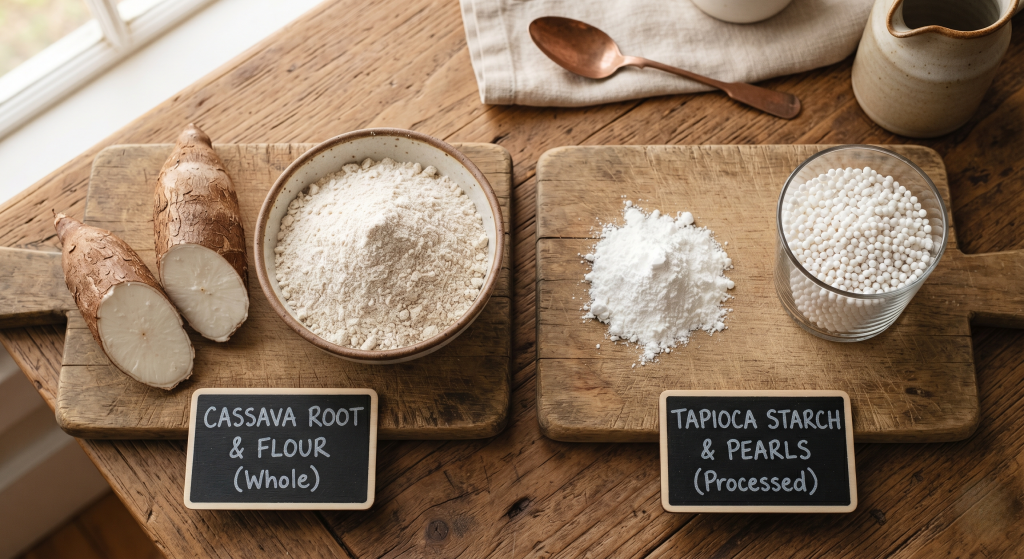
From a procurement and formulation standpoint, selection should be driven strictly by the structural goals of your product category.
When Procurement Should Buy Cassava Flour
Cassava flour is the premium industrial choice for gluten-free baking, tortillas, crackers, and extruded snacks. Its whole-root fiber network functions as a direct structural substitute for wheat flour semolina, providing the necessary dough density, machine handling strength, and an al dente chew that isolated starches cannot replicate on their own.
When Procurement Should Buy Tapioca Starch
Tapioca starch should be prioritized for sauces, gravies, frozen food glazes, processed meats, and instant noodle coatings. Its complete lack of fiber and lipids guarantees maximum freeze-thaw stability, excellent oil emulsification, and a smooth sheen that prevents industrial sauces from weeping or separating during prolonged warehouse storage.
Streamline Your Root Ingredient Sourcing with Amerta Pacific
Whether your factory requires the structural bulk of whole-root cassava flour or the high-purity performance of native tapioca starch, maintaining tight quality thresholds is critical. Minor variations in moisture, mesh size, or extraction purity will disrupt automated mixing systems and alter your final product yields.
At Amerta Pacific, we eliminate sourcing variance by managing a tightly controlled industrial supply network. We supply premium-grade bulk Cassava Flour and Tapioca Starch precisely processed to satisfy the rigorous technical data sheets required by global R&D teams and purchasing directors.
Partnering with Amerta Pacific secures your operations:
Rigid Batch Uniformity: Strict laboratory oversight ensuring consistent viscosity and moisture levels across every container load.
Allergen-Safe Quality: Dedicated processing infrastructure to ensure absolute compliance for certified gluten-free labeling.
End-to-End Export Logistics: Full documentation packages, including Certificates of Analysis (COA) and phytosanitary tracking, delivered directly to your port of choice.
Frequently Asked Questions (FAQ)
Q: Can we replace tapioca starch with cassava flour at a 1:1 ratio in industrial recipes? A: No. Because cassava flour contains fiber and less pure starch per gram, a 1:1 replacement will make your dough overly dry and dense while failing to reach the target gel viscosity. Recipes must be recalibrated based on starch purity differences.
Q: How do these two ingredients handle high-pressure extrusion? A: Tapioca starch acts as an excellent binder and texturizer that speeds up rehydration in instant applications. Cassava flour provides the structural weight and expansion control needed to shape robust, crunchy snacks without tearing at the die face.
Q: What are the standard bulk packaging options for global export? A: We provide standard multi-wall 25kg or 50kg woven polypropylene bags, as well as 850kg to 1,000kg bulk jumbo bags equipped with heavy-duty lifting loops to facilitate automated factory discharge.
Optimize Your Formulation and Procurement Strategy
Stop guessing when it comes to root-derived ingredients. By equipping your R&D and purchasing departments with a clear understanding of whole-root cassava flour versus isolated tapioca starch, your factory can maximize ingredient performance, lower processing scrap rates, and secure a highly resilient supply chain.
Ready to secure your bulk ingredient specifications? Contact Amerta Pacific today to consult with our industrial application engineers, request targeted product samples for your technical lab, and secure competitive volume contracts for your upcoming production schedule.